Sambucus ebulus
L.
Dwarf elder, Danewort, Wallwort, Dane's elder
(c) Bigorna, some rights reserved (CC BY-NC)
(c) Bigorna, some rights reserved (CC BY-NC)
(c) Bigorna, some rights reserved (CC BY-NC)
What to Eat
Edible parts: Fruit, Flowers
The fruit, which is about 6mm in diameter and borne in large clusters, can be cooked and used as a flavouring in soups and similar dishes. Some caution is advised regarding toxicity. The leaves can be used as a tea substitute, though caution is also advised here regarding toxicity.
Known Hazards
Dangerous Lookalikes
This plant can be confused with the following toxic species. Always verify identification carefully before consuming any wild plant.


Pokeweed: Thick red/purple herbaceous stems (no bark), berries in a line (raceme), simple large leaves, large white taproot.
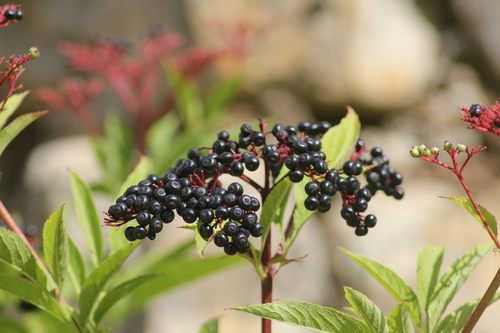
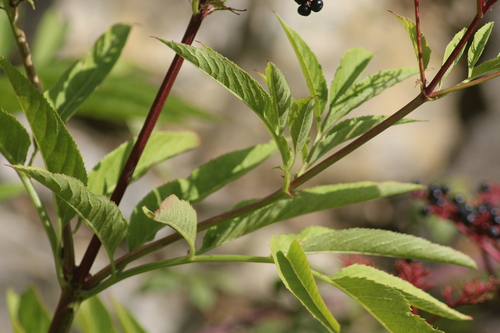
Dwarf elder: Woody bark, berries in broad flat clusters (cymes), compound leaves with 5-7 leaflets.
Where to Find It
It grows in temperate and Mediterranean regions. It suits hardiness zones 5-10.
Africa, Andorra, Armenia, Asia, Australia, Balkans, Belgium, Bosnia, Britain, Bulgaria, Canada, Caucasus, Cyprus, Eurasia, Europe, France, Georgia, Germany, Greece, Hungary, India, Iraq, Iran, Italy, Luxembourg, Mediterranean, Middle East, North Africa, North America, Northeastern India, Slovakia, Spain, Turkey, Türkiye,
How to Identify
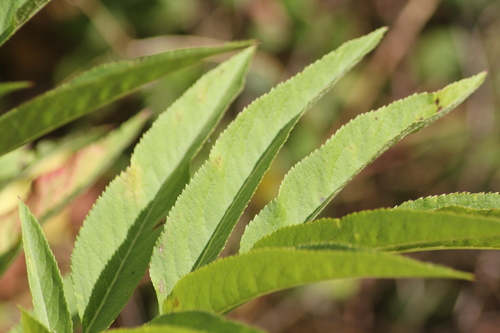
A shrub. It forms suckers. It grows 1.5-2 m high and spreads 0.9-2 m wide. The leaves are divided and there are up to 9 leaflets 15 cm long. The flowers are small. They are in flat heads 10 cm across. The fruit are black berries. They are 6-7 mm across and shiny when ripe.
How to Grow
Tolerates most soils, including chalk, but prefers a moist loamy soil. Grows well in heavy clay soils. Tolerates some shade but is best in a sunny position. Tolerates atmospheric pollution and coastal situations. A very invasive plant, sending up new shoots a metre or more away. It can be used for naturalising in the rougher parts of the garden, growing well on rough banks etc. The whole plant, when bruised, emits a most unpleasant fur-like smell. The bark, in particular, smells like stale perspiration.
Propagation: Seed is best sown as soon as ripe in autumn in a cold frame, where it should germinate in early spring. Stored seed sown in spring will germinate more reliably after 2 months of warm followed by 2 months of cold stratification. Prick seedlings into individual pots when large enough; if growth is strong, plant out in early summer, otherwise hold in a sheltered nursery bed or pots and plant out the following spring. Division of suckers in spring or autumn is very easy.
Medicinal Uses
The leaves are antiphlogistic, cholagogue, diaphoretic, diuretic, expectorant, and laxative. The fruit is also used medicinally, though it is less active than the leaves. The herb is commonly employed in treating liver and kidney complaints. When bruised and applied to boils and scalds, the leaves have a healing effect; they can also be made into a poultice for swellings and contusions. Leaves are harvested in summer and may be dried for later use. The root is diaphoretic, mildly diuretic, and a drastic purgative; dried, powdered, and brewed as a tea, it is considered one of the best remedies for dropsy, though it should only be used under expert supervision as it can cause nausea and vertigo. A homeopathic remedy made from the fresh berries or bark is used to treat dropsy.
Other Uses
A blue dye and an ink are obtained from the fruit. Root juice is used to dye hair black. The leaves are said to repel mice and moles. Plants spaced about 1 metre apart each way can form a dense ground cover suited to large areas and roadsides, though experience to 1995 indicated that while plants spread vigorously, they do not form a sufficiently dense cover to exclude other plants.
Wikipedia
Source ↗Sambucus ebulus, also known as danewort, dane weed, danesblood, dwarf elder or European dwarf elder, walewort, dwarf elderberry, elderwort and blood hilder, is a herbaceous species of elder, native to southern and central Europe and southwest Asia. The species is a well-established archaeophyte in much of the UK, and is also reportedly naturalized in parts of North America (New York, New Jersey and Québec).
Notes
There are about 25 Sambucus species. Also put in the family Sambucaceae.
Names & Synonyms
Bazel, Fodi bodza, Hadvika, Pehosi, Podzemni bez, Trevist baz
References (20)
- Blamey, M and Grey-Wilson, C., 2005, Wild flowers of the Mediterranean. A & C Black London. p 422
- Bussman, R. W., et al, 2016, A comparative ethnobotany of Khevsureti, Samtskhe-Javakheti, Tusheti, Svaneti, and Racha-Lechkhumi, Republic of Georgia (Sakartvelo), Caucasus. Journal of Ethnobiology and Ethnomedicine (2016) 12:43
- Bussman, R. W. et al, 2017, Ethnobotany os Samtskhe-Javakheti, Sakartvelo (Republic of Georgia, (Caucasus). Indian Journal of Traditional Knowledge Vol. 16(1) pp 7-24
- Bussman, R. W., et al, 2021, Unity in diversity—food plants and fungi of Sakartvelo (Republic of Georgia), Caucasus. Journal of Ethnobiology and Ethnomedicine (2021) 17:72 p 4
- Chase, P. & Singh, O. P., 2016, Bioresources of Nagaland: A Case of Wild 4 Edible Fruits in Khonoma Village Forest. in J. Purkayastha (ed.), Bioprospecting of Indigenous Bioresources of North-East India. p 51
- Cundall, P., (ed.), 2004, Gardening Australia: flora: the gardener's bible. ABC Books. p 1308
- Denes, A., et al, 2012, Wild plants used for food by Hungarian ethnic groups living in the Carpathian Basin. Acta Societatis Botanicorum Poloniae 81 (4): 381-396
- Ertug, F, Yenen Bitkiler. Resimli Türkiye Florası -I- Flora of Turkey - Ethnobotany supplement
- Flowerdew, B., 2000, Complete Fruit Book. Kyle Cathie Ltd., London. p 178
- Hedrick, U.P., 1919, (Ed.), Sturtevant's edible plants of the world. p 592
- Hemphill, I, 2002, Spice Notes Macmillan. p 169
- http://cypruswildflowers.com
- Luczaj, L., 2012, Ethnobotanical review of wild edible plants of Slovakia. Acta Societatis Botanicorum Poloniae 81(4):245-255
- Nedelcheva A., 2013, An ethnobotanical study of wild edible plants in Bulgaria. EurAsian Journal of BioSciences 7, 77-94
- Plants for a Future database, The Field, Penpol, Lostwithiel, Cornwall, PL22 0NG, UK. http://www.scs.leeds.ac.uk/pfaf/
- Postman, J. D., et al, 2012, Recent NPGS Coordinated Expeditions in the Trans-Caucasus Region to Collect Wild Relatives of Temperate Fruit and Nut Crops. In Acta Horticulturae Number 948 p 191-198
- Redzic, S. J., 2006, Wild Edible Plants and their Traditional Use in the Human Nutrition in Bosnia-Herzegovina. Ecology of Food and Nutrition, 45:189-232
- Redzic, S., 2010, Use of Wild and Semi-Wild Edible Plants in Nutrition and Survival of People in 1430 Days of Siege of Sarajevo during the War in Bosnia and Herzegovina (1992–1995). Coll. Antropol 34 (2010) 2:551-570
- Sp. pl. 1:269. 1753
- World Checklist of Useful Plant Species 2020. Royal Botanic Gardens, Kew


