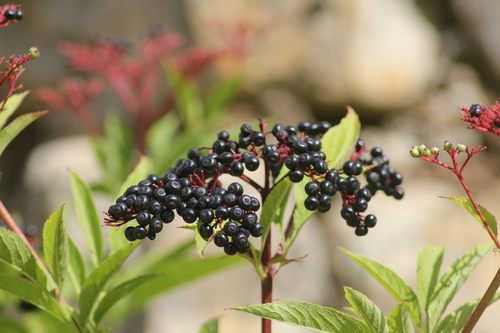
Sambucus racemosa
L.
Red Elder, Red-berried elder, Alpine elder

(c) sarahggage, some rights reserved (CC BY-NC)

no rights reserved, uploaded by neotrigonia

(c) Eric Lamb, some rights reserved (CC BY), uploaded by Eric Lamb
What to Eat
Edible parts: Flowers, Fruit
The flowers are edible raw or cooked. The fruit, about 5mm in diameter and borne in large clusters, is edible raw or cooked but has a bitter flavour. It is quite nutritious, with a relatively high fat, protein, and carbohydrate content. Drying the fruit before use reduces some of its rank taste, and the large clusters make harvesting straightforward. Some caution is advised regarding toxicity. The root can be made into a tea-like beverage.
Known Hazards
Dangerous Lookalikes
This plant can be confused with the following toxic species. Always verify identification carefully before consuming any wild plant.


Pokeweed: Thick red/purple herbaceous stems (no bark), berries in a line (raceme), simple large leaves, large white taproot.
Red Elder: Woody bark, berries in broad flat clusters (cymes), compound leaves with 5-7 leaflets.
Where to Find It
It is a temperate plant. It does best in moist, well-drained soils. It needs a protected shady position. It is frost hardy. It is sensitive to drought. It suits hardiness zones 4-9. Arboretum Tasmania.
Alaska, Armenia, Asia, Australia, Austria, Balkans, Bosnia, Britain, Bulgaria, Canada, Caucasus, China, Europe*, Finland, Georgia, Greece, Hungary, Japan, Luxembourg, Mediterranean, North America, Norway, Russia, Scandinavia, Siberia, Slovenia, Sweden, Switzerland, Tasmania, Turkey, Türkiye, USA,
How to Identify
A shrub. It loses its leaves during the year. It grows 2.5-3 m high and spreads 2.5-3 m wide. The stem is erect and branching. The bark is dark brown. The leaves are compound divided into leaflets along the stalk. There are 5-7 leaflets. The leaves are yellowish-green. There are teeth along the edge. The flowers are cream. They occur in dense flat topped clusters at the ends of the branches. The fruit are scarlet berries. They hang in clusters.
Nutrition Score: 48/100
| Part | Moisture | kJ | kcal | Protein | Vit A | Vit C | Iron | Zinc |
|---|---|---|---|---|---|---|---|---|
| Fruit raw | 78 | 472 | 113 | 1.1 | — | 36.7 | 1.1 | 0.5 |
| Fruit cooked | 78 | 460 | 110 | 2.9 | — | — | 1 | 0.7 |
How to Grow
Tolerates most soils, including chalk, but prefers a moist loamy soil. Grows well in heavy clay soils. Tolerates some shade but is best in a sunny position. Tolerates atmospheric pollution and coastal situations. Closely related to S. racemosa and considered part of that species by some botanists. Plants in this genus are notably resistant to honey fungus.
Propagation: Seed is best sown as soon as it is ripe in autumn in a cold frame, where it should germinate in early spring. Stored seed sown in spring will likely germinate better with 2 months warm followed by 2 months cold stratification. Prick seedlings into individual pots when large enough to handle. If growth is good, young plants can go into permanent positions in early summer; otherwise, overwinter them in a sheltered nursery bed or in pots and plant out the following spring. Cuttings of half-ripe wood, 7–10cm with a heel, can be taken in July/August in a frame. Cuttings of mature wood from the current season's growth, 15–20cm with a heel, can be taken in late autumn in a frame or sheltered outdoor bed.
Medicinal Uses
The bark and leaves are used as a diuretic and purgative. The blossoms have been used in the treatment of measles.
Other Uses
The stem is easily hollowed and can be used to make a whistle.
Wikipedia
Source ↗Sambucus racemosa is a species of elder known by the common names red-berried elder and red elderberry. It produces a red drupe. The species is native across much of the Northern Hemisphere. The plant is largely poisonous when raw, but the fruit can be cooked for consumption.
Notes
There are about 25 Sambucus species. They are also put in the family Caprifoliaceae. Also put in the family Sambucaceae.
Names & Synonyms
Cheren baz, Red elderberry, Rodhyll, Syoeu ridzo
References (32)
- Abbet, C., et al, 2014, Ethnobotanical survey on wild alpine food plants in Lower and Central Valais (Switzerland). Journal of Ethnopharmacology 151 (2014) 624–634
- Bodkin, F., 1991, Encyclopedia Botanica. Cornstalk publishing, p 906
- Brickell, C. (Ed.), 1999, The Royal Horticultural Society A-Z Encyclopedia of Garden Plants. Convent Garden Books. p 930
- Bowser, M., 2017, Handout on Edible Plants of the Kenai Peninsula. USFWS Kenai National Wildlife Refuge p 8
- Cerne, M., 1992, Wild Plants from Slovenia used as Vegetables. Acta Horticulturae 318
- Christanell, A., et al, 2010, The Cultural Significance of Wild Gathered Plant Species in Kartitsch (Eastern Tyrol, Austria) and the Influence of Socioeconomic Changes on Local Gathering Practices. Chapter 3 in Ethnobotany in the New Europe. Berghahn Books.
- Crawford, M., 2012, How to grow Perennial Vegetables. Green Books. p 101
- Cundall, P., (ed.), 2004, Gardening Australia: flora: the gardener's bible. ABC Books. p 1308
- Denes, A., et al, 2012, Wild plants used for food by Hungarian ethnic groups living in the Carpathian Basin. Acta Societatis Botanicorum Poloniae 81 (4): 381-396
- Girard, N. J., 2020, Sustainable Foraging of Wild Edible Plants in Norway. A Biocultural Approach. M. Sc. thesis Norwegian University. p 37
- Heller, C. A., 1962, Wild Edible and Poisonous Plants of Alaska. Univ. of Alaska Extension Service. p 71
- Hibbert, M., 2002, The Aussie Plant Finder 2002, Florilegium. p 286
- Johansson, A., Laakso, P. and Kallio, H., 1997, Characterization of seed oils of wild, edible Finnish berries. Food Chemistry 204:300-307
- Joyce, D., 1998, The Garden Plant Selector. Ryland, Peters and Small. p 159
- Kremer, B.P., 1995, Shrubs in the Wild and in Gardens. Barrons. p 172
- Kuhnlein, H. V., et al, 2009, Indigenous Peoples' food systems. FAO Rome p 33
- MacKinnon, A., et al, 2009, Edible & Medicinal Plants of Canada. Lone Pine. p 125
- Moerman, D. F., 2010, Native American Ethnobotany. Timber Press. p 511
- Nedelcheva A., 2013, An ethnobotanical study of wild edible plants in Bulgaria. EurAsian Journal of BioSciences 7, 77-94
- Plants for a Future database, The Field, Penpol, Lostwithiel, Cornwall, PL22 0NG, UK. http://www.scs.leeds.ac.uk/pfaf/
- Postman, J. D., et al, 2012, Recent NPGS Coordinated Expeditions in the Trans-Caucasus Region to Collect Wild Relatives of Temperate Fruit and Nut Crops. In Acta Horticulturae Number 948 p 191-198
- Redzic, S. J., 2006, Wild Edible Plants and their Traditional Use in the Human Nutrition in Bosnia-Herzegovina. Ecology of Food and Nutrition, 45:189-232
- Ryan, S., 2008, Dicksonia. Rare Plants Manual. Hyland House. p 50
- Scotter, G. W., & Flygare, H., 1993, Wildflowers of the Canadian Rockies. Hurtig. p 30
- Sfikas, G., 1984, Trees and shrubs of Greece. Efstathiadis Group. Athens. p 186
- Sp. pl. 1:270. 1753
- Turner, N., 1995, Food Plants of Coastal First Peoples. Royal BC Museum Handbook p 67
- Turner, N., 1997, Food Plants of Interior First Peoples. Royal BC Museum Handbook p 103
- Turner, N., et al, 2011, "Up on the Mountain": Ethnobotanical Important of Montane Sites in Pacific Coastal North America. Journal of Ethnobiology 31(1): 4-43
- van Wyk, B., 2005, Food Plants of the World. An illustrated guide. Timber press. p 336
- Wiersema, J. H. & Leon, B., 2013, World Economic Plants. A Standard Reference CRC Press. 2nd Ed. p 612
- World Checklist of Useful Plant Species 2020. Royal Botanic Gardens, Kew