Arbutus xalapensis
Kunth.
Madrone

(c) 106757949696626451802, some rights reserved (CC BY-NC), uploaded by 106757949696626451802

(c) rloera, some rights reserved (CC BY-NC)

(c) Mary PK Burns, some rights reserved (CC BY-NC)
What to Eat
Edible parts: Fruit, Flowers
Edible Parts: Fruit Edible Uses: Its red, bumpy fruits are edible when ripe, though they can cause nausea if eaten in excess. The berries are sweet but mild, similar in character to Arizona madrone. Unfortunately, they are highly susceptible to fungal spoilage if not harvested promptly. Fruits were eaten fresh or dried and could be ground for flour or used in beverages [2-3]. Fruit - raw. Edibility rating: 3/5 – Pleasant fruits, but less reliable in storage than Arizona madrone.
Where to Find It
It is a warm temperate plant. It suits hardiness zones 9-10.
Australia, Central America, Guatemala, Honduras, Mexico, Nicaragua, North America, USA,
How to Identify
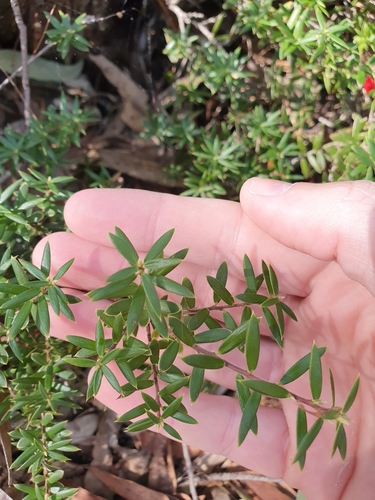
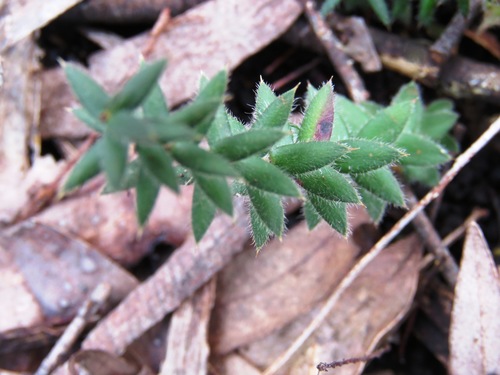
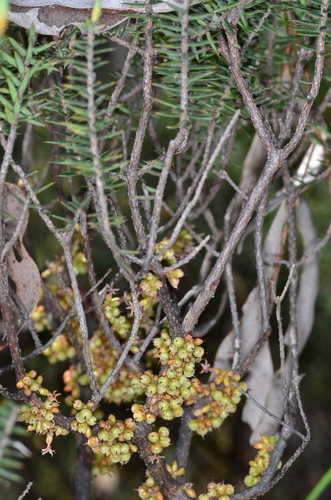
A shrub or small tree. It can grow 12 m tall. The bark turns shiny cinnamon before peeling off. The leaves are deep green above and paler underneath. The flowers are pink or white and in loose panicles. The fruit are dark red and in clusters. They are 1 cm long.
Nutrition Score: 1/100
| Part | Moisture | kJ | kcal | Protein | Vit A | Vit C | Iron | Zinc |
|---|---|---|---|---|---|---|---|---|
| Fruit | — | 276 | 4.15 | — | — | — | — | — |
How to Grow
Requires a lime-free nutrient-rich well-drained moisture-retentive soil in sun or semi-shade and shelter from cold drying winds, especially when young. This species thrives on limestone soils and in dry conditions. Plants are not very hardy in the colder areas of the country, tolerating temperatures down to about -10°c.
Propagation: Seed - best surface sown in a cold frame as soon as it is ripe. Stored seed should be soaked for 5 - 6 days in warm water and then surface sown in a shady position in a greenhouse. Do not allow the compost to become dry. 6 weeks cold stratification helps. The seed usually germinates well in 2 - 3 months at 20°c. Seedlings are prone to damp off, they are best transplanted to individual pots as soon as they are large enough to handle and should be kept well ventilated. Grow them on in a greenhouse for their first winter and then plant out in late spring after the last expected frosts. Basal cuttings in late winter. Cuttings of mature wood of the current season's growth, November/December in a frame. Poor percentage. Layering of young wood - can take 2 years.
Medicinal Uses
None known
Other Uses
Wood The berries were sometimes fermented into drinks. The tree’s ornamental qualities—smooth red bark, white flowers, and red berries—make it valued in landscaping. Wildlife such as birds and mammals also feed on the fruits. Special Uses
Wikipedia
Source ↗Arbutus xalapensis, commonly known as the Texas madrone, Amazaquitl, or Texas madroño, is a species of flowering plant in the heather family. It is native to Central America, the southwestern United States (western Texas and New Mexico), and throughout Mexico. It is found in canyons and mountains, on rocky plains, and in oak woodlands, at altitudes of up to 3,000 m (9,800 ft) in the south of the range, but lower, down to 600 m (2,000 ft) in the north of the range. Arbutus xalapensis is a large shrub or small to medium-sized evergreen tree growing to 5–25 meters (16–82 ft) tall with a trunk up to 50 cm (20 in) in diameter, with smooth orange-brown bark peeling in thin sheets. The size varies regionally with available rainfall, with small, shrubby plants in dry areas such as western Texas and New Mexico, and larger trees in moister areas of Mexico; plants in Texas, New Mexico, and the far northeast of Mexico are distinguished as a variety, A. xalapensis var. texana, or even a distinct species A. texana, by some botanists, but others do not regard these as distinct. The leaves are oblong to lanceolate, 5–17 cm (2.0–6.7 in) long and 1.5–5 cm (0.59–1.97 in) broad, with an entire or serrated margin. The flowers are bell-shaped, white or pale pink, 5–10 mm long, produced in loose panicles. The fruit is a rough-surfaced red berry 1 cm (0.39 in) in diameter, reportedly edible (however, those of related species have narcotic properties), and contains numerous small seeds.
Notes
There are 14 Arbutus species.
Names & Synonyms
Duraznillo, Madron, Madrono
References (12)
- Astrada, E., et al, 2007, Ethnobotany in the Cumbres de Monterrey National Park, Nuevo Leon, Mexico. Journal of Ethnobiology and Ethnomedicine 3:8
- Beckstrom-Sternberg, Stephen M., and James A. Duke. "The Foodplant Database." http://probe.nalusda.gov:8300/cgi-bin/browse/foodplantdb.(ACEDB version 4.0 - data version July 1994)
- Bircher, A. G. & Bircher, W. H., 2000, Encyclopedia of Fruit Trees and Edible Flowering Plants in Egypt and the Subtropics. AUC Press. p 38
- Cruz, I. M., et al, 2015, Edible fruits and seeds in the State of Mexico. Revista Mexicana de Ciencias Agricolas. Vol. 6. Num. 2 pp 331-346
- Cundall, P., (ed.), 2004, Gardening Australia: flora: the gardener's bible. ABC Books. p 173
- Estrada-Castillon, E., et al, 2014, Ethnobotany in Rayones, Nuevo Leon, Mexico. Journal of Ethnobiology and Ethnomedicine, 10:62
- Etherington, K., & Imwold, D., (Eds), 2001, Botanica's Trees & Shrubs. The illustrated A-Z of over 8500 trees and shrubs. Random House, Australia. p 100
- Piedra-Malagón, E. M. et al, 2022, Edible native plants of the Gulf of Mexico Province. Biodiversity Data Journal 10: e80565 p 18
- Plants for a Future database, The Field, Penpol, Lostwithiel, Cornwall, PL22 0NG, UK. http://www.scs.leeds.ac.uk/pfaf/
- Segura, S., et al, 2018, The edible fruit species in Mexico. Genet Resour Crop Evol (2018) 65:1767–1793
- Sotelo, A., et al, 2007, Content of Nutrient and Antinutrient in Edible Flowers of Wild Plants in Mexico. Plant Foods for Human Nutrition 62: 133-138
- F. W. H. A. von Humboldt et al., Nov. gen. sp. 3:219[folio]; 3:279[quarto]. 1819