Schizophragma hydrangeoides
Siebold & Zucc.
Climbing Hydrangea Vine, Japanese Hydrangea vine
(c) Hua Wan, some rights reserved (CC BY-NC)

(c) 空猫 T. N, some rights reserved (CC BY-NC)

(c) 空猫 T. N, some rights reserved (CC BY-NC)
What to Eat
Edible parts: Leaves
The leaves are edible when cooked.
Where to Find It
It is a temperate plant. It suits hardiness zones 5-9.
Asia, Australia, Canada, Japan*, Korea, North America,
How to Identify
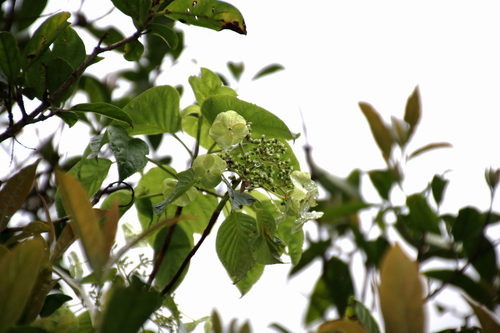
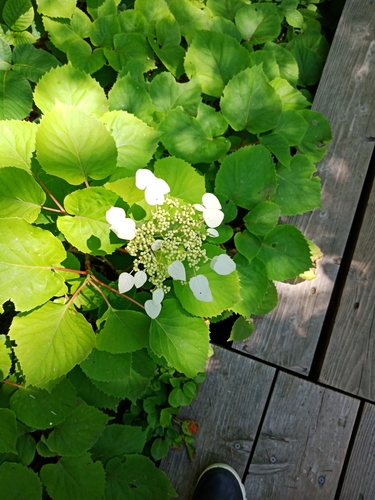
A woody climber. It grows 9-12 m long. It spreads 3 m wide. The leaves are dark green and pointed. They have teeth around the edge. The flowers occur in flat flower heads. These are 25 cm across. There is a creamy white bract around the sterile flowers. The bracts is oval or heart-shaped.
How to Grow
Requires a moist leafy soil and some shade at the roots. An easily grown plant, it prefers a good loamy soil and plenty of moisture. Succeeds on most soil types, disliking only very alkaline soils. Plants succeed in sun or shade, though they prefer full sun. In the hotter parts of Britain they prefer shade from the midday sun. They succeed on north-facing walls. The fully dormant plant is hardy to about -20°c. Plants are slow to establish and slow-growing when young, though they speed up somewhat with age. Plants do not normally require pruning, though any unwanted growth can be removed in the winter. Plants have a similar growth habit to ivy (Hedera helix) climbing trees by means of aerial roots or growing along the woodland floor. Plants might need some help to become attached in their early years. Some named varieties have been developed for their ornamental value.
Propagation: Sow seed in late winter to early spring in a greenhouse. Germination is usually fair to very good. Prick out seedlings into individual pots once large enough to handle and grow on in light shade for their first winter, planting out in late spring or early summer. Layering in spring directly into pots gives a fair to good success rate, though finding suitable low growth can be difficult. Take cuttings of half-ripe wood, 4–5cm with a heel, in July in a frame, keeping them moist.
Medicinal Uses
None known
Other Uses
Plants can be allowed to sprawl and used as a ground cover for a shady position.
Wikipedia
Schizomeria hydrangeoides is a deciduous climbing plant that grows to 12 m in height and spread at a slow rate. Hardy to UK zone 5, it flowers from July to September and has both male and female organs pollinated by insects. It adapts to light sandy, medium loamy, and heavy clay soils across mildly acidic to mildly alkaline pH ranges, tolerating full shade to full sun, and prefers moist soil.
Notes
There are 2 Schizophragma species.
References (5)
- Fl. jap. 1:59, t. 60. 1837
- Hibbert, M., 2002, The Aussie Plant Finder 2002, Florilegium. p 288
- Joyce, D., 1998, The Garden Plant Selector. Ryland, Peters and Small. p 186
- Plants for a Future database, The Field, Penpol, Lostwithiel, Cornwall, PL22 0NG, UK. http://www.scs.leeds.ac.uk/pfaf/
- Ryan, S., 2008, Dicksonia. Rare Plants Manual. Hyland House. p 78