Serenoa repens
(W. Bartram) Small
Saw palmetto, Silver saw palmetto
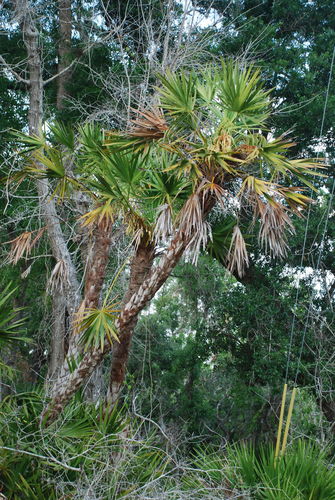
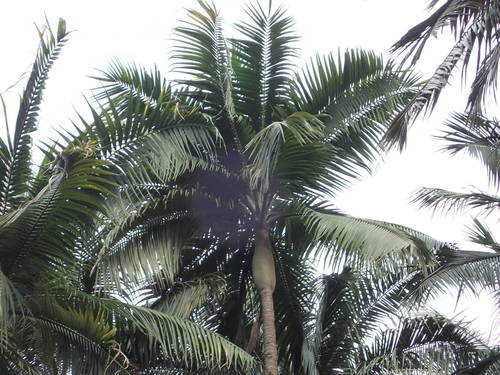
(c) Douglas Goldman, some rights reserved (CC BY-SA), uploaded by Douglas Goldman

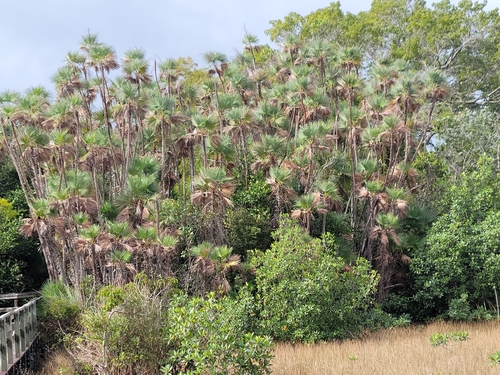
(c) David Durieux, some rights reserved (CC BY-NC-ND), uploaded by David Durieux

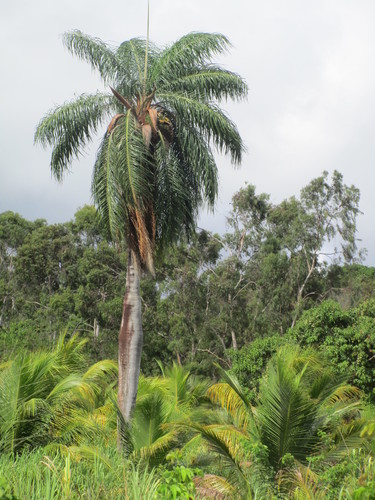
(c) Mary Keim, some rights reserved (CC BY-NC-SA)
What to Eat
Edible parts: Nuts, Cabbage, Fruit, Palm heart
The fruit can be eaten raw or cooked. It has a sweet flavour but with a soapy taste and a strong vanilla-like aroma. Regular consumption is considered very beneficial to health, aiding digestion and helping to increase weight and strength. The seed can also be eaten raw or cooked.
Where to Find It
A tropical and subtropical plant. It grows in colonies in woodlands and coastal dunes. It suits seasonally moist and dry climates. They need well drained soils. They can tolerate salt exposure. They are cold sensitive. They need a sunny location. They can tolerate fire. It suits hardiness zones 8-11.
Africa, Asia, Australia, Europe, Indonesia, North Africa, North America, SE Asia, Spain, USA*,
How to Identify
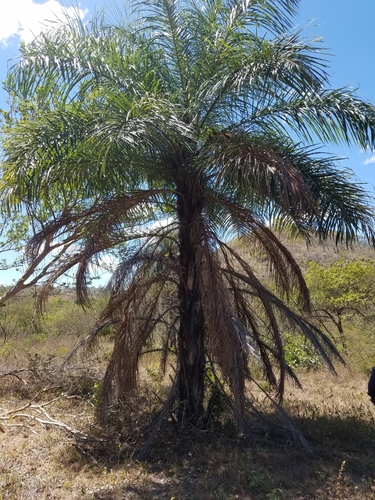
A fan palm with a short trunk. Sometimes it is creeping or underground. It forms clumps and is prickly. The trunks are slim and can be 3-6 m high. They are covered with fibres and leaf bases. The trunks can form branches, especially if the tip is damaged. The leaves are fan shaped. They are stiff and the leaf stalks are thorny. The leaves are 1 m long and the leaf stalks 1-1.6 m long. The leaves can be green, blue-green or blue-silver. The leaves are held stiffly erect. It produces flower stalks among the leaves. Flowers contain both sexes. The fruit are oval and 2 cm long. They are black when ripe. They are edible. Each fruit contains a single seed.
How to Grow
Plants are grown from seed. Plants are easy to grow but slow growing. Single plants can produce fertile seeds. Plants can be divided but this is difficult unless plants are small. Plants are difficult to transplant.
Propagation: Seed is best sown in a warm greenhouse as soon as it is ripe, where it usually germinates freely. Stored seed is more difficult to germinate and should be pre-soaked for 24 hours in warm water before sowing in a warm greenhouse. Prick seedlings out into individual pots when large enough to handle and grow on in the greenhouse for at least their first two winters. Plant out into permanent positions in late spring or early summer, after the last expected frosts. Although the plant forms suckers, these do not usually transplant well, making seed the only reliable propagation method.
Medicinal Uses
Saw palmetto berries are a tonic herb used to treat debility, urinary tract problems and enlarged prostate glands. The partially dried ripe fruit is aphrodisiac, urinary antiseptic, diuretic, expectorant, sedative and tonic. It is taken internally for impotence, debility in elderly men, prostate enlargement and inflammation, bronchial complaints associated with coldness, and wasting diseases. Saw palmetto is considered one of the few Western herbs that are anabolic, strengthening body tissue and encouraging weight gain. The fruit pulp or a tincture is given for wasting disease, general debility and failure to thrive. It also benefits the urinary system, helping to reduce an enlarged prostate and strengthen the neck of the bladder. The fruit has a probable oestrogenic action and is prescribed for impotence, reduced or absent sex drive and testicular atrophy in men, and to stimulate breast enlargement in women. It is also used for colds, coughs, irritated mucous membranes and asthma. A suppository of the powdered fruits in cocoa butter has been used as a uterine and vaginal tonic. The German Commission E Monographs approve Serenoa repens for prostatic complaints and irritable bladder.
Other Uses
The leaf stems have been used in making baskets. The plant has also been used to make brushes and cordage.
Wikipedia
Source ↗Serenoa repens is a slow-growing evergreen shrub reaching 3 m tall by 2 m wide, remaining in leaf year-round. Hardy to UK zone 8 with hermaphrodite flowers. Adapts to light sandy, medium loamy, and heavy clay soils preferring good drainage, mildly acid to mildly alkaline pH, and even saline soils. Requires full sun, cannot grow in shade, prefers moist soil, and tolerates maritime exposure.
Production
It is slow growing. It normally flowers in warm, wet months.
Notes
There is only one Serenoa palm. The seeds are used in medicine. It is useful as a medicine for Prostate problems. It contains Sitosterine which has oestrogen-like properties.
Names & Synonyms
Palem gergaji
References (24)
- Balick, M.J. and Beck, H.T., (Ed.), 1990, Useful palms of the World. A Synoptic Bibliography. Colombia p 227, 549 (As Serenoa serrulata), 557, 587, 643,
- Beckstrom-Sternberg, Stephen M., and James A. Duke. "The Foodplant Database." http://probe.nalusda.gov:8300/cgi-bin/browse/foodplantdb.(ACEDB version 4.0 - data version July 1994) (As Serenoa serrulata),
- Blomberry, A. & Rodd, T., 1982, Palms. An informative practical guide. Angus & Robertson. p 169
- Cundall, P., (ed.), 2004, Gardening Australia: flora: the gardener's bible. ABC Books. p 1337
- Facciola, S., 1998, Cornucopia 2: a Source Book of Edible Plants. Kampong Publications,
- Gibbons, M., 1993, Palms. Compact study Guide and Identifier. Sandstone. p 72
- Gibbons, M., 2003, A pocket guide to Palms. Chartwell Books. p 196
- Grandtner, M. M., 2008, World Dictionary of Trees. Wood and Forest Science Department. Laval University, Quebec, Qc Canada. (Internet database http://www.wdt.qc.ca)
- Haynes, J., & McLaughlin, J., 2000, Edible palms and Their Uses. University of Florida Fact sheet MCDE-00-50-1 p 13
- Hedrick, U.P., 1919, (Ed.), Sturtevant's edible plants of the world. p 112
- Henderson, A., Galeano, G and Bernal, R., 1995, Field Guide to the Palms of the Americas. Princeton. p 54
- http://en.hortipedia.com
- Janick, J. & Paul, R. E. (Eds.), 2008, The Encyclopedia of Fruit & Nuts. CABI p 157
- Jones, D.L., 1994, Palms throughout the World. Smithtonian Institution, Washington. p 54, 355
- J. New York Bot. Gard. 27:197, t. 1-4. 1926
- Kermath, B. M., et al, 2014, Food Plants in the Americas: A survey of the domesticated, cultivated and wild plants used for Human food in North, Central and South America and the Caribbean. On line draft. p 798
- Llamas, K.A., 2003, Tropical Flowering Plants. Timber Press. p 118
- Martin, F.W. & Ruberte, R.M., 1979, Edible Leaves of the Tropics. Antillian College Press, Mayaguez, Puerto Rico. p 211
- Menninger, E.A., 1977, Edible Nuts of the World. Horticultural Books. Florida p 142
- Moerman, D. F., 2010, Native American Ethnobotany. Timber Press. p 527
- Plants for a Future database, The Field, Penpol, Lostwithiel, Cornwall, PL22 0NG, UK. http://www.scs.leeds.ac.uk/pfaf/
- Riffle, R.L. & Craft, P., 2003, An Encyclopedia of Cultivated Palms. Timber Press. p 452
- Sukarya, D. G., (Ed.) 2013, 3,500 Plant Species of the Botanic Gardens of Indonesia. LIPI p 819
- Wickens, G.E., 1995, Edible Nuts. FAO Non-wood forest products. FAO, Rome. p171