Sida acuta
Burm. f.
Spinyhead sida, Green sida

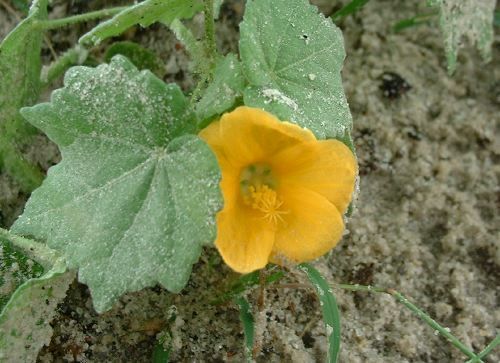
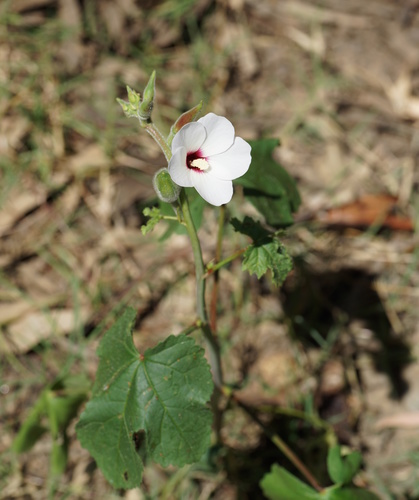
(c) Anil Kumar Verma, some rights reserved (CC BY-NC), uploaded by Anil Kumar Verma
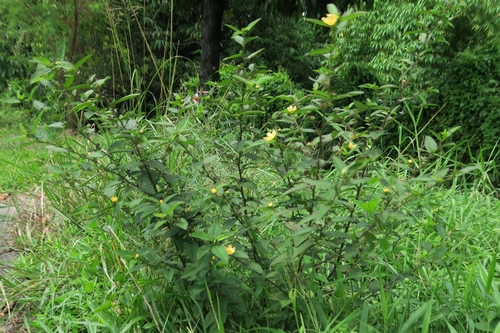
(c) Soh Kam Yung, some rights reserved (CC BY-NC), uploaded by Soh Kam Yung
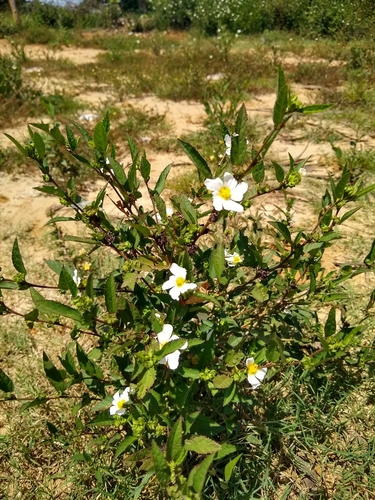
(c) Viviana Londoño Lemos, some rights reserved (CC BY-NC), uploaded by Viviana Londoño Lemos
What to Eat
Edible parts: Leaves, Leaves - tea
The young leaves are cooked and eaten as a vegetable. The leaves can also be used to make tea.
Known Hazards
Where to Find It
It is a tropical plant. It is common in waste places. It grows in savannah woodland and palm groves. In Yunnan.
Africa, Andamans, Asia, Australia, Benin, Bhutan, British Indian Ocean Terr., BIOT, Burkina Faso, Cambodia, Central Africa, China, Christmas Island, Dominican Republic, East Africa, East Timor, Eswatini, Fiji, Gabon, Guiana, Guianas, Guinea, Guinée, Guinea-Bissau, Guyana, Haiti, Himalayas, India, Indochina, Indonesia, Kenya, Laos, Malawi, Malaysia, Maldives, Marquesas, Mexico, Mozambique, Myanmar, Nauru, Nepal, New Caledonia, North America, Pacific, Papua New Guinea, PNG, Rotuma, Samoa, Sao Tome and Principe, SE Asia, Sierra Leone, Sri Lanka, South Africa, Southern Africa, South America, Suriname, Swaziland, Taiwan, Thailand, Timor-Leste, Tonga, Venezuela, Vietnam, West Africa, West Indies, Zambia, Zimbabwe,
How to Identify
A herb. It grows up to 70 cm high. It has many branches. The leaf stalk is 4-6 mm long. The leaves are sword shaped. They are 2-5 cm long by 0.4-1 cm wide. They have teeth around the edge. The flowers are yellow. They occur in the axils of leaves. They are either singly or in pairs. The fruit is nearly round and 3-5 mm across.
Medicinal Uses
The roots are used in medicine.
Other Uses
The bark is a good source of fibre. It is used to make ropes, canvas and fishnets. The stems are used for making house brooms. The leaves are macerated in water to make a hair conditioner and a shampoo for flaky skin. The young twigs are made into brooms.
Wikipedia
Source ↗Sida acuta, the common wireweed, is a species of flowering plant in the mallow family, Malvaceae. It is believed to have originated in Central America, but today has a pantropical distribution and is considered a weed in some areas. In northern Australia, Sida acuta is considered an invasive species, and the beetle Calligrapha pantherina has been introduced as a biological control agent in an attempt to control the plant.
Other Information
It is sold in local markets in China. It is cultivated.
Notes
There are about 100-200 Sida species. They are mostly tropical to warm temperate. The roots are used in medicine.
Names & Synonyms
Adongo nyar yuoro, Ancharna, Ariva-mooku kelrai, Bala dungaraubal, Bala, Balajungli-methi, Bariara, Bassoura, Boriala, Bunga telur belangkas, Cha da India, Cheruparuva, Chikana, Chitimutti, Delelemukula, Galunggang, Holap, Huang hua ren, Indlekwane, Ipirpijon, Karenta, Kareta, Kayapunalu, Ketumbar hutan, Kharenta, Khareti, Latele-bala, Lidah ular, Malaitangi, Malatanni, Mat'zai:ru, Mayir-manikham, Mai rou cao, Mutuvapulagam, Nachano, Neelabenda, N'tachen, Ongodi, Pata, Pazhampaasi, Pila-barela-shikar, Pokok kelulut puteh, Pon musuttai, Sadagori, Seleguri, Sidaguri, Siobola, Sirivadibabila, Sunakhodika, Sweer berela, Taaiman, Ting-khilow, Tukati, Tupkaria, Vassoura-di-camara, Vattatirippi, Veyo dhiggaa, Vir miru baha, Visha boddi, Yung kwat, Yung pat
References (38)
- Ambasta, S.P. (Ed.), 2000, The Useful Plants of India. CSIR India. p 572
- Burkill, I.H., 1966, A Dictionary of the Economic Products of the Malay Peninsula. Ministry of Agriculture and Cooperatives, Kuala Lumpur, Malaysia. Vol 2 (I-Z) p 2060
- Cooper, W. and Cooper, W., 2004, Fruits of the Australian Tropical Rainforest. Nokomis Editions, Victoria, Australia. p 280
- Cowie, I, 2006, A Survey of Flora and vegetation of the proposed Jaco-Tutuala-Lore National Park. Timor-Lests (East Timor) www.territorystories.nt/gov.au p 50
- Diaz-Betancourt, M., et al, 1999, Weeds as a future source for human consumption. Rev. Biol. Trop. 47(3):329-338
- Fl. indica 147. 1768
- Fowler, D. G., 2007, Zambian Plants: Their Vernacular Names and Uses. Kew. p 46
- Franklin, J., Keppel, G., & Whistler, W., 2008, The vegetation and flora of Lakeba, Nayau and Aiwa Islands, Central Lau Group, Fiji. Micronesica 40(1/2): 169–225, 2008
- Henty, E.E., & Pritchard, G.S., 1973, Weeds of New Guinea and their control. Botany Bulletin No 7, Division of Botany, Lae, PNG. p 124
- Hussey, B.M.J., Keighery, G.J., Cousens, R.D., Dodd, J., Lloyd, S.G., 1997, Western Weeds. A guide to the weeds of Western Australia. Plant Protection Society of Western Australia. p 176
- Johns, T., and Kokwaro, J.O., 1991, Food Plants of the Luo of Siayo District, Kenya. Economic Botany 45(1), pp 103-113
- Kenneally, K.E., Edinger, D. C., and Willing T., 1996, Broome and Beyond, Plants and People of the Dampier Peninsula, Kimberley, Western Australia. Department of Conservation and Land Management. p 123
- Kokwaro, J. O. and Johns. T., Luo Biological Dictionary. p 101
- Lazarides, M. & Hince, B., 1993, Handbook of Economic Plants of Australia, CSIRO. p 218
- Li, D. et al, 2017, Ethnobotanical survey of herbal tea plants from the traditional markets in Chaoshan, China. Journal of Ethnopharmacology. 205 (2017) 195-206
- Long, C., 2005, Swaziland's Flora - siSwati names and Uses http://www.sntc.org.sz/flora/ (As Sida alba subsp. acuta)
- Magwede, K., van Wyk, B.-E., & van Wyk, A. E., 2019, An inventory of Vhavenḓa useful plants. South African Journal of Botany 122 (2019) 57–89
- McMakin, P.D., 2000, Flowering Plants of Thailand. A Field Guide. White Lotus. p 99
- Mutie, F. M., et al, 2023, Important Medicinal and Food Taxa (Orders and Families) in Kenya, Based on Three Quantitative Approaches. Plants 2023, 12, 1145
- Paczkowska, G. & Chapman, A.R., 2000, The Western Australian Flora. A Descriptive Catalogue. Western Australian Herbarium. p 292
- Pandy, R. K. & Saini, S. K., 2007, Edible plants of tropical forests among tribal communities of Madhya Pradesh. Indian Journal of Traditional Knowledge. 6(1), pp 185-190
- Peekel, P.G., 1984, (Translation E.E.Henty), Flora of the Bismarck Archipelago for Naturalists, Division of Botany, Lae, PNG. p 361, 360
- Pham-Hoang Ho, 1999, An Illustrated Flora of Vietnam. Nha Xuat Ban Tre. p 517
- Plants of Haiti Smithsonian Institute http://botany.si.edu/antilles/West Indies
- Ruiters-Welcome, A. K., 2019, Food plants of southern Africa. Ph.D. thesis. Univ. of Johannesburg p 77
- Salako, V. K. et al, 2013, Home gardens: an assessment of their biodiversity and potential contribution to conservation of threatened species and crop wild relatives in Benin. Genet Resour Crop Evol
- Smith, A.C., 1981, Flora Vitiensis Nova, Lawaii, Kuai, Hawaii, Volume 2 p 436
- Smith, F. I. and Eyzaquirre, P., 2007, African leafy vegetables: Their role in the World Health Organization's global Fruit and Vegetables Initiative. AJFAND, Vol. 7 No. 3
- Srivastava, R. C., 2009, Traditional knowledge of Adi tribe of Arunachal Pradesh on plants. Indian Journal of Traditional Knowledge. 8(2): 146-153
- Sujanapal, P., & Sankaran, K. V., 2016, Common Plants of Maldives. FAO & Kerala FRI, p 244
- Swaziland's Flora Database http://www.sntc.org.sz/flora
- Tang ya, Malvaceae. Flora of China. p
- Topp, J. M. W., 1988, An Annotated Check List of the Flora of Diego Garcia, British Ocean Territory. Atoll Research Bulletin No. 313
- Welcome, A. K. & Van Wyk, B.-E., 2019, An inventory and analysis of the food plants of southern Africa. South African Journal of Botany 122 (2019) 136–179
- Wheeler, J.R.(ed.), 1992, Flora of the Kimberley Region. CALM, Western Australian Herbarium, p 236
- Williamson, J., 2005, Useful Plants of Malawi. 3rd. Edition. Mdadzi Book Trust. p 226
- World Checklist of Useful Plant Species 2020. Royal Botanic Gardens, Kew
- Yuncker, T.G., 1959, Plants of Tonga, Bernice P. Bishop Museum, Hawaii, Bulletin 220. p 181