Areca catechu
L.
Betel nut
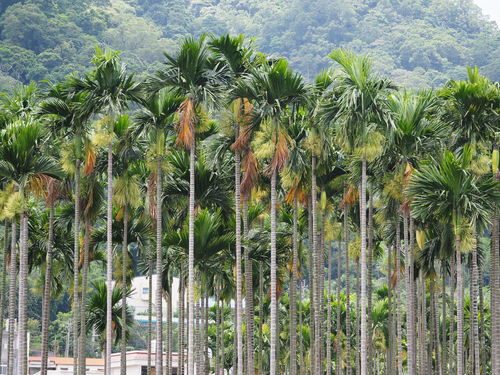
no rights reserved, uploaded by 葉子
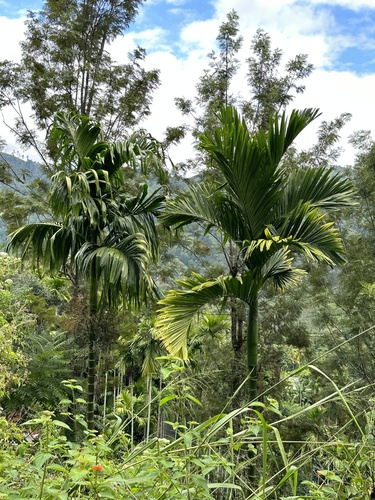
(c) einadia, some rights reserved (CC BY-NC)
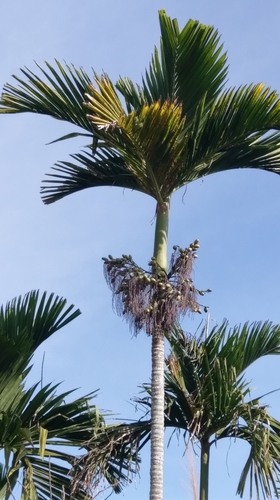
(c) Onion Hu, some rights reserved (CC BY-NC), uploaded by Onion Hu
What to Eat
Edible parts: Nuts, Cabbage, Palm heart, Male flowers
Edible Parts: Fruit Leaves Seed Shoots Edible Uses: Edible portion: Nut, Cabbage, Palm heart, Male flower. Seed - raw. The seed has mild narcotic properties, it is widely used in some areas of the tropics as a masticatory, being mixed with the leaves of a pepper plant (Piper betle), a gum and, often, lime. Betel seeds contain tannins and alkaloids - these stimulate saliva flow, accelerate heart and perspiration rates, suppress hunger and offer positive protection against intestinal worms. The ovoid fruit is 4 - 5cm long and produced in large clusters of 200 - 300. Young leaves, inflorescences and the sweet inner part of the shoots are cooked and eaten as vegetables. The skin of the fruit is edible. The nut contains 8-12% fat that has characteristics comparable with hydrogenated coconut oil. It can be made edible by refining it with an alkali.
Known Hazards
Where to Find It
A tropical plant. They occur from sea level up to 900 m altitude in the tropics. It does best in rich moist soils in a shady, sheltered position. It needs soils of reasonable depth for good production. Plants are drought and frost tender. The seed needs to be sown when temperatures are 24-27°C. Plants can tolerate temperatures down to a minimum of 13-15°C. Found in settled areas throughout the Philippines. Also found in virgin forest in Palawan. It grows in Nepal up to 400 m altitude. In Cairns Botanical Gardens including var. alba. It suits hardiness zones 11-12. In Yunnan.
Africa, Andamans, Asia, Australia, Bangladesh, Bhutan, Bougainville, Cambodia, Cameroon, Caroline Islands, Central Africa, China, Cuba, Dominican Republic, East Africa, East Timor, Fiji, Grenada, Guam, Haiti, Hawaii, Himalayas, India, Indochina, Indonesia*, Jamaica, Kenya, Laos, Malaysia, Maldives, Mariana Islands, Marshall Islands, Mayotte, Micronesia, Myanmar, Nepal, Northeastern India, Pacific, Pakistan, Palau, Papua New Guinea, PNG, Philippines, Pohnpei, Puerto Rico, Samoa, SE Asia, Singapore, Solomon Islands, Sri Lanka, Suriname, Taiwan, Tanzania, Thailand, Timor-Leste, USA, Vietnam, West Africa, West Indies, West Papua, Yap,
How to Identify
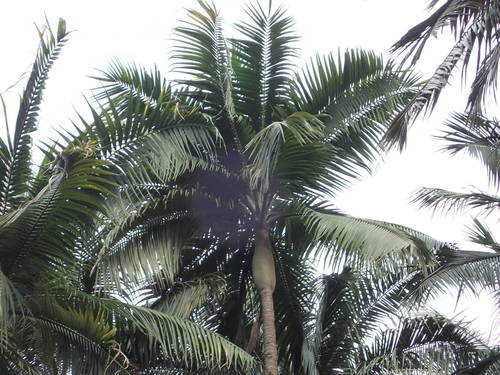
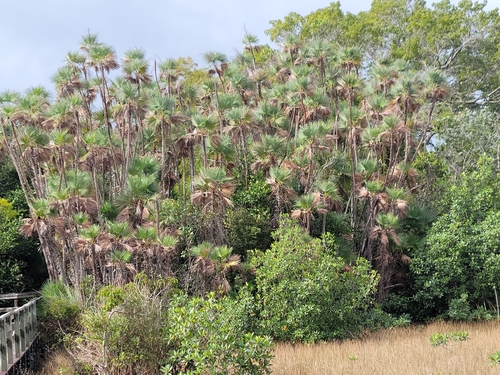
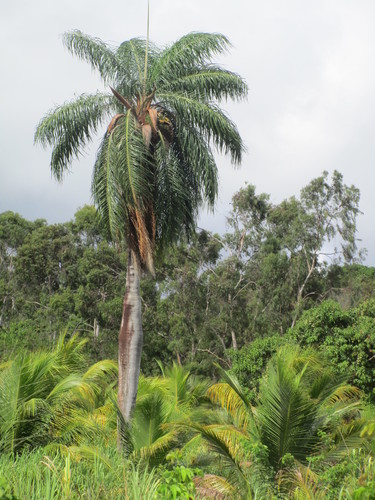
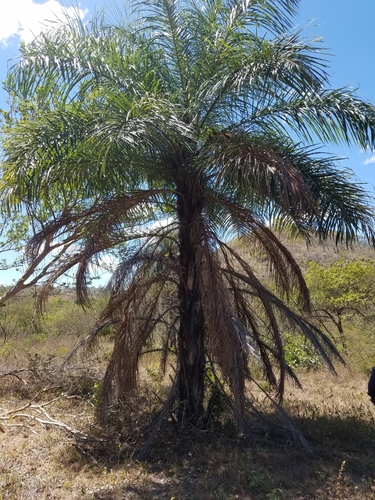
A straight slender palm up to 30 m tall. The leaves can spread 5 m across. The trunk is slender and erect. The trunk has rings around it and is about 10 to 15 cm across. The fronds or leaves are divided into leaflets along a stalk. The leaves are a dark green and 1.5 m long with leaf divisions about 25 cm long. The leaves arch over. The ends of the leaflets have irregularly placed teeth. A much branched flower cluster develops below the sheath. This can be 60 cm long with pale yellow flowers. The female flower occurs on its own at the base surrounded by small, white, sweet smelling male flowers. The fruit are egg shaped and up to 7 cm long. They change from green to red or yellow as they ripen.
Nutrition Score: 54/100
| Part | Moisture | kJ | kcal | Protein | Vit A | Vit C | Iron | Zinc |
|---|---|---|---|---|---|---|---|---|
| Nuts | 10.8 | 1671 | 399 | 4.4 | 0 | 0 | 4.2 | — |
| Palm heart | — | — | — | — | — | — | — | — |
How to Grow
Trees are grown from seed. The seedlings are transplanted at 1-2 years of age. A spacing of 3 m between plants is the best spacing. Bananas can be used to provide temporary shade while betel nut palms get established. Holes 50 cm across and deep need to be dug. The seedlings should be planted 20 cm below ground level. As emerging prop roots develop the hole should be filled in.
Propagation: Seed - sow in containers. The seed has a short viability so only fresh seed should be used. Germination usually takes place in 6 - 13 weeks. Areca nut is exclusively seed propagated. Seed nuts are allowed to ripen completely on the tree and then dried in the sun for 1-2 days before sowing 2.5 cm apart in shallow pits. Drying does not seem to improve germination rate. A spacing of 3 m between plants is the best spacing. Bananas can be used to provide temporary shade while betel nut palms get established. Holes 50 cm across and deep need to be dug. The seedlings should be planted 20 cm below ground level. As emerging prop roots develop the hole should be filled in.
Medicinal Uses
Astringent Diuretic Dysentery Laxative Leprosy Malaria Purgative Stimulant Betel palm is an astringent, stimulant herb that relieves hunger, abdominal discomfort and weariness. It kills intestinal parasites and other pathogens, and also has diuretic and laxative effects. It is used mainly in veterinary medicine to expel tapeworms. The seed is used against anaemia, fits, leucoderma, leprosy, obesity and worms. It is also used in the treatment of dysentery and malaria. In combination with other ingredients, it is also a purgative and an ointment for nasal ulcers. Kernels of green and mature fruits are chewed as an astringent and stimulant, often with the leaves or fruit of betel pepper (Piper betle) and slaked lime. The rind is also used as a laxative in cases of constipation with flatulence and bloating, as well as a diuretic in treating oedema. The fruits are harvested when fully ripe, and can be dried for later use. The areca nut decoction as well as arecoline and its salts have been found to be effective on various parasitic helminth infections such as those caused by Taenia spp.
Other Uses
Adhesive Containers Dye Nails Paper Plant support Tannin Thatching Wood Other uses rating: High (4/5). Agroforestry Uses: Experimental evidence indicates that intercropping with areca nut is not harmful to the main crop. When intercropped with black pepper, it acts as a live standard for training the pepper plants. Banana, cardamom, cowpea, paddy, pineapple, sorghum, vegetables and yams are also grown by farmers as intercrops with areca nut. Other Uses The leaves are used for thatching. In some parts of Sri Lanka the chief vessels used for carrying water are made from the leaves of this graceful palm, which, being of leather-like consistency, are easily converted into strong and durable water buckets. The leaf sheath is made into cups, plates, and bags for holding plantains, sweetmeats, and fish. The flower sheath is made into skullcaps, small umbrellas, and dishes. The husk fibres are predominantly composed of cellulose with varying proportions of hemi-cellulose, lignin, pectin and protopectin. Based on various tests, it has been proposed that the husk fibre could be used in making such items as thick boards, fluffy cushions and non-woven fabrics. Trial experiments have shown that satisfactory yield and quality of brown wrapping paper could be prepared from blends of areca nut and bamboo or banana pseudostem pulp. Areca nut husk can be a good source of furfural. Possibilities of producing activated carbon from the husks have been investigated, and yields of 25-28% have been recorded. The plant is a good source of tannins. These are used for dyeing clothes, as adhesives in plywood manufacture etc. The nut contains 8-12% fat that has characteristics comparable with hydrogenated coconut oil. It contains both saturated and unsaturated fatty acids. The outside portion of betel palm stem forms a useful building material in the villages, and it is widely used throughout southeast Asia for a variety of construction purposes. The timber can also be used in making a variety of utility articles such as rulers, shelves and waste paper baskets. Nails made from areca stem are widely used in the furniture industry. Special Uses Carbon Farming Food Forest
Wikipedia
Source ↗Areca catechu is a species of palm native to the Philippines cultivated for areca nuts. It was carried widely through the tropics by the Austronesian migrations and trade since at least 1500 BCE due to its use in betel nut chewing. It is widespread in cultivation and is considered naturalized in much of tropical Asia and in Taiwan, southern China (Guangxi, Hainan, Yunnan), Madagascar, parts of the Pacific Islands, and also in the West Indies. Its fruits (called areca nuts or betel nuts) are chewed together with slaked lime and betel leaves for their stimulant and narcotic effects.
Production
The palm commences bearing fruit after about 7 years. The fruit take 6-8 months to ripen. Trees can continue fruiting for 30-60 years.
Other Information
It occurs as an important social nut and masticatory in all lowland areas of many Asian and Pacific countries. It is traded into the highland regions. It is cultivated.
Notes
Seeds contain the alkaloid arecolaine and others alkaloids. There are 60 Areca species. They are tropical. The nuts can contain significant fluoride which is ingested while chewing.
Names & Synonyms
Adakka, Adike, Angiro, Areca nut, Betel, Bo, Bonga, Bu, Bua, Buai, Bunga, Buuch, Chambe, Fen-foah, Gaisa, Go-yu, Heta, Jambe, Jin si bao ta, Kasu, Kikiro fasia, Kove, Kunthi-pin, Maak, Malua, Mpopoo, Nga nga, Nokalua, Nyia nwotapi, Ota, Pakku, Pan, Pijaka, Pinang, Pinang sirih, Poc, Poogiphalam, Pu, Pua liki, Pua mouku, Pua, Puak, Pugua, Supari, Tamol, Vakka, Vua
References (97)
- Ali, A. M. S., 2005, Homegardens in Smallholder Farming Systems: Examples from Bangladesh. Human Ecology, Vol. 33, No. 2 pp. 245-270
- Ambasta S.P. (Ed.), 2000, The Useful Plants of India. CSIR India. p 50
- Awasthi, A.K., 1991, Ethnobotanical studies of the Negrito Islanders of Andaman Islands, India - The Great Andamanese. Economic Botany 45(2) pp274-280
- Balkrishna, A., et al, 2022, Indigenous Uses of Plants among Forest-dependent Communities of Seijosa, Arunachal Pradesh. International Journal of Economic Plants 2022, 9(1):064-080
- Baker, W.J. and Dransfield, J., 2006, Field Guide to Palms of New Guinea. Kew p 53
- Balick, M.J. and Beck, H.T., (Ed.), 1990, Useful palms of the World. A Synoptic Bibliography. Colombia p 74, 121, 447,
- Bandyopadhyay, S. et al, 2009, Wild edible plants of Koch Bihar district, West Bengal. Natural Products Radiance 8(1) 64-72
- Barfod, A.S., Banka R., and Dowe, J. L., 2001, Field Guide to Palms in Papua New Guinea. AAU Reports 40 Department of Systematic Botany University of Aarhus. Denmark. p 56
- Batet, K., Koil, U., and Hertel, H., 1998, Traditional Plant Use by the Didipa Clan, Baitabag, Papua New Guinea. GDS. p 23
- Bircher, A. G. & Bircher, W. H., 2000, Encyclopedia of Fruit Trees and Edible Flowering Plants in Egypt and the Subtropics. AUC Press. p 40
- Blench, R., 2004, Fruits and Arboriculture in the Indo-Pacific Region. Indo-Pacific Prehistory Association Bulletin 24. (Taipei Papers Volume 2) p 34
- Blomberry, A. & Rodd, T., 1982, Palms. An informative practical guide. Angus & Robertson. p 51
- Bodkin, F., 1991, Encyclopedia Botanica. Cornstalk publishing, p 98
- Borrell, O.W., 1989, An Annotated Checklist of the Flora of Kairiru Island, New Guinea. Marcellin College, Victoria Australia. p 35
- Bremness, L., 1994, Herbs. Collins Eyewitness Handbooks. Harper Collins. p 37
- Brickell, C. (Ed.), 1999, The Royal Horticultural Society A-Z Encyclopedia of Garden Plants. Convent Garden Books. p 133
- Brouk, B., 1975, Plants Consumed by Man. Academic Press, London. p 373
- Brown, D., 2002, The Royal Horticultural Society encyclopedia of Herbs and their uses. DK Books. p 128
- Burkill, H. M., 1985, The useful plants of west tropical Africa, Vol. 4. Kew.
- Burkill, I.H., 1966, A Dictionary of the Economic Products of the Malay Peninsula. Ministry of Agriculture and Cooperatives, Kuala Lumpur, Malaysia. Vol 1 (A-H) p 223
- Castillo, C., 2013, The Archaeobotany of Khao Sam Kaeo and Phu Khao Thong: The Agriculture of Late Prehistoric Southern Thailand. Ph. D. thesis University College, London
- Chatterjee, A. S., 1997, Fruit Trees in Cambodian Home Gardens. Trainers' training manual. Home garden series No.3 p 44
- Chowdery, T., et al, 2014, Wild edible plants of Uttar Dinajpur District, West Bengal. Life Science Leaflets. 47:pp 20-36 http://lifesciencesleaflets.ning.com
- Clarke, W.C. & Thaman, R.R., 1993, Agroforestry in the Pacific Islands: Systems for sustainability. United Nations University Press. New York. p 222
- Cobley, L.S. (rev. Steele, W.M.) 2nd Ed., 1976, An Introduction to the Botany of Tropical Crops. Longmans. p 217
- Cundall, P., (ed.), 2004, Gardening Australia: flora: the gardener's bible. ABC Books. p 180
- Elevitch, C.R.(ed.), 2006, Traditional Trees of the Pacific Islands: Their Culture, Environment and Use. Permanent Agriculture Resources, Holualoa, Hawaii. p 69
- Etherington, K., & Imwold, D., (Eds), 2001, Botanica's Trees & Shrubs. The illustrated A-Z of over 8500 trees and shrubs. Random House, Australia. p 103
- Ethnobotany of Karbis. Chapter 4 in p 107
- Evans, B. R, 1999, Edible nut Trees in Solomon Islands. A variety collection of Canarium, Terminalia and Barringtonia. ACIAR Technical Report No. 44 96pp
- Facciola, S., 1998, Cornucopia 2: a Source Book of Edible Plants. Kampong Publications, p 26
- Farnworth, E.R., 1976, Betel Nut- Its Composition, Chemistry and Uses, Science in New Guinea 4 (2): 85-90
- Flora of Pakistan. www.eFloras.org
- French, B., 1986, Food Plants of Papua New Guinea, Asia Pacific Science Foundation p 157
- French, B.R., 2010, Food Plants of Solomon Islands. A Compendium. Food Plants International Inc. p 274
- Friday, J. B., 2005, Forestry and Agroforestry Trees of East Timor. http://www.ctahr.hawaii.edu/forestry/data/Timor/Timor trees.html
- Furusawa, T., et al, 2014, Interaction between forest biodiversity and people's used of forest resources in Roviana, Solomon Islands: implications for biocultural conservation under socioeconomic changes. Journal of Ethnobiology and Ethnomedicine, 10:10
- Gibbons, M., 1993, Palms. Compact study Guide and Identifier. Sandstone. p 17
- Hani Medicine of Xishuangbanna, 1999, p 471
- Hariyadi, B., 2008, The Entwined Tree: Traditional Natural Resource Management of Serampas, Jambi, Indonesia. Ph. D thesis. Univ. or Hawaii. p 444
- Haynes, J., & McLaughlin, J., 2000, Edible palms and Their Uses. University of Florida Fact sheet MCDE-00-50-1 p 2
- Hedrick, U.P., 1919, (Ed.), Sturtevant's edible plants of the world. p 70
- Henderson, C.P. and I.R.Hancock, 1988, A Guide to the Useful Plants of the Solomon Islands. Res. Dept. Min of Ag. & Lands. Honiara, Solomon Islands. p 144
- Henty, E.E., 1980, Harmful Plants in Papua New Guinea. Botany Bulletin No 12. Division Botany, Lae, Papua New Guinea. p 114
- Hibbert, M., 2002, The Aussie Plant Finder 2002, Florilegium. p 32
- Hu, Shiu-ying, 2005, Food Plants of China. The Chinese University Press. p 300
- Jacquat, C., 1990, Plants from the Markets of Thailand. D.K. Book House p 106
- Janick, J. & Paul, R. E. (Eds.), 2008, The Encyclopedia of Fruit & Nuts. CABI p 86
- Johnson, D.V., 1998, Tropical palms. Non-wood Forest products 10. FAO Rome. p 125
- Jones, D.L., 1994, Palms throughout the World. Smithtonian Institution, Washington. p 56, 57
- Jones, D.L., 2000, Palms of Australia 3rd edition. Reed/New Holland. p 115
- Kiple, K.F. & Ornelas, K.C., (eds), 2000, The Cambridge World History of Food. CUP p 1891
- Kumar, S. A., Manus, D. & Mallika, M., 2018, Impact of non-timber forest products on Forest and in Livelihood Economy of the People of Adjoining Areas of Jalpaiguri Forest Division, West Bengal, India. Int. J. of Life Sciences, 2018; 6 (2):365-385
- Kuo, W. H. J., (Ed.) Taiwan's Ethnobotanical Database (1900-2000), http://tk.agron.ntu.edu.tw/ethnobot/DB1.htm
- Lepofsky, D., 1992, Arboriculture in the Mussau Islands, Bismarck Archipelago. Economic Botany, Vol 46, No. 2, pp. 192-211
- Liu, Yi-tao, & Long, Chun-Lin, 2002, Studies on Edible Flowers Consumed by Ethnic Groups in Yunnan. Acta Botanica Yunnanica. 24(1):41-56
- Llamas, K.A., 2003, Tropical Flowering Plants. Timber Press. p 92
- Lord, E.E., & Willis, J.H., 1999, Shrubs and Trees for Australian gardens. Lothian. p 92
- Manandhar, N.P., 2002, Plants and People of Nepal. Timber Press. Portland, Oregon. p 94
- Martin, F.W. & Ruberte, R.M., 1979, Edible Leaves of the Tropics. Antillian College Press, Mayaguez, Puerto Rico. p 209
- Martin, F. W., et al, 1987, Perennial Edible Fruits of the Tropics. USDA Handbook 642 p 46
- Monsalud, M.R., Tongacan, A.L., Lopez, F.R., & Lagrimas, M.Q., 1966, Edible Wild Plants in Philippine Forests. Philippine Journal of Science. p 516
- Murtem, G. & Chaudhrey, P., 2016, An ethnobotanical note on wild edible plants of Upper Eastern Himalaya, India. Brazilian Journal of Biological Sciences, 2016, v. 3, no. 5, p. 63-81
- Mutie, F. M., et al, 2023, Important Medicinal and Food Taxa (Orders and Families) in Kenya, Based on Three Quantitative Approaches. Plants 2023, 12, 1145
- Ochse, J. J. et al, 1931, Vegetables of the Dutch East Indies. Asher reprint. p 551
- Ong, H., et al, 2012, Traditional knowledge and usage of edible plants among the Semai community of Kampung Batu 16, Tapah, Perak, Malaysia. Scientific Research and Essays Vol. 7(4), pp. 441-445, 30 January, 2012
- Parham, B. E. V., 1972, Plants of Samoa. New Zealand Department of Scientific and Industrial Research. Information Series. No. 85 p 89
- Peekel, P.G., 1984, (Translation E.E.Henty), Flora of the Bismarck Archipelago for Naturalists, Division of Botany, Lae, PNG. p 62, 60
- Phon, P., 2000, Plants used in Cambodia. © Pauline Dy Phon, Phnom Penh, Cambodia. p 48
- Plants of Haiti Smithsonian Institute http://botany.si.edu
- Purseglove, J.W., 1972, Tropical Crops. Monocotyledons. Longmans p 434
- Rashid, H. E., 1977, Geography of Bangladesh. Westview. p 323
- Riffle, R.L. & Craft, P., 2003, An Encyclopedia of Cultivated Palms. Timber Press. p 30, 253
- Sahni, K.C., 2000, The Book of Indian Trees. Bombay Natural History Society. Oxford. p 184
- Schuler, S., (Ed.), 1977, Simon & Schuster's Guide to Trees. Simon & Schuster. No. 47
- Selvam, V., 2007, Trees and shrubs of the Maldives. RAP Publication No. 2007/12 p 208
- Smith, P.M., 1979, Betel Nut, in Simmonds, N.W., (ed), Crop Plant Evolution. Longmans. London. p 318
- Sp. pl. 2:1189. 1753 "cathecu"
- Staples, G.W. and Herbst, D.R., 2005, A tropical Garden Flora. Bishop Museum Press, Honolulu, Hawaii. p 618
- Sujanapal, P., & Sankaran, K. V., 2016, Common Plants of Maldives. FAO & Kerala FRI, p 40
- Sukarya, D. G., (Ed.) 2013, 3,500 Plant Species of the Botanic Gardens of Indonesia. LIPI p 749
- Teron, R. & Borthakur, S. K., 2016, Edible Medicines: An Exploration of Medicinal Plants in Dietary Practices of Karbi Tribal Population of Assam, Northeast India. In Mondal, N. & Sen, J.(Ed.) Nutrition and Health among tribal populations of India. p 149
- Terra, G.J.A., 1973, Tropical Vegetables. Communication 54e Royal Tropical Institute, Amsterdam, p 25
- United Nations University. Appendix One hundred Pacific Island agroforestry trees (2)
- Vander Velde, N, 2003, The Vascular Plants of Majuro Atoll, Republic of the Marshall Islands. Atoll research Bulletin. No. 503. Smithsonian Institute. p 31
- Vivien, J., & Faure, J.J., 1996, Fruitiers Sauvages d'Afrique. Especes du Cameroun. CTA p 74
- Wahyudi, 2017, Non-timber Forest Product (NTFP) Commodities Harvested and Marketed by Local People at the Local Markets in Manokwari - West Papua. Indonesian Journal of Forestry Research Vol. 4, No. 1, 27-35
- Watling, D., 2005, Palms of the Fiji Islands. Environmental Consultants (Fiji) Ltd. p 153
- Wickens, G.E., 1995, Edible Nuts. FAO Non-wood forest products. FAO, Rome. p162
- Wiersema, J. H. & Leon, B., 2013, World Economic Plants. A Standard Reference CRC Press. 2nd Ed. p 66
- Williams, C.N., Chew, W.Y., and Rajartnam, J.A., 1989, Tree and Field Crops of the Wetter Regions of the Tropics. Longman, p 76
- Wong, M., 2006, Edible Plants for Hawai'i Landscapes. College of Tropical Agriculture and Human Resources. Univ. of Hawai'i
- World Checklist of Useful Plant Species 2020. Royal Botanic Gardens, Kew
- www.ethnobiomed.com
- www.worldagroforestrycentre.org/sea/products/afdbases/af/asp/SpeciesInfo.asp?SpID=233
- Yeshi, K. et al, 2017, Taxonomical Identification of Himalayan Edible Medicinal Plants in Bhutan and the Phenolic Contents and Antioxidant Activity of Selected Plants. TBAP 7 (2) 2017 pp 89 - 106
- Zeven, A. C. & de West, J. M. J., 1982, Dictionary of cultivated plants and their regions of diversity. Wageningen. p 61