Areca macrocalyx
Zipp. ex Blume
Kambibi, Highland Betel nut palm
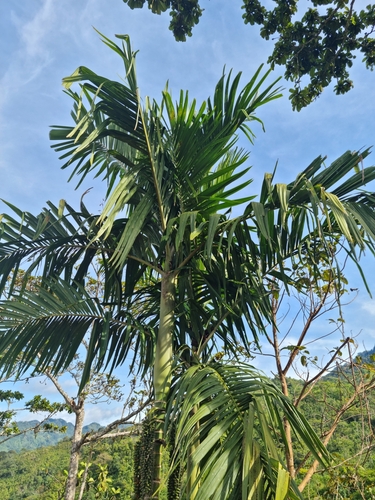
(c) Callum Blacklaw, some rights reserved (CC BY-NC), uploaded by Callum Blacklaw
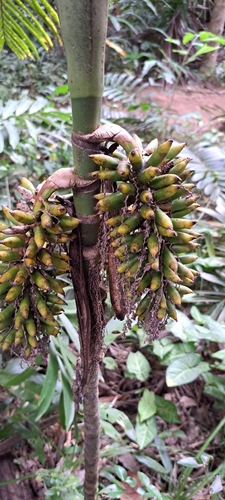
(c) Marcio Santos Ferreira, some rights reserved (CC BY-NC), uploaded by Marcio Santos Ferreira
What to Eat
Edible parts: Nuts, Edible heart, Cabbage, Palm heart
The seeds are used as an inferior substitute for those of areca palm (Areca catechu). These uses are as follows:- Seed - raw. The seed has mild narcotic properties, it is widely used in some areas of the tropics as a masticatory, being mixed with the leaves of a pepper plant (Piper betle), a gum and, often, lime. Betel seeds contain tannins and alkaloids - these stimulate saliva flow, accelerate heart and perspiration rates, suppress hunger and offer positive protection against intestinal worms.
Where to Find It
A tropical plant. It grows in the highlands of Papua New Guinea mostly between 1000 m and 1900 m.. It grows in tropical and subtropical areas. It grows in mountain rainforests. In Cairns Botanical Gardens.
Asia, Australia, Indonesia, Indonesia-Papua, Malaysia, Pacific, Papua New Guinea, PNG, SE Asia, Solomon Islands,
How to Identify
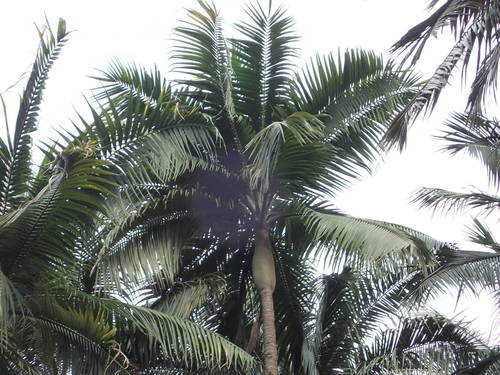
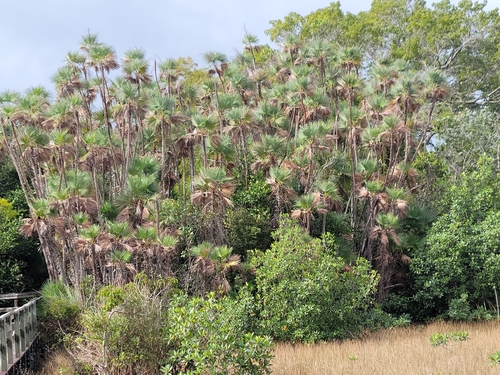
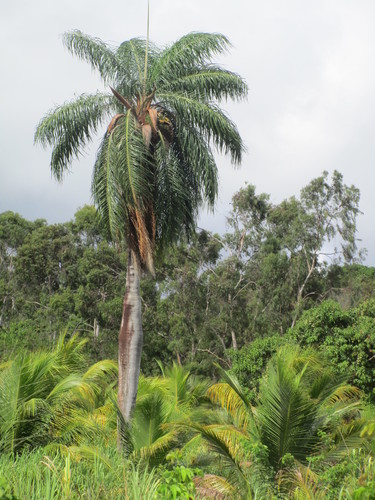
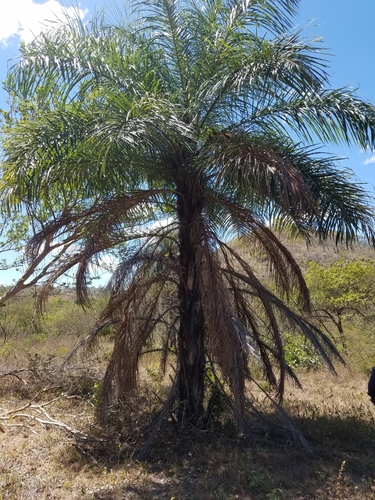
This is a small palm up to 2-10 m high. It has a thick dark green crown. The trunk is straight. It is green in its younger parts. There are widely spaced white rings of leaf base scars along the trunk. The crown-shaft is long and narrow. It is 1.2 m long. The leaves are 2 m long. They stick upwards and do not arch over. The leaflets are pleated. They vary in width and spacing. They are dark green above and pale underneath. It has dead male spikes between the rows of nuts. It has dense club-like clusters of fruit. The fruit can be round or elongated. They are deep orange when mature.
How to Grow
Plants can be grown from seed.
Medicinal Uses
The fruits have medicinal uses.
Other Uses
The leaves are used as thatch for huts or temporary buildings. The stems are used for flooring in traditional huts.
Notes
There are 60 Areca species. They are tropical.
Names & Synonyms
Ariki, Aupmo, E'esu, Heta pinomo, Kasmai, Kumul, Mbet, Monbat, Muncu sirbi, Owee, Palem sirih dataran tinggi, Pinang hutan, Rigi, Sias, Sungeri piawan, Wauneb
References (16)
- Baker, W.J. and Dransfield, J., 2006, Field Guide to Palms of New Guinea. Kew p 50
- Balick, M.J. and Beck, H.T., (Ed.), 1990, Useful palms of the World. A Synoptic Bibliography. Colombia p 602 (Also as Areca torulo and Areca rechingeriana) and (As Areca majasolu) - presumably nigasolu.
- Borrell, O.W., 1989, An Annotated Checklist of the Flora of Kairiru Island, New Guinea. Marcellin College, Victoria Australia. p 36
- French, B., 1986, Food Plants of Papua New Guinea, Asia Pacific Science Foundation p 157
- French, B.R., 2010, Food Plants of Solomon Islands. A Compendium. Food Plants International Inc. p 276
- Haynes, J., & McLaughlin, J., 2000, Edible palms and Their Uses. University of Florida Fact sheet MCDE-00-50-1 p 2
- Heatubun, C. D., et al, 2012, A monograph of the betel nut palms (Areca: Arecaceae) of East Malesia. Botanical Journal of the Linnean Society, 2012, 168, 147–173
- Johnson, D.V., 1998, Tropical palms. Non-wood Forest products 10. FAO Rome. p 79, 46
- Jones, D.L., 1994, Palms throughout the World. Smithtonian Institution, Washington. p 56, 129
- Jones, D.L., 2000, Palms of Australia 3rd edition. Reed/New Holland. p 116
- Riffle, R.L. & Craft, P., 2003, An Encyclopedia of Cultivated Palms. Timber Press. p 255
- Rumphia 2:75. 1839
- Sillitoe, P. 1995, An Ethnobotanical Account of the Plant Resources of the Wola Region, Southern Highlands Province, Papua New Guinea. J. Ethnobiol. 15(2): 201-235
- Sukarya, D. G., (Ed.) 2013, 3,500 Plant Species of the Botanic Gardens of Indonesia. LIPI p 750
- Webbia iii. 163 (1910). (As Areca rechingeriana)
- World Checklist of Useful Plant Species 2020. Royal Botanic Gardens, Kew