Areca triandra
Roxb. ex Buch.-Ham.
Triandra palm

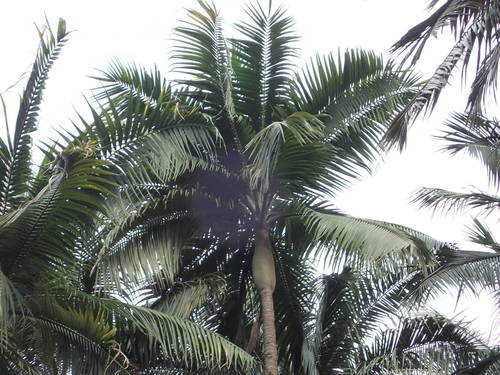
(c) Colin Chiu, some rights reserved (CC BY-NC), uploaded by Colin Chiu
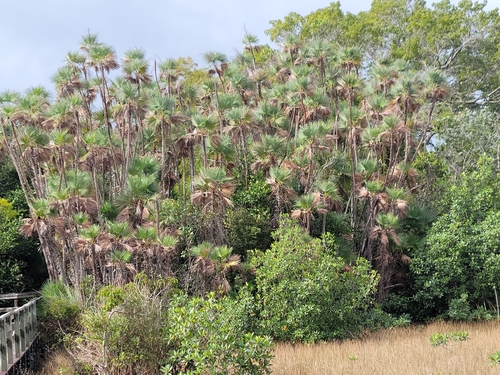
(c) Jens-Christian Svenning, some rights reserved (CC BY), uploaded by Jens-Christian Svenning

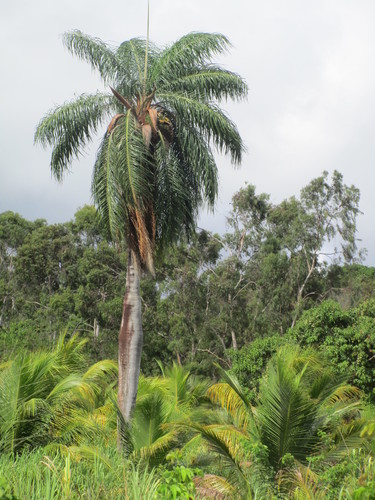
(c) Scott Zona, some rights reserved (CC BY-NC)
What to Eat
Edible parts: Nuts, Cabbage, Palm heart
The apical bud, often called a palm cabbage, is edible. Harvesting this bud leads to the death of the stem because the plant is unable to form side branches. If the plant is a form with a solitary stem then this obviously means the death of the plant. The seeds are sometimes used as an inferior substitute for those of areca palm (Areca catechu). These uses are as follows:- Seed - raw. The seed has mild narcotic properties, it is widely used in some areas of the tropics as a masticatory, being mixed with the leaves of a pepper plant (Piper betle), a gum and, often, lime. Betel seeds contain tannins and alkaloids - these stimulate saliva flow, accelerate heart and perspiration rates, suppress hunger and offer positive protection against intestinal worms.
Where to Find It
A tropical plant. It is a plant for the humid tropics. It does best in direct sunlight. It needs plenty of water. It grows in forest near the seashore. It suits hardiness zones 11-12. In Adelaide Botanical Gardens hot house. In the Cairns Botanical Gardens. In XTBG Yunnan.
Andamans, Asia, Australia, Bangladesh, Cambodia, China, India, Indochina, Indonesia, Laos, Malaysia*, Myanmar, Pacific, Philippines, SE Asia, Thailand, Vietnam,
How to Identify
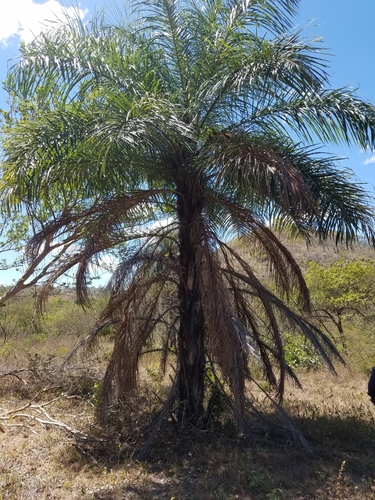
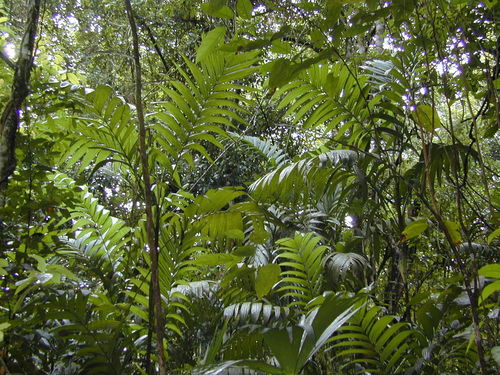
A clumping palm. It grows to 4.5 m high. It has several trunks and these have rings around them due to leaf scars. The stems are pale green. The leaf sheaths form a crown-shaft. It has feather-like leaves. The leaflets are both wide and narrow on the one leaf. The ends of the leaflets is jagged. They are deep green. The flowering stalk comes from below the crown-shaft. The male and female flowers are separate but on the same plant. The flowers are pale coloured and have a strong lemon perfume. The fruit are orange-red when ripe and 2.5 cm long. The seed is oval but flattened at one end.
How to Grow
Plants are grown from fresh seed. These germinate quickly. Plants need to be sheltered from wind and direct sun while small. Plants can also be grown from suckers.
Propagation: Seed - sow fresh in a nursery seedbed or in containers. It takes 6 - 10 months to germinate. Basal suckers can be removed from the parent plant and transplanted.
Medicinal Uses
The nuts are traditionally used as a betel substitute.
Other Uses
The leaves are used for thatching. The stems are used as posts.
Wikipedia
Source ↗Areca triandra, the wild areca palm, is a palm which is often used as ornamental plant. It is native to India, Bangladesh, Cambodia, Laos, Burma, Thailand, Vietnam, Malaysia, Indonesia, and the Philippines. It is also reportedly naturalized in Hawaii, Panama, Sri Lanka and southern China. As a wild plant, it commonly occurs in littoral forest in Southeast Asia.
Production
Plants grow quickly.
Notes
There are 60 Areca species. They are tropical.
Names & Synonyms
Bon gua, Chnarb, Jangali supari, Pinang hutan, Pinang triandra, Sla prei, Taw-kun-thi, Wils areca palm
References (27)
- Altschul, S.V.R., 1973, Drugs and Foods from Little-known Plants. Notes in Harvard University Herbaria. Harvard Univ. Press. Massachusetts. no. 91
- Ambasta S.P. (Ed.), 2000, The Useful Plants of India. CSIR India. p 50 (Also as Areca nagensis)
- Bircher, A. G. & Bircher, W. H., 2000, Encyclopedia of Fruit Trees and Edible Flowering Plants in Egypt and the Subtropics. AUC Press. p 40 (Also as Areca borneensis)
- Blomberry, A. & Rodd, T., 1982, Palms. An informative practical guide. Angus & Robertson. p 51
- Bodkin, F., 1991, Encyclopedia Botanica. Cornstalk publishing, p 98
- Burkill, I.H., 1966, A Dictionary of the Economic Products of the Malay Peninsula. Ministry of Agriculture and Cooperatives, Kuala Lumpur, Malaysia. Vol 1 (A-H) p 231 (Also as Areca borneensis)
- Cundall, P., (ed.), 2004, Gardening Australia: flora: the gardener's bible. ABC Books. p 180
- Dobriyal, M. J. R. & Dobriyal, R., 2014, Non Wood Forest Produce an Option for Ethnic Food and Nutritional Security in India. Int. J. of Usuf. Mngt. 15(1):17-37
- Etherington, K., & Imwold, D., (Eds), 2001, Botanica's Trees & Shrubs. The illustrated A-Z of over 8500 trees and shrubs. Random House, Australia. p 103
- Gibbons, M., 1993, Palms. Compact study Guide and Identifier. Sandstone. p 18
- Haynes, J., & McLaughlin, J., 2000, Edible palms and Their Uses. University of Florida Fact sheet MCDE-00-50-1 p 2
- Haynes, J., & McLaughlin, J., 2000, Edible palms and Their Uses. University of Florida Fact sheet MCDE-00-50-1 p 2 (As Areca laxa)
- Hedrick, U.P., 1919, (Ed.), Sturtevant's edible plants of the world. p 71 (As Areca laxa)
- Hibbert, M., 2002, The Aussie Plant Finder 2002, Florilegium. p 32
- Johnson, D.V., 1998, Tropical palms. Non-wood Forest products 10. FAO Rome. p 42, 46
- Jones, D.L., 1994, Palms throughout the World. Smithtonian Institution, Washington. p 130
- Jones, D.L., 1994, Palms throughout the World. Smithtonian Institution, Washington. p 56 (As Areca laxa)
- Jones, D.L., 2000, Palms of Australia 3rd edition. Reed/New Holland. p 117
- Martin, F.W. & Ruberte, R.M., 1979, Edible Leaves of the Tropics. Antillian College Press, Mayaguez, Puerto Rico. p 209 (As Areca borneensis)
- Mem. Wern. Nat. Hist. Soc. 5:310. (Roxb., Hort. bengal. 68.1814, nom. nudum). 1826
- Menninger, E.A., 1977, Edible Nuts of the World. Horticultural Books. Florida p 167 (Also as Areca nagensis)
- Partha, P., 2014, Ethnobotany of the Laleng (Patra) Community in Bangladesh. Journal of Pharmacognosy and Phytochemistry. 2(6):173-184
- Sukarya, D. G., (Ed.) 2013, 3,500 Plant Species of the Botanic Gardens of Indonesia. LIPI p 750
- Terra, G.J.A., 1973, Tropical Vegetables. Communication 54e Royal Tropical Institute, Amsterdam, p 25 (As Areca borneensis)
- Turreira Garcia, N., et al, 2017, Ethnobotanical knowledgeof the Kuy and Khmer people in Prey Lang, Cambodia. Cambodian Journal of Natural History 2017 (1): 76-101
- Wickens, G.E., 1995, Edible Nuts. FAO Non-wood forest products. FAO, Rome. p162 (As Areca laxa)
- World Checklist of Useful Plant Species 2020. Royal Botanic Gardens, Kew