Arenga engleri
Becc.
Dwarf sugar Palm, Formosan Sugar Palm, Taiwan arenga
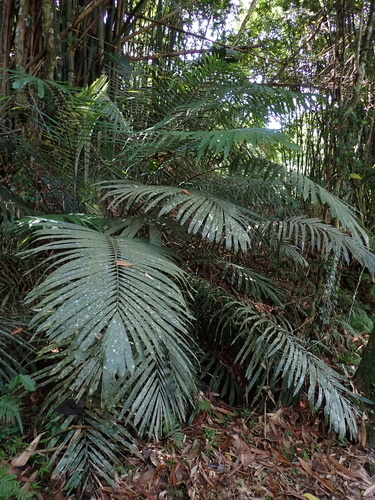
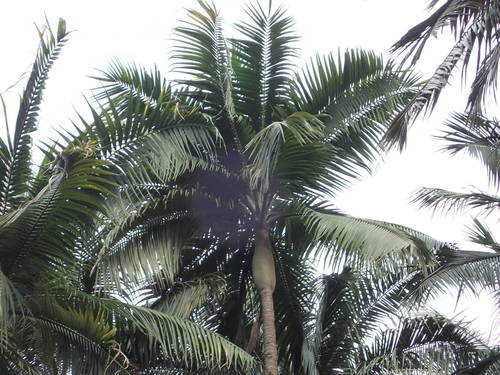
(c) Y. K. L., some rights reserved (CC BY-NC), uploaded by Y. K. L.

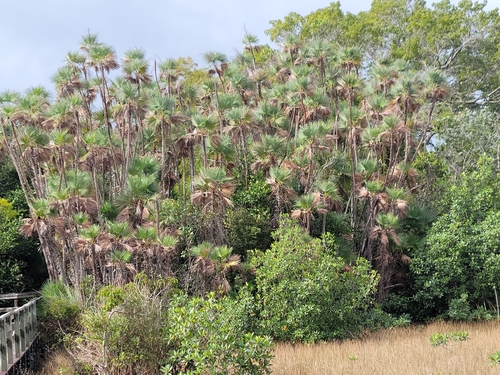
(c) Ting Cheng, some rights reserved (CC BY-NC-SA)

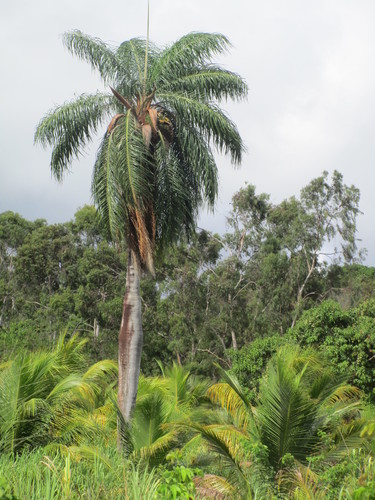
(c) Cheng-Tao Lin, some rights reserved (CC BY), uploaded by Cheng-Tao Lin
What to Eat
Edible parts: Cabbage, Starch, Sap, Palm heart
The pith of the stem is processed to extract starch, the sap from flowering stalks is used to make sugar, and young leaves and buds are eaten.
Known Hazards
Where to Find It
It will grow from tropical to warm temperate locations. It grows up to 1,600 m above sea level. It will grow in most soils. It needs a protected position. It is damaged by frost or drought. It can tolerate sun or shade. It suits hardiness zones 9-12. Geelong Botanical Gardens. Melbourne Botanical gardens hothouse. Brisbane Botanical Gardens. In XTBG Yunnan. In Townsville palmetum.
Asia, Australia, China, Hainan, Indonesia, Japan*, Mexico, North America, SE Asia, Taiwan*, USA,
How to Identify
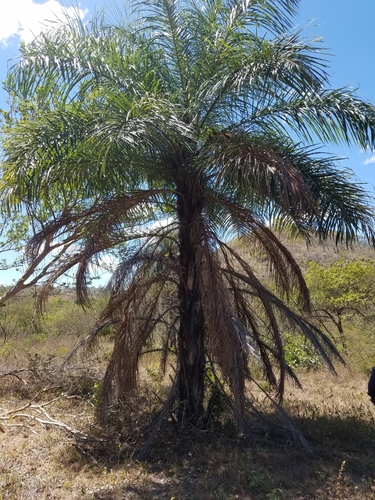
A small evergreen palm. It grows to 3 m high and spreads to 1.5 m across. The stem is erect and slender. It forms several stems producing a cluster. The stems are covered with fibres. The leaves are dull green above and silvery below. The fronds are 1.5-3 m long. The leaflets are crowded on the fronds. Often the ends and edges are irregular. The flowers are orange and occur in stiff branched stalks. The flowering stalks come from among the leaves and after that stalk fruits that particular stem dies. The fruit are deep red berries. They are 12 mm across and round. Each berry contains 3 hard grey seeds. The pulp of the fruit damages the skin.
How to Grow
Plants are grown from seed. The seed germinate erratically taking either weeks or months. It is best to soak the seed for 3-5 days. It can also be improved by filing the mesocarp near the point of the hylum. It can be grown from suckers.
Propagation: Seed - difficult to germinate. It can take 4 - 26 weeks. A deep root is formed before the seedling emerges above soil level, and so the seed should be sown in individual, deep containers. Pre-soak the seed for 24 hours in warm water before sowing. It can take 3 - 6 months or more before signs of growth are seen above soil level.
Other Uses
The leaves are used for thatching and wickerwork.
Wikipedia
Source ↗Arenga engleri, or the Formosa palm, Taiwan sugar palm, dwarf sugar palm, or Taiwan arenga palm, is a species of flowering plant in the family Arecaceae. The plant rarely grows more than 10 ft. tall, with a stem diameter of 6in. and a spread of 16 ft. The palm is native to Taiwan as well as Japan's Ryukyu Islands. The fruit of the palm is known to cause a severe allergic reaction.
Production
Plants grow slowly.
Notes
There are 17-20 Arenga species.
Names & Synonyms
Palem aren mini
References (21)
- Balick, M.J. and Beck, H.T., (Ed.), 1990, Useful palms of the World. A Synoptic Bibliography. Colombia p 210
- Blomberry, A. & Rodd, T., 1982, Palms. An informative practical guide. Angus & Robertson. p 55
- Bodkin, F., 1991, Encyclopedia Botanica. Cornstalk publishing, p 99
- Cundall, P., (ed.), 2004, Gardening Australia: flora: the gardener's bible. ABC Books. p 181
- Etherington, K., & Imwold, D., (Eds), 2001, Botanica's Trees & Shrubs. The illustrated A-Z of over 8500 trees and shrubs. Random House, Australia. p 104
- Facciola, S., 1998, Cornucopia 2: a Source Book of Edible Plants. Kampong Publications, p 26
- Gibbons, M., 1993, Palms. Compact study Guide and Identifier. Sandstone. p 19
- Gibbons, M., 2003, A pocket guide to Palms. Chartwell Books. p 38
- Hibbert, M., 2002, The Aussie Plant Finder 2002, Florilegium. p 32
- Jones, D.L., 1994, Palms throughout the World. Smithtonian Institution, Washington. p 132
- Jones, D.L., 2000, Palms of Australia 3rd edition. Reed/New Holland. p 118
- Kuo, W. H. J., (Ed.) Taiwan's Ethnobotanical Database (1900-2000), http://tk.agron.ntu.edu.tw/ethnobot/DB1.htm
- Malesia 3:184. 1889
- Martin, F.W. & Ruberte, R.M., 1979, Edible Leaves of the Tropics. Antillian College Press, Mayaguez, Puerto Rico. p 209
- Reis, S. V. and Lipp, F. L., 1982, New Plant Sources for Drugs and Foods from the New York Botanical Garden herbarium. Harvard. p 17
- Riffle, R.L. & Craft, P., 2003, An Encyclopedia of Cultivated Palms. Timber Press. p 258
- Sukarya, D. G., (Ed.) 2013, 3,500 Plant Species of the Botanic Gardens of Indonesia. LIPI p 752
- Terra, G.J.A., 1973, Tropical Vegetables. Communication 54e Royal Tropical Institute, Amsterdam, p 25
- USDA, ARS, National Genetic Resources Program. Germplasm Resources Information Network - (GRIN). [Online Database] National Germplasm Resources Laboratory, Beltsville, Maryland. Available: www.ars-grin.gov/cgi-bin/npgs/html/econ.pl (10 April 2000)
- Wiersema, J. H. & Leon, B., 2013, World Economic Plants. A Standard Reference CRC Press. 2nd Ed. p 66
- World Checklist of Useful Plant Species 2020. Royal Botanic Gardens, Kew