Arenga pinnata
(Wurmb) Merr.
Black Sugar palm

(c) rambatino, some rights reserved (CC BY-NC)

(c) rambatino, some rights reserved (CC BY-NC)

(c) rambatino, some rights reserved (CC BY-NC)
What to Eat
Edible parts: Juice - flowers, Sap, Seeds, Cabbage, Sago, Starch, Palm heart
Edible Parts: Leaves Sap Seed Edible Uses: Drink Sweetener A drink and sugar are made from the sweet sap obtained from the flowering stems. It is obtained by beating and bruising the developing inflorescence, which is then cut and a juice is obtained from the cut end over a period. Leaves - cooked. The appical bud, known as a 'palm heart' is sometimes used for food. It can be eaten raw in salads or cooked as a vegetable. Removing this bud will result in the death of the plant, since it is unable to produce side shoots. A sago-like flour can be ground from the trunk pith and used for cakes, noodles and other dishes. A product typically made from the plant in West Java is known as kolang kaling - this is the cooked endosperm of young sugar palm fruits. One infructescence yields about 4,500 endosperms. It is used for a cocktail and local refreshment known as kolak.
Known Hazards
Where to Find It
A tropical palm. It needs warmth and humidity. It grows in lowland forest up to 500 m altitude. Widely distributed at low and medium altitudes throughout the settled areas of the Philippines along streams. It grows in limestone areas. It suits hardiness zones 10-12. In the Cairns Botanical Gardens. In Yunnan. In Townsville Palmetum.
Africa, Asia, Australia, Bali, Bangladesh, Benin, Cambodia, China, Colombia, East Africa, East Timor, Fiji, Guam, India, Indochina, Indonesia, Laos, Malaysia, Myanmar, Northeastern India, Pacific, Papua New Guinea, PNG, Philippines, SE Asia, South America, Sri Lanka, Taiwan, Tanzania, Thailand, Tibet, Timor-Leste, USA, Vietnam, West Africa, West Timor,
How to Identify
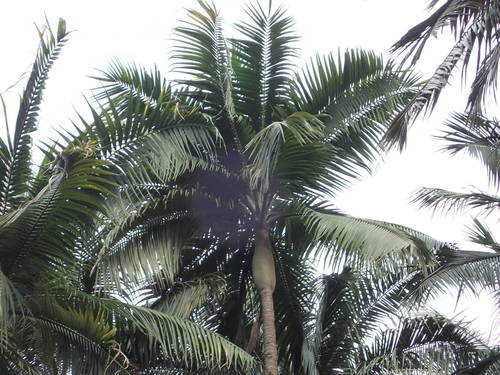
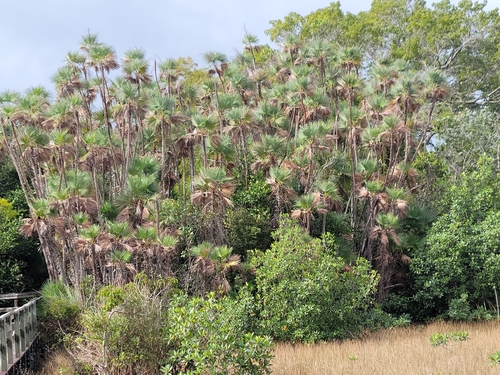
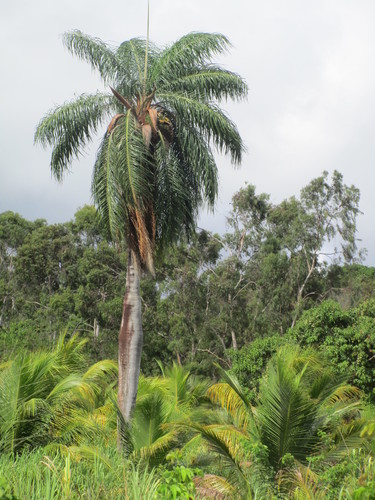
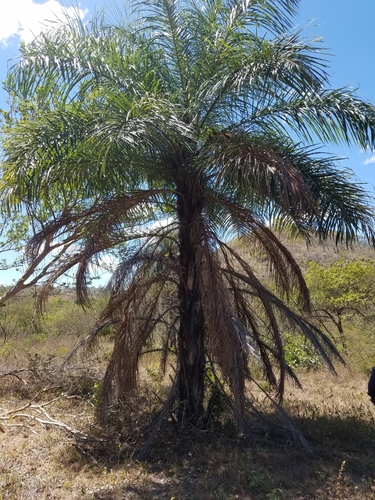
A large palm. It grows to 18 m high. It forms one trunk 30 cm across and covered with old leaf bases and black fibres. It has spines 7.5 cm long. It has long leaves which reach upwards. They have leaflets along the stalk made up of 100 or more pairs. The leaves are 8.5 m long. The leaflets are whitish beneath, lobed at the tip and with ear like pieces near the base. They have large flower stalks hanging down from the leaf axils. Several fruit stalks develop from the top downwards. When the palm is mature a flowering shoot is sent out from the axil of the upper leaf then followed by other flowers until the tree reserves are exhausted and the palm dies. The fruit are round and dark red. They are 4 cm across. The fruit pulp damages skin. There are usually 3 seeds per fruit. They have one flat side.
Nutrition Score: 5/100
| Part | Moisture | kJ | kcal | Protein | Vit A | Vit C | Iron | Zinc |
|---|---|---|---|---|---|---|---|---|
| Sap | 1656 | 396 | — | — | — | — | — | — |
| Palm heart | 94.7 | 79 | 19 | 0.1 | — | — | 0.5 | — |
| Pith starch | — | — | — | — | — | — | — | — |
| Nuts | — | — | 10.03 | — | — | — | — | — |
How to Grow
Plants are grown from seed. The seed grow easily.
Propagation: Seed - pre-soak for 24 hours in warm water and sow in deep containers. Alternatively, scratch the seed near the germination spot until the brown, inner seed-coat layer becomes visible, then soak in water overnight. The seeds should then be seeded in a clean medium with good aeration, planted with the germination spot downward and covered with a 1-cm layer of sand. The sand should be kept moist at all times. Within 2-3 weeks about 80% of the seeds will have germinated and can be transplanted to any type of container. Germination varies from 2 - 12 months or more. Direct sowing is possible but seedlings take a long time to establish well and may grow at irregular distances. Untreated seeds freely dispersed show 10-20% germination after 6 months. Plants can also sometimes be propagated through suckers.
Medicinal Uses
Roots provide medicinal products, such as a tea decoction used to cure bladder trouble.
Other Uses
Basketry Broom Containers Fibre Filter Fuel Insecticide Paper Plant support Soil stabilization Thatching Tinder Wood Other uses rating: High (4/5). Agroforestry Uses: The plant has an extensive root system, up to 3 metres deep and 10 metres wide. It has been planted, especially on slopes, for soil stabilization. Other Uses The leaf sheath is a source of a tough, black fibre (gomuti or yonot fibre). It is not pliable enough to be used for purposes such as running rigging, but is very strong and durable and used chiefly for making cables and a very strong rope that is tolerant of both fresh and salt water and of fire; it is used for marine work, thatching, upholstery and brushes. The hairs found on the base of the leaf sheaths are very good tinder for igniting fire. The fibre, placed in the bottom of a vessel, is useful for filtering water of its physical impurities. At the base of the leaves there is a woolly material used in caulking ships and stuffing cushions. Old woody leaf bases, as well as the long leaves, can be used for fuel. The split petioles are used for basketry and a form of marquetry. The youngest leaves are sometimes used as cigarette paper. The leaves are used as a source of thatching material. The roots are a useful insect repellent. The trunks of dead trees are allowed to rot and become hollow and are then used as water pipes. The pith of the leaf rachis is an ideal shape for use as a drinking cup. The very hard outer part of the trunk is used for barrels, flooring and furniture. Posts for pepper vines, boards, tool handles and musical instruments like drums are all made from the wood Special Uses Carbon Farming Food Forest
Wikipedia
Source ↗Arenga pinnata (syn. Arenga saccharifera) is an economically important feather palm native to tropical Asia, from eastern India east to Malaysia, Indonesia, and the Philippines in the east. Common names include sugar palm, areng palm (also aren palm or arengga palm), black sugar palm, and kaong palm, among other names.
Production
It is fast growing and short lived. An estimated sugar yield for 150-200 trees per hectare is 10 tons of marketable sugar over 10-15 years. A tree can yield 2 litres per day for 25 days. If the growing tip or cabbage is removed the palm usually develops side shoots and remains alive.
Other Information
It is cultivated.
Notes
There are 17-20 Arenga species.
Names & Synonyms
Anau, Aren, Bergat, Berkat, Cabo-negro, Datil, Enau, Gomuti palm, Habong, Inau, Juo, Kabong, Kaong, Kawung, Kichilippanai, Lirang, Mergat, Nanggung, Nau, Palem aren, Palem saguer, Peluluk, Sugar palm, Suikerpalm, Tali metan, Taren, Ta-shing, Taung-on, Taw-on, Thangtung
References (64)
- Ali, A. M. S., 2005, Homegardens in Smallholder Farming Systems: Examples from Bangladesh. Human Ecology, Vol. 33, No. 2 pp. 245-270 (As Arenga saccharifera)
- Ambasta S.P. (Ed.), 2000, The Useful Plants of India. CSIR India. p 51
- Anderson, E. F., 1993, Plants and people of the Golden Triangle. Dioscorides Press. p 202
- Arora, R. K., 2014, Diversity in Underutilized Plant Species - An Asia-Pacific Perspective. Bioversity International. p 100
- Baker, W.J. and Dransfield, J., 2006, Field Guide to Palms of New Guinea. Kew p 54
- Balick, M.J. and Beck, H.T., (Ed.), 1990, Useful palms of the World. A Synoptic Bibliography. Colombia p 99, 121 (As Arenga saccharifera), 215, 408, 542 (As Saguerus pinnatus), 659 (As Arenga saccharifera),
- Bircher, A. G. & Bircher, W. H., 2000, Encyclopedia of Fruit Trees and Edible Flowering Plants in Egypt and the Subtropics. AUC Press. p 40
- Blomberry, A. & Rodd, T., 1982, Palms. An informative practical guide. Angus & Robertson. p 55
- Bremness, L., 1994, Herbs. Collins Eyewitness Handbooks. Harper Collins. p 38
- Brickell, C. (Ed.), 1999, The Royal Horticultural Society A-Z Encyclopedia of Garden Plants. Convent Garden Books. p 134
- Brouk, B., 1975, Plants Consumed by Man. Academic Press, London. p 250, 365
- Burkill, H. M., 1985, The useful plants of west tropical Africa, Vol. 4. Kew.
- Burkill, I.H., 1966, A Dictionary of the Economic Products of the Malay Peninsula. Ministry of Agriculture and Cooperatives, Kuala Lumpur, Malaysia. Vol 1 (A-H) p 232
- Cowie, I, 2006, A Survey of Flora and vegetation of the proposed Jaco-Tutuala-Lore National Park. Timor-Lests (East Timor) www.territorystories.nt/gov.au p 43
- Cundall, P., (ed.), 2004, Gardening Australia: flora: the gardener's bible. ABC Books. p 181
- Dobriyal, M. J. R. & Dobriyal, R., 2014, Non Wood Forest Produce an Option for Ethnic Food and Nutritional Security in India. Int. J. of Usuf. Mngt. 15(1):17-37
- Etherington, K., & Imwold, D., (Eds), 2001, Botanica's Trees & Shrubs. The illustrated A-Z of over 8500 trees and shrubs. Random House, Australia. p 104
- Facciola, S., 1998, Cornucopia 2: a Source Book of Edible Plants. Kampong Publications, p 26
- Food Composition Tables for use in East Asia FAO http://www.fao.org/infoods/directory No. 754
- Friday, J. B., 2005, Forestry and Agroforestry Trees of East Timor. http://www.ctahr.hawaii.edu/forestry/data/Timor/Timor trees.html
- Gibbons, M., 1993, Palms. Compact study Guide and Identifier. Sandstone. p 19
- Gibbons, M., 2003, A pocket guide to Palms. Chartwell Books. p
- Hariyadi, B., 2008, The Entwined Tree: Traditional Natural Resource Management of Serampas, Jambi, Indonesia. Ph. D thesis. Univ. or Hawaii. p 401
- Haynes, J., & McLaughlin, J., 2000, Edible palms and Their Uses. University of Florida Fact sheet MCDE-00-50-1 p 2
- Hedrick, U.P., 1919, (Ed.), Sturtevant's edible plants of the world. p 71 (As Arenga saccharifera)
- Hibbert, M., 2002, The Aussie Plant Finder 2002, Florilegium. p 32
- Ho, C. W., Aida, W. M. W., Maskat, M. Y. and Osman, H., 2007, Changes in volatile compounds of palm sap (Arenga pinnata) during the heating process for production of palm sugar. Food Chemistry 102: 1156-1160.
- http://palaeoworks.anu.edu.au/Nuno_PhD/04.pdf re Timor
- Hu, Shiu-ying, 2005, Food Plants of China. The Chinese University Press. p 300
- Interpr. Herb. amboin. 119. 1917
- Janick, J. & Paul, R. E. (Eds.), 2008, The Encyclopedia of Fruit & Nuts. CABI p 87
- Jardin, C., 1970, List of Foods Used In Africa, FAO Nutrition Information Document Series No 2.p 11
- Johnson, D.V., 1998, Tropical palms. Non-wood Forest products 10. FAO Rome. p 42, 46, 121
- Jones, D.L., 1994, Palms throughout the World. Smithtonian Institution, Washington. p 51, 56, 57, 135
- Jones, D.L., 2000, Palms of Australia 3rd edition. Reed/New Holland. p 119
- Kar, A., et al, 2013, Wild Edible Plant Resources used by the Mizos of Mizoram, India. Kathmandu University Journal of Science, Engineering and Technology. Vol. 9, No. 1, July, 2013, 106-126
- Lalfakzuala, R., 2007, Ethnobotanical usages of plants in western Mizoram. Indian Journal of Traditional Knowledge. Vol 6(3) pp 480-493
- Li, S., et al, 2020, Monpa, memory, and change: an ethnobotanical study of plant use in Mêdog County, South-east Tibet, China. Journal of Ethnobiology and Ethnomedicine. (2020) 16:5 p 16
- Martin, F.W. & Ruberte, R.M., 1979, Edible Leaves of the Tropics. Antillian College Press, Mayaguez, Puerto Rico. p 209
- Menninger, E.A., 1977, Edible Nuts of the World. Horticultural Books. Florida p 126
- Mokoginta, M. M., 2015, Prospective Use of Palm (Arenga pinnata Merr.) as Raw Material of Sugar Palm in the Village of Moyag, Bolaang Mongondow, Indonesia, International Journal of Agriculture and Forestry, 5(4), pp. 240-243.
- Monsalud, M.R., Tongacan, A.L., Lopez, F.R., & Lagrimas, M.Q., 1966, Edible Wild Plants in Philippine Forests. Philippine Journal of Science. p 520
- Mot So Rau Dai an Duoc O Vietnam. Wild edible Vegetables. Ha Noi 1994, p 118
- Ochse, J. J. et al, 1931, Vegetables of the Dutch East Indies. Asher reprint. p 553
- Ogle, B. M., et al, 2003, Food, Feed or Medicine: The Multiple Functions of Edible Wild Plants in Vietnam. Economic Botany 57(1): 103-117 (As Arenga saccharifera)
- Phon, P., 2000, Plants used in Cambodia. © Pauline Dy Phon, Phnom Penh, Cambodia. p 49
- Priyadi, H., et al, Five hundred plant species in Gunung Halimun Salak National Park West Java. A checklist including Sundanese names, distribution and use. CIFOR, FFPRI, SLU p 12
- Purseglove, J.W., 1972, Tropical Crops. Monocotyledons. Longmans p 419
- Riffle, R.L. & Craft, P., 2003, An Encyclopedia of Cultivated Palms. Timber Press. p 37, 260
- Smith, A.C., 1979, Flora Vitiensis Nova: A New flora of Fiji, Hawai Botanical Gardens, USA Vol 1 p 407
- Smith, P.M., 1979, Sugar palms, in Simmonds, N.W., (ed), Crop Plant Evolution. Longmans. London. p 318
- Sujarwo, W., et al, 2016, Traditional knowledge of wild and semi-wild edible plants used in Bali (Indonesia) to maintain biological and cultural diversity. Plant Biosystems, 2016, Vol. 150, No. 5, 971-976
- Sukarya, D. G., (Ed.) 2013, 3,500 Plant Species of the Botanic Gardens of Indonesia. LIPI p 753
- Sukenti, K., et al, 2016, Ethnobotanical study on local cuisine of the Sasak tribe in Lombok Island, Indonesia. Journal of Ethnic Foods. 3 (2016) 189-200 p 198
- Terra, G.J.A., 1973, Tropical Vegetables. Communication 54e Royal Tropical Institute, Amsterdam, p 25
- Thitiprasert, W., et al, 2007, Country report on the State of Plant Genetic Resources for Food and Agriculture in Thailand (1997-2004). FAO p 106
- van Wyk, B., 2005, Food Plants of the World. An illustrated guide. Timber press. p 69
- Wickens, G.E., 1995, Edible Nuts. FAO Non-wood forest products. FAO, Rome. p 86, 162
- Wiersema, J. H. & Leon, B., 2013, World Economic Plants. A Standard Reference CRC Press. 2nd Ed. p 66
- Williams, C.N., Chew, W.Y., and Rajaratnam, J.A., 1989, Tree and Field Crops of the Wetter Regions of the Tropics. Longman, p 240
- World Checklist of Useful Plant Species 2020. Royal Botanic Gardens, Kew
- www.worldagroforestrycentre.org/treedb/
- Xu, You-Kai, et al, 2004, Wild Vegetable Resources and Market Survey in Xishuangbanna, Southwest China. Economic Botany. 58(4): 647-667.
- Zeven, A. C. & de West, J. M. J., 1982, Dictionary of cultivated plants and their regions of diversity. Wageningen. p 61, 78