Sterculia setigera
Delile
Star chestnut
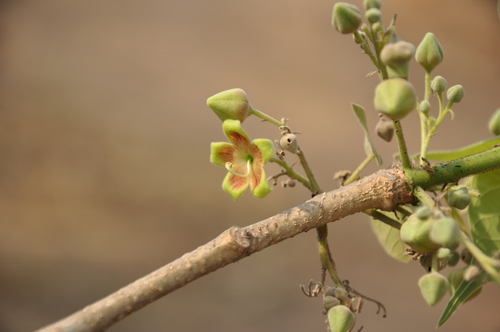
(c) Christian Gilli, some rights reserved (CC BY-NC), uploaded by Christian Gilli

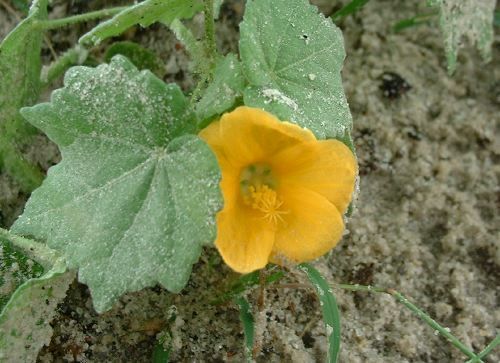
(c) Dr Anh Galat-Luong, some rights reserved (CC BY-NC)

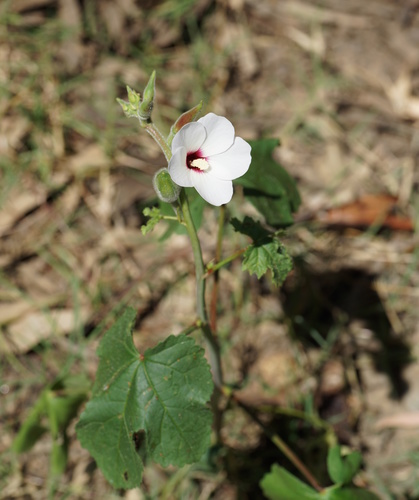
(c) Marco Schmidt, some rights reserved (CC BY-NC-SA)
What to Eat
Edible parts: Seeds, Gum, Leaves, Flower
The seeds are eaten as a famine food. The gum is used in food preparations as a water-soluble binder for sauces. Flowers and leaves are occasionally eaten.
Where to Find It
A tropical plant. It grows in dry deciduous savannah woodland. It is often along river-banks. It grows in the Sahel. It can grow in arid places. It can grow in poor soils.
Africa, Angola, Benin, Burkina Faso, Cameroon, Central Africa, Congo DR, East Africa, Eritrea, Ethiopia, Guinea, Guinée, Guinea-Bissau, Nigeria, Sahel, Senegal, Somalia, South Sudan, Sudan, Tanzania, Togo, Uganda, West Africa,
How to Identify
A tree. It grows 16 m high. It has small buttresses at the base. The trunk is 1.5 m around. It loses its leaves during the year. The bark is grey and flakes off in oblong pieces leaving a light coloured bark underneath. The leaves have 3-5 lobes spread out like fingers on a hand. The leaf stalks are 8 cm long. The leaves are velvety with hairs on both surfaces. Trees are separately male and female. The flowers are dull red or yellowish-green. They are in small groups on last year's shoots. The fruit form 3-5 boat shaped parts. There are about 12 seeds in each section. The layer around the seeds is yellow.
How to Grow
Plants can be grown from seeds.
Propagation: Seed - a physical dormancy caused by the hard seed coat can be overcome by scarifying the seed. This is carried out by cutting away or abrading some of the seed coat to allow the ingress of water, though great care must be taken not to damage the embryo. The aril surrounding the seed should also be removed - this is easiest when it has been softened through soaking in water. The seeds germinate optimally at temperatures between 20 - 30°c. They can be sown in a nursery seedbed or in containers. A germination rate of about 95%, occurring within about 2 weeks can be expected if the seed has been properly treated.
Medicinal Uses
Seeds are eaten by nomadic groups in Northern Nigeria. A wide spread species, it has multi-purpose functions in various local communities. A decoction of stem bark extracts are used as part of an herbal regimen to treat skin ailments and infections, fever, diarrhea and toothache.
Other Uses
The tree produces a highly water-soluble gum, known as 'Karaya Gum'. It is used in foods and medicinally and also as an adhesive and for glazing pottery. A fibre obtained from the inner bark is used for rope making and cloth. The wood is white and very soft. It is used for non timber forest products. It is used for insulation and concealed items in carpentry. The wood is unsuitable for fuel wood and charcoal. The tree is a good regenerator in open areas, colonizing fallow land. It shows promise as a pioneer species for restoring native woodland - we need more information on growth rates.
Wikipedia
Source ↗Sterculia setigera is a deciduous tree species within the Malvaceae family. It commonly occurs in the Sahelo-Sudan and Guinea savannah zones of Tropical Africa. Among the Hausa people it is known as Kukkuki and Boɓori among Fulani people of Nigeria. It is an important tree crop in Senegal as Gum karaya obtained from the woody species is exported from the country.
Production
The gum is tapped by carving the trees at the beginning of the rainy season.
Other Information
The leaves are only occasionally eaten.
Notes
Also put in the family Sterculiaceae.
Names & Synonyms
Adhiak, Baroot, Bobori, Boggo, Faider, Hogorec, Jobitabae, Jobitabo, Karaya gum tree, Kongosira, Kukuki, Kumendur, Laloo mbeb, Ohuroi, Posemporgo, Sugubo, Tartar, Telieh
References (30)
- Achigan-Dako, E, et al (Eds), 2009, Catalogue of Traditional Vegetables in Benin. International Foundation for Science.
- Alyegba, S. S. et al, 2013, Ethnobotanical Survey of Edible Wild Plants in Tiv Communities of Benue State, Nigeria. Journal of Natural Sciences Research. Vol.3, No.7
- Atakpama, W, et al, 2015, Quantitative Approach of Sterculia setigera Delile (Malvaceae) Ethnobotanical Uses Among Rural Communities in Togo (West Africa). Ethnobotany Research & Applications 14:063-080
- Atato, A., et al, 2010, Diversity of Edible Wild Fruit Tree Species of Togo. Global Science Books.
- Bonou, A., et al, 2013, Valeur economique des Produits Forestiers Non Ligneux (PFNL) au Benin. Editions Universitaires Europeennes p 93
- Burkill, H. M., 1985, The useful plants of west tropical Africa, Vol. 5. Kew.
- Centurie de plantes d'Afrique 61. 1826 (F. Cailliaud, Voy. Meroe4:354. 1827)
- Chapman, J. D. & Chapman, H. M., 2001, The Forest Flora of Taraba and Andamawa States, Nigeria. WWF & University of Canterbury. p 205
- Dalziel, J. M., 1937, The Useful plants of west tropical Africa. Crown Agents for the Colonies London.
- Dansi, A., et al, 2008, Traditional leafy vegetables and their use in the Benin Republic. Genet Resour Crop Evol (2008) 55:1239–1256
- Edwards. S., et al, (Eds), 1995, Flora of Ethiopia and Eritrea. Vol.2, Part 2 Canellaceae to Euphorbiaceae. Uppsala, Sweden. p 162
- Gallagher, D. E., 2010, Farming beyond the escarpment: Society, Environment, and Mobility in Precolonial Southeastern Burkina Faso. PhD University of Michigan
- Gilbert, T., et al, 2017, Diversity and local transformation of indigenous edible fruits in sahelian domain of Cameroon. Journal of Animal & Plant Sciences Vol. 26 (2): 5289-5300
- Grivetti, L. E., 1980, Agricultural development: present and potential role of edible wild plants. Part 2: Sub-Saharan Africa, Report to the Department of State Agency for International Development. p 25
- A. Guillemin et al., Fl. Seneg. tent. 1:81, t. 16. 1831 (As Sterculia tomentosa)
- Harris, F. M. A. and Mohammed, S., 2003, Relying on Nature: Wild Foods in Northern Nigeria. Ambio Vol. 32 No. 1. p 25-30
- Hedrick, U.P., 1919, (Ed.), Sturtevant's edible plants of the world. p 635 (As Sterculia tomentosa)
- Jardin, C., 1970, List of Foods Used In Africa, FAO Nutrition Information Document Series No 2.p 36
- Janaki, B. & R. B. Sashidhar, 1998, Physico-chemical analysis of gum kondagogu (Cochlospermum gossypium): a potential food additive. Food Chemistry, Vol. 61, No. 1/2, pp. 231-236
- Keay, R.W.J., 1989, Trees of Nigeria. Clarendon Press, Oxford. p 128
- Kristensen, M and Lykke, A. M., 2003, Informant-Based Valuation of Use and Conservation Preferences of Savanna Trees in Burkina Faso. Economic Botany, Vol 57, No. 2, pp. 203-271
- Le Houerou, H. N., (Ed.), 1980, Browse in Africa. The current state of knowledge. International Livestock Centre for Africa, Ethiopia. p 163
- Maydell, H. von, 1990 Trees and shrubs of the Sahel: their characteristics and uses. Margraf. p 377
- Menninger, E.A., 1977, Edible Nuts of the World. Horticultural Books. Florida p 43 (As Sterculia tomentosa)
- Ojelel, S., et al, 2019, Wild edible plants used by communities in and around selected forest reserves of Teso-Karamoja region, Uganda. Journal of Ethnobiology and Ethnomedicine (2019) 15:3
- Peters, C. R., O'Brien, E. M., and Drummond, R.B., 1992, Edible Wild plants of Sub-saharan Africa. Kew. p 189
- Sambou, A., et al, 2016, The contribution of trees and palms to a blanced diet in three rural villages of the Fatick Province, Senegal. FORESTS, TREES AND LIVELIHOODS, 2016 VOL. 25, NO. 3, 212–225
- Wickens, G.E., 1995, Edible Nuts. FAO Non-wood forest products. FAO, Rome. p156
- World Checklist of Useful Plant Species 2020. Royal Botanic Gardens, Kew
- Zika, A., et al, 2015, Traditional plant use in Burkina Faso (West Africa): a national-scale analysis with focus on traditional medicine. Journal of Ethnobiology and Ethnomedicine 2015, 11:9