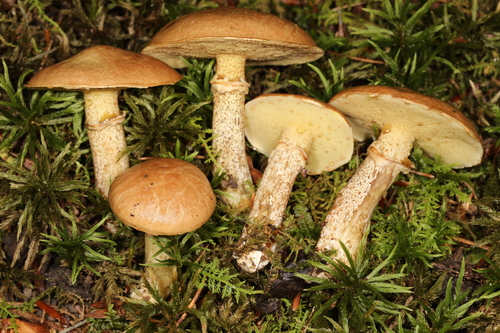
Suillus luteus
(C. Linnaeus: E.M. Fries) Gray
Chilean slippery jack, Slippery Jack
(c) Davide Puddu, some rights reserved (CC BY), uploaded by Davide Puddu

(c) Kari Pihlaviita, some rights reserved (CC BY-NC), uploaded by Kari Pihlaviita

(c) Christian Schwarz, some rights reserved (CC BY-NC), uploaded by Christian Schwarz
What to Eat
Edible parts: Mushroom, Fungus, Caution
The fruiting bodies are eaten with the slimy skin peeled off. They can be used in sauces, marinades, and gravies, or dried and pickled.
Known Hazards
Where to Find It
In Chile it grows from sea level to 2,000 m above sea level. It grows near water. It grows in humid areas. It can grow in shade. It suits hardiness zone 9.
Africa, Andorra, Argentina, Armenia, Asia, Australia, Balkans, Belarus, Britain, Bulgaria, Burundi, Caucasus, Chile, China, Czech Republic, East Africa, Europe, Finland, Georgia, Hungary, Italy, Madagascar, Malawi, Mediterranean, Mexico, New Zealand, North America, Poland. Portugal, Russia, Scandinavia, Sicily, South Africa, Southern Africa, South America, Spain, Sweden, Turkey, Türkiye, USA, Ukraine,
How to Identify
A mushroom in the Suillaceae family that grows approximately 10 cm high, found in Chile from sea level to 2,000 m in humid areas near water.
Wikipedia
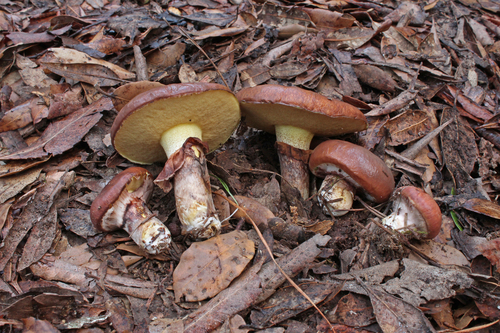
Source ↗Suillus luteus is a species of bolete fungus commonly referred to as slippery jack or sticky bun. The fungus was originally assigned to Boletus by Carl Linnaeus in 1753, before being made the type species of Suillus in 1796. The slimy cap is typically up to 10 cm (4 in) wide and conical before flattening. A membranous partial veil connects the cap to the stem when young. Yellow tubes extend downward from the underside of the cap, which spores escape through. The pale stem is up to 10 cm (4 in) tall and 3 cm (1+1⁄4 in) thick, bearing small dots near the top. Unlike most other boletes, it bears a distinctive membranous ring, tinged brown to violet on the underside. A common fungus native all across Eurasia from Ireland to Korea, it has been introduced widely elsewhere, including North and South America, southern Africa, Australia and New Zealand. The fungus grows in coniferous forests in its native range, and pine plantations in countries where it has become naturalized. It forms symbiotic ectomycorrhizal associations with living trees by enveloping the tree's underground roots with sheaths of fungal tissue. The fruit bodies are often produced in large numbers above ground in summer and autumn. The mushroom is edible, though not as highly regarded as other boletes. It is commonly prepared and eaten in soups, stews or fried dishes. The slime coating, however, may cause indigestion if not removed before eating. It is often sold as a dried mushroom.
Other Information
It is an export crop from Chile. It is popular.
Notes
Also put in the family Boletaceae.
Names & Synonyms
Callampa, Callampas, Chilean porcini, Hehuan runiuganjun, Hongos pino, Pine Bolete, Smorsopp, Smorsvamp, Sticky Bun, The yellow bolete, Zethiana
References (39)
- Boa, E. R., Wild edible fungi and their importance to people. FAO Non Wood Forest Products Booklet 17
- Bonney, N., 2012, Edible Wild Native Plants for Southern Australia. p 88
- Bougher, N.L. & Syme, K., 1998, Fungi of Southern Australia. UWA Press p 310
- Brouk, B., 1975, Plants Consumed by Man. Academic Press, London. p 57 (As Boletus luteus)
- Bussman, R. W., et al, 2016, A comparative ethnobotany of Khevsureti, Samtskhe-Javakheti, Tusheti, Svaneti, and Racha-Lechkhumi, Republic of Georgia (Sakartvelo), Caucasus. Journal of Ethnobiology and Ethnomedicine.
- Bussman, R. W., et al, 2021, Unity in diversity—food plants and fungi of Sakartvelo (Republic of Georgia), Caucasus. Journal of Ethnobiology and Ethnomedicine (2021) 17:72 p 17
- Buyck, B., & Nzigidahera, B., 1995, Ethnomycological Notes from Western Burundi. Belg. Journ. Bot. 128(2): 131-138
- Buyck, B., 2008, The Edible Mushrooms of Madagascar: An Evolving Enigma. Economic Botany 62(3) pp. 509-520
- Cocchi, L. et al, 2006, Heavy metals in edible mushrooms in Italy. Food Chemistry 98: 277-284
- Crowe, A., 1997, A Field Guide to the Native Edible Plants of New Zealand. Penguin. p 125
- Dashorst, G.R.M., and Jessop, J.P., 1998, Plants of the Adelaide Plains & Hills. Botanic Gardens of Adelaide and State Herbarium. p 24
- Degreef, J., et al, 2016, Wild edible mushrooms, a valuable resource for food security and rural development in Burundi and Rwanda. Biotechnol. Agron. Soc. Environ. 2016 20(4), 441-452
- Denchev, C. M., et al, The wild edible mushrooms in Bulgaria. Bulgarian Academy of Science.
- Facciola, S., 1998, Cornucopia 2: a Source Book of Edible Plants. Kampong Publications, p 250
- Farfan B., et al, 2007, Mazahua Ethnobotany and Subsistence in the Monarch Butterfly Biosphere Reserve, Mexico. Economic Botany 61(2) pp 173-191
- Fuhrer, B., 2005, A field guide to Australian Fungi. Bloomings Books. p 195
- Genccelep, H. et al, 2009, Determination of mineral contents of wild-grown edible mushrooms. Food Chemistry 113: 1033-1036
- Gryzenhout, M., 2010, Mushrooms of South Africa. Pocket Guide. Struik. p 75
- Guedes de Piniho, P., et al, 2008, Correlation between the Pattern Volatiles and the Overall Aroma of Wild Edible Mushrooms. Journal of Agricultural and Food Chemistry. 56: 1704-1712
- Hall, I. R., et al, 2003, Edible and Poisonous Mushrooms of the World. Timber Press. p 233
- Jordan, P., 2000, The Mushroom Guide and Identifier, Hermes House, p 90
- Kalac, P. and Svoboda, L., 1999, A review of trace element concentrations in edible mushrooms. Food Chemistry 69: 273-281
- Kaufmann, B. et al, 1999, The Great Encyclopedia of Mushrooms. Konemann. p 20
- Kaye, G.C., 1986, Wild and Exotic Mushroom Cultivation in North America
- Lentini, F. and Venza, F., 2007, Wild food plants of popular use in Sicily. J Ethnobiol Ethnomedicine. 3: 15
- Li, H., et al, 2020, Reviewing the world’s edible mushroom species: A new evidence-based classification system. Compr Rev Food Sci Food Saf. 2021;20:1982–2014.
- Mabey, R., 1973, Food for Free. A Guide to the edible wild plants of Britain, Collins. p 50 (As Boletus luteus)
- Ostry, M. E., et al, 2010, Field Guide to Common Macrofungi in Eastern Forests and Their Ecosystem Functions. USDA Forest Service General Technical Report NRS-79 p 48
- Pace, G., 1998, Mushrooms of the world. Firefly books. p 192 (As Boletus luteus)
- Pelkonen, R., et al, 2008, Element Concentrations in Wild Edible Mushrooms in Finland. The Finnish Environment 25
- Pfister, D. H., 2016, Fungi and Forests. ReVista 16(1) p 14
- Rila Monastery Nature Park Management Plan 2004 - 2013 (Bulgaria) p 380
- Stoyneva-Gartner, M.P. & Uzunov, B.A., 2015, An Ethnobiological Glance on Globalization Impact on the Traditional Use of Algae and Fungi as Food in Bulgaria. J Nutr Food Sci 2015, 5:5
- Stryamets, N., et al, 2015, From economic survival to recreation: contemporary uses of wild food and medicine in rural Sweden, Ukraine and NW Russia. Journal of Ethnobiology and Ethnomedicine 11:53
- Svanberg, I., & Lindh, H., 2019, Mushroom hunting and consumption in twenty-first century post-industrial Sweden. Journal of Ethnobiology and Ethnomedicine (2019) 15:42
- Szanto, Zs et al, 2007, Current Radioactivity Content of Wild Edible Mushrooms. Journal of Radioanalytical and Nuclear Chemistry, Vol. 273, No. 1: 167–170
- Toledo, B. A., et al, 2007, Knowledge and Use of Edible and Medicinal Plants in two Populations from the Chaco Forest, Cordoba Province, Argentina. Journal of Ethnobiology 27(2):218-232
- www.chileflora.com
- www.plantnames.unimelb.edu.au