Symplocos paniculata
(Thunberg) Miquel
Asiatic sweetleaf, Sapphire berry, White sandalwood
no rights reserved, uploaded by 葉子

(c) Andrew Conboy, some rights reserved (CC BY)

(c) Andrew Conboy, some rights reserved (CC BY)
What to Eat
Edible parts: Fruit, Seeds - oil
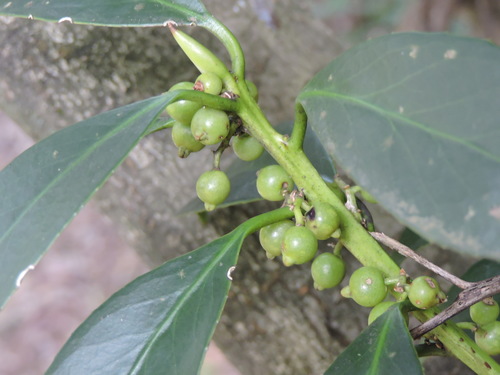
The fruit, which is about 8mm in diameter, is edible when cooked and is used in jams, jellies, and sauces.
Where to Find It
It grows in warm temperate zones. It grows in the Himalayas from 1,000 - 2,600 m altitude. It suits hardiness zones 7-9. In Sichuan and Yunnan.
Asia, Australia, Bhutan, China, Himalayas, India, Indochina, Japan, Korea, Laos, Myanmar, Nepal, North America, Pakistan, SE Asia, Taiwan, Tibet, Vietnam,
How to Identify
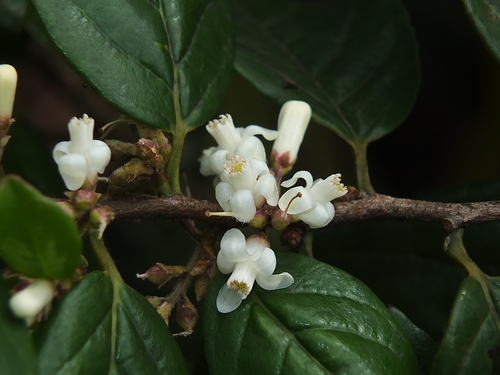
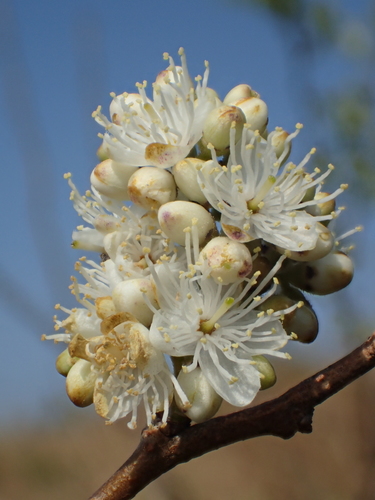
A shrub which loses its leaves. It grows 4.5 m high and spreads 4.5 m wide. The leaves are oval and slightly hairy. The leaves are small and have very fine teeth. The flowers are white and have a scent. They occur in clusters. The fruit are round blue berries.
How to Grow
Propagation: Sow seed in a cold frame as soon as it is ripe. Stored seed requires stratification and is best sown in a cold frame in late winter; germination can take up to 12 months. Prick out seedlings into individual pots when large enough to handle and grow on in the cold frame through their first winter. Plant out in late spring or early summer. Cuttings of half-ripe wood, 7–10cm with a heel, can be taken in July or August and placed in individual pots in a cold frame; roots form in about 4 weeks with a good success rate.
Medicinal Uses
The bark is astringent, cooling, and tonic. It is used in the treatment of menorrhagia, bowel complaints, eye diseases, and ulcers. It can also be used as a gargle to firm up spongy and bleeding gums. The juice of the bark is applied externally to sprains and muscular swellings.
Other Uses
A yellow or red dye is obtained from the leaves and bark. While no specific information is available for this species, many plants in the Symplocos genus contain alum and can be used as mordants in dyeing. The wood is white, soft to moderately hard, close-grained, and prone to twisting and splitting during seasoning; it has possible use in turnery.
Wikipedia
Source ↗Symplocos paniculata, called Asiatic sweetleaf or sapphire-berry, is a species of tree in the family Symplocaceae. It is native to all of eastern Asia and was introduced to the United States in around 1871. It is a tree reaching 12 m (39 ft) in favorable conditions, though it is often more shrub-like, and is used as an ornamental due to its visually striking blue fruit from which it derives its common name.
Other Information
It is a cultivated food plant.
Notes
There are over 250 Symplocos species.
Names & Synonyms
Baitan, Dung chum-tutan, Lodhra, Ludh, Lodar, Lodh, Lodra, Dieng-iong, Sawa-futagi
References (10)
- Ambasta, S.P. (Ed.), 2000, The Useful Plants of India. CSIR India. p 611
- Ann. Mus. Bot. Lugduno-Batavum 3:102. 1867
- Cundall, P., (ed.), 2004, Gardening Australia: flora: the gardener's bible. ABC Books. p 1386
- Facciola, S., 1998, Cornucopia 2: a Source Book of Edible Plants. Kampong Publications, p 240 (As Symplocos chinensis)
- Flora of Pakistan. www.eFloras.org
- Heywood, V.H., Brummitt, R.K., Culham, A., and Seberg, O., 2007, Flowering Plant Families of the World. Royal Botanical Gardens, Kew. p 314
- Hu, Shiu-ying, 2005, Food Plants of China. The Chinese University Press. p 625
- Mukhia, P.K., et al, 2013, Wild plants as Non Wood Forest Products used by the rural community of Dagana, a southern foothill district of Bhutan, SAARC Journal, 27 pages
- Plants for a Future database, The Field, Penpol, Lostwithiel, Cornwall, PL22 0NG, UK. http://www.scs.leeds.ac.uk/pfaf/ (Also as Symplocos crataegoides)
- Valder, P., 1999, The Garden Plants of China. Florilegium. p 333