Tagetes patula
L.
Sweet scented Marigold

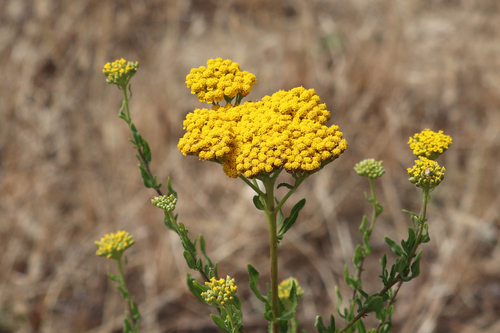
(c) brianmdub, some rights reserved (CC BY-NC)
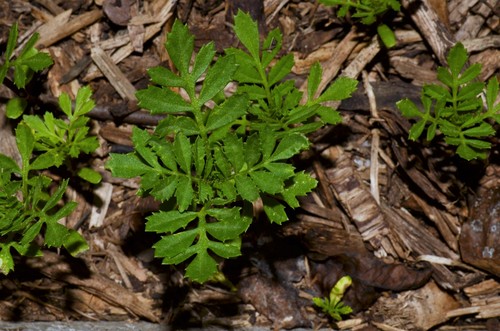
(c) J. Richard Abbott, some rights reserved (CC BY-NC), uploaded by J. Richard Abbott

(c) Kim Brown, some rights reserved (CC BY-NC), uploaded by Kim Brown
What to Eat
Edible parts: Leaves - spice, Flowers - tea, Root, Seed
The flowers are used in refreshing drinks, and the leaves are used as a food flavouring. The essential oil serves as a food flavouring, though it is considered inferior to the oil from T. minuta. Dried flowers are used as an adulterant of saffron (Crocus sativus) to colour foods yellow.
Where to Find It
A tropical plant. It suits hardiness zones 11-12.
Africa, Asia, Australia, Caribbean, Caucasus, Central Africa, Central America, China, Congo, Gabon, Georgia, Guatemala*, Hawaii, India, Korea, Mexico*, Myanmar, New Zealand, Niue, North America, Pacific, SE Asia, Slovenia, USA,
How to Identify
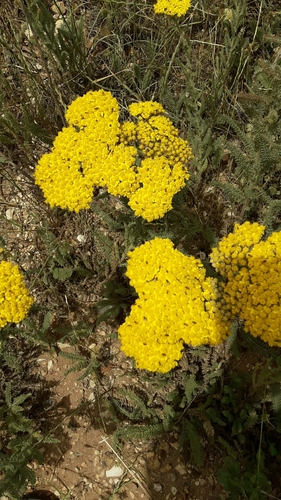
A herb. It is smaller than Tagetes erecta. It grows 20-50 cm high and spreads 15-30 cm wide. The stems are round and purple. The leaves are divided into leaflets along the stalk. The segments are sword shaped and they have narrow teeth. The flowers can have reddish-brown colours. They can occur singly or in clusters.
How to Grow
Requires a well-drained moderately fertile soil in a sunny position. Grows well in heavy clay soils and in sandy soils. A very ornamental plant, there are many named varieties. A good butterfly plant. Removing dead flowers before the seed is formed will extend the flowering season. The bruised leaves emit a refreshing pungent smell. Plants are prone to slugs, snails and botrytis. The French marigold is often used as a companion plant, especially for growing amongst tomatoes and potatoes where it helps to repel pests. See 'Other uses' below for more details. Tagetes patula (French Marigold) is self-fertile, meaning it can produce seeds from its own pollen without requiring cross-pollination. However, like many Tagetes species, it is also pollinated by insects, which can enhance seed production. This makes it a reliable seed-producing plant even when grown in isolation.
Propagation: Sow seed in March in a greenhouse, barely covering it. Germination typically occurs within 2 weeks. When seedlings are large enough to handle, prick them out into individual pots and plant outside after the last expected frosts.
Medicinal Uses
The whole herb is aromatic, digestive, diuretic, and sedative. It is taken internally to treat indigestion, colic, severe constipation, coughs, and dysentery. External uses include treatment of sore eyes and rheumatism. Leaves can be harvested fresh as needed during the growing season, or the flowering plant may be dried and stored for later use.
Other Uses
Secretions from the roots of growing plants have an insecticidal effect on the soil against nematodes and keeled slugs, developing about 3–4 months after sowing. The whole plant is harvested in flower and distilled for its essential oil, which is used in perfumery — blended with sandalwood oil to produce the perfume known as 'attar genda'. Approximately 35 kilos of oil can be extracted from 1 hectare of the plant, which yields around 2,500 kilos of flowers and 25,000 kilos of herbage. The whole plant contains substances toxic to cockroaches. Growing the plant near tomatoes repels whitefly. A yellow dye obtained from the flowers is used to colour foods and textiles, and the flowers are sometimes used as an adulterant of saffron.
Wikipedia
Source ↗Tagetes patula, the French marigold, is a species of flowering plant in the family Asteraceae, native to Mexico and Guatemala with several naturalised populations in many other countries. It is widely cultivated as an easily grown bedding plant with hundreds of cultivars, which often have bright yellow to orange flowers. Some authorities regard Tagetes patula as a synonym of Tagetes erecta, the Mexican marigold.
Notes
There are about 50 Tagetes species.
Names & Synonyms
French marigold, Genda, Gendu, Guljaphini, Imeretian saffron, Kongquecao, Machamul, Peacock plant, Rjavkasta žametnica, Sweet Mace, Taugla
References (19)
- Ambasta, S.P. (Ed.), 2000, The Useful Plants of India. CSIR India. p 617
- Benvenuti, S. & Mazzoncini, M., 2021, The Biodiversity of Edible Flowers: Discovering New Tastes and New Health Benefits. Frontiers in Plant Science Article 569499.
- Bremness, L., 1994, Herbs. Collins Eyewitness Handbooks. Harper Collins. p 272
- Bussman, R. W., et al, 2016, A comparative ethnobotany of Khevsureti, Samtskhe-Javakheti, Tusheti, Svaneti, and Racha-Lechkhumi, Republic of Georgia (Sakartvelo), Caucasus. Journal of Ethnobiology and Ethnomedicine (2016) 12:4
- Bussman, R. W. et al, 2017, Ethnobotany of Samtskhe-Javakheti, Sakartvelo (Republic of Georgia), Caucasus. Indian Journal of Traditional Knowledge Vol. 16(1) pp 7-24
- Bussman, R. W., et al, 2021, Unity in diversity—food plants and fungi of Sakartvelo (Republic of Georgia), Caucasus. Journal of Ethnobiology and Ethnomedicine (2021) 17:72 p 7
- Cundall, P., (ed.), 2004, Gardening Australia: flora: the gardener's bible. ABC Books. p 1397
- Facciola, S., 1998, Cornucopia 2: a Source Book of Edible Plants. Kampong Publications, p 43
- http://www.botanic-gardens-ljubljana.com/en/plants
- Kermath, B. M., et al, 2014, Food Plants in the Americas: A survey of the domesticated, cultivated and wild plants used for Human food in North, Central and South America and the Caribbean. On line draft. p 851
- Lim, T. K., Edible Medicinal and Non-Medicinal Plants Volume 7 Flowers
- Martin, F.W. & Ruberte, R.M., 1979, Edible Leaves of the Tropics. Antillian College Press, Mayaguez, Puerto Rico. p 186
- Raponda-Walker, A & Sillans, R., 1961, Les Plantes Utiles du Gabon. Editions Paul Lechevalier, Paris. p 131
- Rop, O., et al, 2012, Edible Flowers - A New Promising Source of Mineral Elements in Human Nutrition. Molecules 2012, 17, 6672-6683
- Sp. pl. 2:887. 1753
- Staples, G.W. and Herbst, D.R., 2005, A tropical Garden Flora. Bishop Museum Press, Honolulu, Hawaii. p 166
- Terra, G.J.A., 1973, Tropical Vegetables. Communication 54e Royal Tropical Institute, Amsterdam, p 77
- Valder, P., 1999, The Garden Plants of China. Florilegium. p 384
- Wiersema, J. H. & Leon, B., 2013, World Economic Plants. A Standard Reference CRC Press. 2nd Ed. p 674