Artemisia wrightii
Gray.
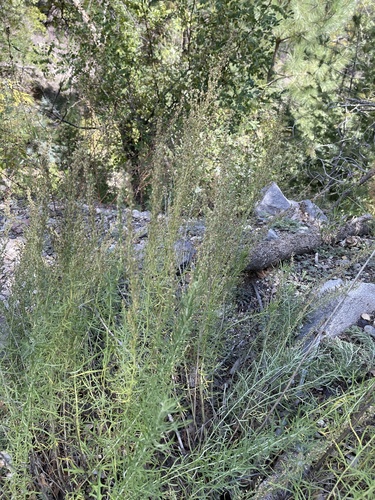
(c) CK2AZ, some rights reserved (CC BY)

(c) CK2AZ, some rights reserved (CC BY)

(c) Jason K., some rights reserved (CC BY-NC)
What to Eat
Edible parts: Leaves, Seeds
Edible Parts: Leaves Seed Edible Uses: Leaves - cooked. Seed - raw or cooked. An oily texture. The seed is very small and fiddly to use.
Known Hazards
Where to Find It
It is a temperate plant.
North America, USA,
How to Identify
Perennial hermaphrodite wind-pollinated species. Tolerates light sandy to medium loamy, well-drained soils in mildly acid to basic conditions. Grows in semi-shade or full sun; adapts to dry or moist soil with good drought tolerance.
How to Grow
We have very little information on this species and do not know if it will be hardy in Britain, though judging by its native range it should succeed outdoors in many parts of this country. The following notes are based on the general needs of the genus. Easily grown in a well-drained circumneutral or slightly alkaline loamy soil, preferring a sunny position. Established plants are drought tolerant. Plants are longer lived, more hardy and more aromatic when they are grown in a poor dry soil. Members of this genus are rarely if ever troubled by browsing deer.
Propagation: Seed - surface sow from late winter to early summer in a greenhouse, making sure that the compost does not dry out. When large enough to handle, prick the seedlings out into individual pots and grow them on in the greenhouse for their first winter. Plant out in late spring or early summer. Division in spring or autumn. Basal cuttings in late spring. Harvest the young shoots when about 10 - 15cm long, pot up in a lightly shaded position in a greenhouse or cold frame and plant them out when well rooted. Very easy.
Medicinal Uses
None known
Other Uses
None known Special Uses
Wikipedia
Source ↗Perennial hermaphrodite wind-pollinated species. Tolerates light sandy to medium loamy, well-drained soils in mildly acid to basic conditions. Grows in semi-shade or full sun; adapts to dry or moist soil with good drought tolerance.
Notes
There are about 300 Artemisia species.
References (4)
- Beckstrom-Sternberg, Stephen M., and James A. Duke. "The Foodplant Database." http://probe.nalusda.gov:8300/cgi-bin/browse/foodplantdb.(ACEDB version 4.0 - data version July 1994)
- Bircher, A. G. & Bircher, W. H., 2000, Encyclopedia of Fruit Trees and Edible Flowering Plants in Egypt and the Subtropics. AUC Press. p 42
- Plants for a Future database, The Field, Penpol, Lostwithiel, Cornwall, PL22 0NG, UK. http://www.scs.leeds.ac.uk/pfaf/
- Trendafilova, A., et al, 2020, Research Advances on Health Effects of Edible Artemisia Species and Some Sesquiterpene Lactones Constituents. Foods 2021, 10, 65. p 5