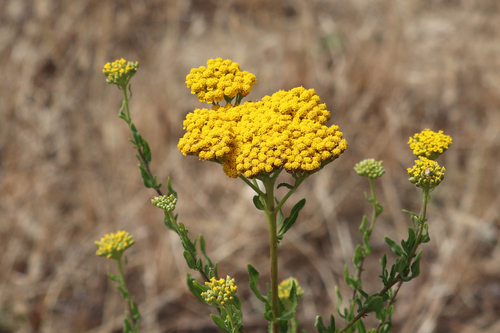
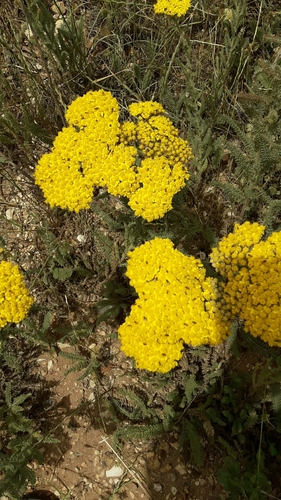
Parapolydora fastigiata
(Oliv. et Hiern.) H. Rob.

(c) Troos van der Merwe, some rights reserved (CC BY-NC), uploaded by Troos van der Merwe

(c) Michael Schrenk, some rights reserved (CC BY-NC), uploaded by Michael Schrenk
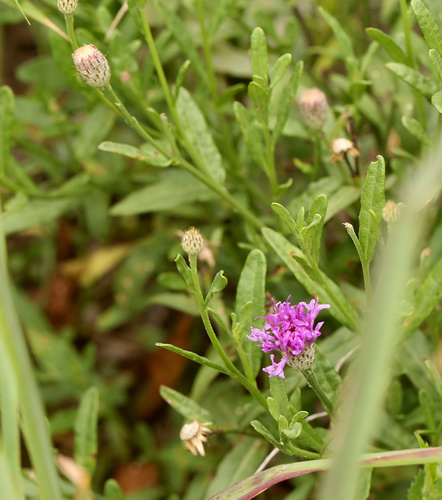
(c) Wynand Uys, some rights reserved (CC BY), uploaded by Wynand Uys
What to Eat
Edible parts: Leaves
The young leaves are cooked and eaten as a potherb and are also added to soups.
Where to Find It
A subtropical plant. In Swaziland it is in the low veld only. It grows in hot arid places. It grows between 3-1,800 m above sea level. It grows in well-drained soils. It can grow in arid places.
Africa, Botswana, East Africa, Eswatini, Malawi, Mozambique, Namibia, South Africa, Southern Africa, Swaziland, Worldwide, Zimbabwe,
How to Identify
A herb. It grows each year from seed. It has slender branches. These are spreading and slightly woody. It can grow up to about 1 m high. The leaves narrow towards the base. The tip is pointed. There are a few teeth along the edge. The lower leaves are sword shaped. They are 5 cm long by 1 cm wide. The upper leaves are more narrow. The flower heads are on slender stalks. They are purple.
Names & Synonyms
Lehlanye, Vitola
References (15)
- Fox, F. W. & Young, M. E. N., 1982, Food from the Veld. Delta Books. p 127 (As Vernonia fastigiata)
- Grivetti, L. E., 1980, Agricultural development: present and potential role of edible wild plants. Part 2: Sub-Saharan Africa, Report to the Department of State Agency for International Development. p 75 (As Vernonia fastigiata)
- Jardin, C., 1970, List of Foods Used In Africa, FAO Nutrition Information Document Series No 2.p 109 (As Vernonia fastigiata)
- Long, C., 2005, Swaziland's Flora - siSwati names and Uses http://www.sntc.org.sz/flora/ (As Vernonia fastigiata)
- Martin, F.W. & Ruberte, R.M., 1979, Edible Leaves of the Tropics. Antillian College Press, Mayaguez, Puerto Rico. p 186 (As Vernonia fastigiata)
- Matlhare, T., et al, Vegetables in Botswana. p 21 Bioversity website. (As Vernonia fastigiata)
- D. Oliver, Fl. trop. Afr. 3:282. 1877 (As Vernonia fastigiata)
- Peters, C. R., O'Brien, E. M., and Drummond, R.B., 1992, Edible Wild plants of Sub-saharan Africa. Kew. p 93 (As Vernonia fastigiata)
- Quin, 1959, (As Vernonia fastigiata)
- Royal Botanic Gardens, Kew (1999). Survey of Economic Plants for Arid and Semi-Arid Lands (SEPASAL) database. Published on the Internet; http://www.rbgkew.org.uk/ceb/sepasal/internet [Accessed 14th April 2011] (As Vernonia fastigiata)
- Ruiters-Welcome, A. K., 2019, Food plants of southern Africa. Ph.D. thesis. Univ. of Johannesburg p 36
- Swaziland's Flora Database http://www.sntc.org.sz/flora (As Vernonia fastigiata)
- Terra, G.J.A., 1973, Tropical Vegetables. Communication 54e Royal Tropical Institute, Amsterdam, p 80 (As Vernonia fastigiata)
- Welcome, A. K. & Van Wyk, B.-E., 2019, An inventory and analysis of the food plants of southern Africa. South African Journal of Botany 122 (2019) 136–179
- World Checklist of Useful Plant Species 2020. Royal Botanic Gardens, Kew