Walleria nutans
J. Kirk

(c) Bart Wursten, some rights reserved (CC BY-NC), uploaded by Bart Wursten
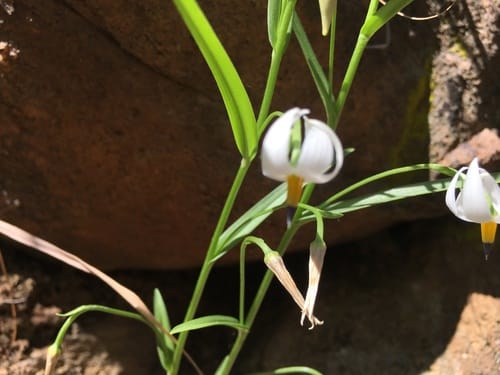
(c) David Hoare, some rights reserved (CC BY-NC-SA)
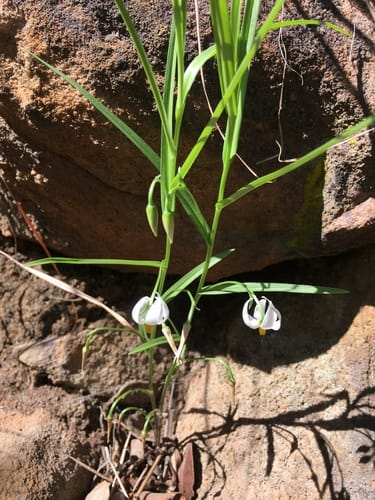
(c) David Hoare, some rights reserved (CC BY-NC-SA)
What to Eat
Edible parts: Bulbs, Tuber, Root
The tubers are eaten raw, cooked in other food preparations, or roasted. It is an important food in some areas.
Where to Find It
It is a subtropical plant. It grows in hot arid places with a marked dry season. In grows in well drained sandy loams. It grows between 950-1,700 m above sea level. It can re-grow after fire. It can grow in arid places.
Africa, Angola, Botswana, Central Africa, East Africa, Namibia, South Africa, Southern Africa, Zambia, Zimbabwe,
How to Identify
A herb with a corm or bulb. It grows 30 cm high. There are 1-5 tubers and they are 2-3 cm across. They occur up to 20 cm below the ground. The leaves occur along the stem. They become larger and closer together up the stem. They are narrow and 7-17 cm long by 1 cm wide.
Nutrition Score: 46/100
| Part | Moisture | kJ | kcal | Protein | Vit A | Vit C | Iron | Zinc |
|---|---|---|---|---|---|---|---|---|
| Bulb | 63.8 | 582 | 139 | 1.7 | — | 19.8 | 2.2 | 0.3 |
Wikipedia
Source ↗Walleria nutans is a perennial flowering plant belonging to the genus Walleria. The species is native to Angola, Botswana, Malawi, Mozambique, South Africa and Zambia.
Production
The tubers can be stored for 3 months. In Namibia they are available for 10 months.
Other Information
It is an important food in some areas.
Names & Synonyms
Dchun
References (13)
- Fox, F. W. & Young, M. E. N., 1982, Food from the Veld. Delta Books. p 256, 349
- Jardin, C., 1970, List of Foods Used In Africa, FAO Nutrition Information Document Series No 2.p 111 (As Walleria sp.)
- Lee, 1979,
- Maguire, 1978
- Marshall, 1976,
- Peters, 1990,
- Peters, C. R., O'Brien, E. M., and Drummond, R.B., 1992, Edible Wild plants of Sub-saharan Africa. Kew. p 40
- Royal Botanic Gardens, Kew (1999). Survey of Economic Plants for Arid and Semi-Arid Lands (SEPASAL) database. Published on the Internet; http://www.rbgkew.org.uk/ceb/sepasal/internet [Accessed 11th June 2011]
- Ruiters-Welcome, A. K., 2019, Food plants of southern Africa. Ph.D. thesis. Univ. of Johannesburg p 105
- Silbauer, 1965, 1972, 1981,
- Wehmeyer, A. S, 1986, Edible Wild Plants of Southern Africa. Data on the Nutrient Contents of over 300 species (As Walleria sp.)
- Welcome, A. K. & Van Wyk, B.-E., 2019, An inventory and analysis of the food plants of southern Africa. South African Journal of Botany 122 (2019) 136–179
- World Checklist of Useful Plant Species 2020. Royal Botanic Gardens, Kew


