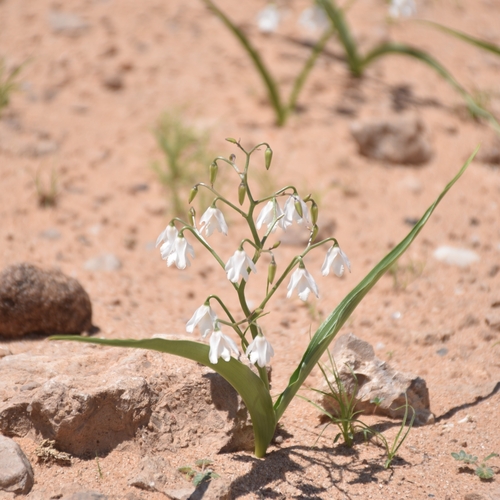
Cyanella alba
L.f.

(c) Richard Adcock, some rights reserved (CC BY-NC), uploaded by Richard Adcock

(c) Richard Adcock, some rights reserved (CC BY-NC), uploaded by Richard Adcock
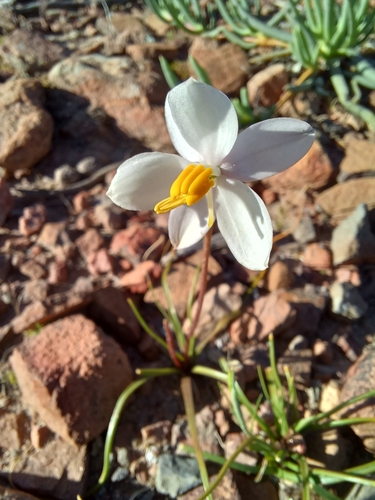
(c) Danie Palm, some rights reserved (CC BY)
What to Eat
Edible parts: Roots, Corm
The corms are eaten as a snack and cooked as a vegetable.
Where to Find It
It is a subtropical plant.
Africa, South Africa*, Southern Africa,
How to Identify
A bulb or corm plant. It grows 8-20 cm tall. The corm is 15-25 mm across. There are 10-20 leaves at the base. They are narrow and 5-10 cm long by 0.5-3 mm wide. The flowers are very close together on a long stalk. The fruit is an erect capsule 13-15 mm long by 7-8 mm wide and it has 3 lobes.
Wikipedia
Source ↗Cyanella alba, the lady's hand or toe-toe-uintjie, is a perennial flowering plant and geophyte belonging to the genus Cyanella and is part of the fynbos. The plant is endemic to the Northern Cape and the Western Cape and occurs on the Bokkeveld escarpment. The plant flowers in August, September and October.
References (2)
- Ruiters-Welcome, A. K., 2019, Food plants of southern Africa. Ph.D. thesis. Univ. of Johannesburg p 105
- Welcome, A. K. & Van Wyk, B.-E., 2019, An inventory and analysis of the food plants of southern Africa. South African Journal of Botany 122 (2019) 136–179