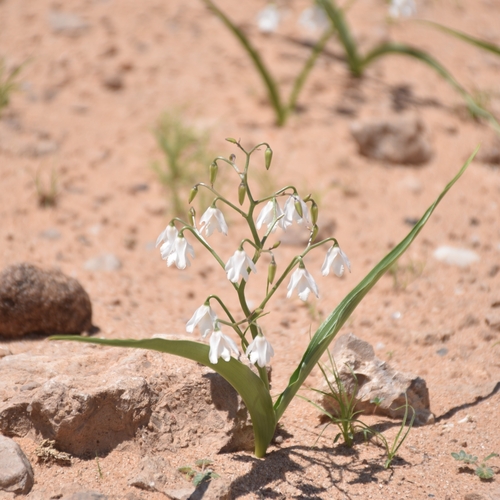
Cyanella lutea
L.f.
Five fingers, Yellow lady's hand.

(c) sqquish, some rights reserved (CC BY-NC)

(c) lucystofberg, some rights reserved (CC BY-NC)

(c) Lizelle Erasmus, some rights reserved (CC BY-NC), uploaded by Lizelle Erasmus
What to Eat
Edible parts: Root, Bulb
The bulb is edible cooked.
Where to Find It
It is a subtropical plant. It grows on clay of limestone flats.
Africa, Botswana, South Africa, Southern Africa,
How to Identify
A herb. It is a bulb or corm plant. It keeps growing from year to year. It grows 12-25 cm tall . The leaves are sword shaped. The flowers are on long spreading stalks that bend up at the end.
How to Grow
Prefers a light sandy soil. Requires a very warm sunny position in a well-drained soil, it is best grown at the foot of a south-facing wall or in a south-facing bed. Plants have deeply seated corms and are very drought resistant once established. Plants are not very frost hardy, but they can be grown outdoors in the milder areas of the country if given a good mulch. Plant the bulbs 15cm deep in autumn to flower in spring or in the spring to flower in the summer. Lift the bulbs when they die down, dry them and store in a cool place until it is time to replant. Flowers are produced in 3 - 4 years from seed.
Propagation: Sow seed thinly in autumn in a greenhouse, at a density that avoids the need to thin seedlings. Once germinated, grow seedlings in the same pot for their first year with occasional liquid feeding to prevent mineral deficiency. When dormant, pot two to three small bulbs per pot and grow on in a greenhouse until they reach flowering size, then plant out in spring after the last expected frosts. Divide offsets during dormancy; larger bulbs can go directly into permanent positions, while smaller ones are better grown on for a year in a cold frame before planting out.
Medicinal Uses
None known
Other Uses
None known
Wikipedia
Source ↗Cyanella lutea (commonly known as "Five-fingers" or "Geelraaptol") is a species of cormous herb, native to South Africa (Cape Provinces and Free State) and southern Namibia, where it grows in clay-rich or loamy soils.
Names & Synonyms
Geelreptol
References (7)
- Fox, F. W. & Young, M. E. N., 1982, Food from the Veld. Delta Books. p 71, 349
- Heywood, V.H., Brummitt, R.K., Culham, A., and Seberg, O., 2007, Flowering Plant Families of the World. Royal Botanical Gardens, Kew. p 403
- Manning, J., 2007, Field Guide to Fynbos. Struik Nature p 92
- Plants for a Future database, The Field, Penpol, Lostwithiel, Cornwall, PL22 0NG, UK. http://www.scs.leeds.ac.uk/pfaf/
- Ruiters-Welcome, A. K., 2019, Food plants of southern Africa. Ph.D. thesis. Univ. of Johannesburg p 105
- van Wyk, Be., & Gericke, N., 2007, People's plants. A Guide to Useful Plants of Southern Africa. Briza. p 84
- Welcome, A. K. & Van Wyk, B.-E., 2019, An inventory and analysis of the food plants of southern Africa. South African Journal of Botany 122 (2019) 136–179