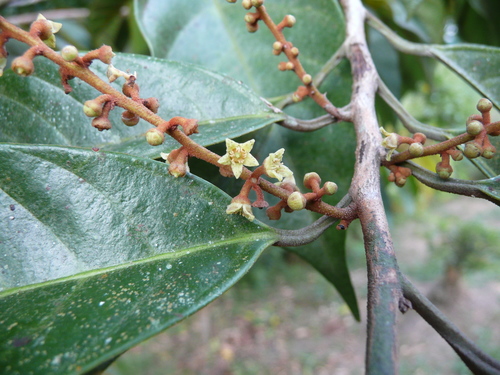
Olax acuminata
Wall. ex Benth.

Royal Botanic Garden Edinburgh
What to Eat
Edible parts: Leaves
The leaves are cooked and eaten with fish and meat, or prepared in curry.
Known Hazards
Where to Find It
A tropical and subtropical plant. It grows in the rainforest below 500 m altitude in S China. It occurs in Yunnan.
Asia, Bhutan, China, Himalayas, India, Indochina, Myanmar, Northeastern India, SE Asia,
How to Identify
A shrub. It grows 5 m tall. The branches do not have thorns. They are yellow. The leaf stalk is 3-7 mm long. The leaf blade is oblong to sword shaped and 6-10 cm long by 2.5-3.5 cm wide. It is papery. It is rounded or wedge shaped at the base and tapers to the tip. There are 9-11 veins. The flower racemes are in the axils of leaves. They are 1-1.5 cm long. There are 3-8 flowers. There are 3 yellow petals. The fruit is fleshy with a hard covering over the seed. It is oval and covered half way by the calyx. It is 1.5-1.8 cm across and orange.
How to Grow
Plants can be grown from seeds.
Notes
There are about 40 Olax species. They are tropical.
Names & Synonyms
Bol-narang, Dieng-tilut, Dieng-tyrut, Hanboka, Han-boka, Han-kanoj, Han-misang, Jian ye tie qing shu, Moen, Pachilaing, Yaolai
References (11)
- Ambasta, S.P. (Ed.), 2000, The Useful Plants of India. CSIR India. p 406
- Dobriyal, M. J. R. & Dobriyal, R., 2014, Non Wood Forest Produce an Option for Ethnic Food and Nutritional Security in India. Int. J. of Usuf. Mngt. 15(1):17-37
- Ethnobotany of Karbis. Chapter 4 in p 84
- Flora of China @ efloras.org Volume 5
- Kar, A., & Borthakur, S. K., 2008, Wild vegetables of Karbi - Anglong district, Assam, Natural Product Radiance, Vol. 7(5), pp 448-460
- Medhi, P., Sarma, A and Borthakur, S. K., 2014, Wild edible plants from the Dima Hasao district of Assam, India. Pleione 8(1): 133-148
- Phangchopi, U., et al, 2015, Diversity of wild edible plants in Marat Longri Wildlife Sanctuary, Assam. Indian Journal of Natural Products and Resources Vol. 6(4), December 2015 pp. 305-313
- Sawian, J. T., et al, 2007, Wild edible plants of Meghalaya, North-east India. Natural Product Radiance Vol. 6(5): p 419
- Schatz, G.E., 2001, Generic Tree Flora of Madagascar. Royal Botanical Gardens, Kew and Missouri Botanical Garden. p 293 (Genus)
- Singh, H.B., Arora R.K.,1978, Wild edible Plants of India. Indian Council of Agricultural Research, New Delhi. p 31
- Teron, R. & Borthakur, S. K., 2016, Edible Medicines: An Exploration of Medicinal Plants in Dietary Practices of Karbi Tribal Population of Assam, Northeast India. In Mondal, N. & Sen, J.(Ed.) Nutrition and Health among tribal populations of India. p 153