Solanum spirale
Roxb.

(c) VanLap Hoàng, some rights reserved (CC BY)
(c) djw12, some rights reserved (CC BY-NC)

(c) 刘光裕 Liu Guangyu, some rights reserved (CC BY-NC), uploaded by 刘光裕 Liu Guangyu
What to Eat
Edible parts: Leaves, Fruit, Vegetable
The ripe fruit are eaten raw, used in soups, dried for use as a spice, or made into chutney. Young leaves are cooked and eaten; leaves are sold in local markets.
Known Hazards
Where to Find It
A tropical plant. It grows on the edges of forests and by roads and tracks. In Yunnan in China it grows between 500-1900 m above sea level. In XTBG Yunnan.
Asia, Australia, China, Himalayas, India, Indochina, Laos, Myanmar, Northeastern India, SE Asia, Thailand, Vietnam,
How to Identify
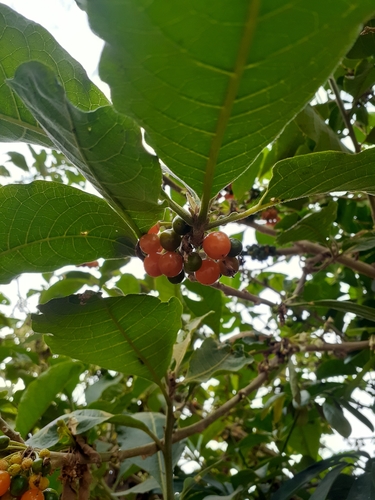
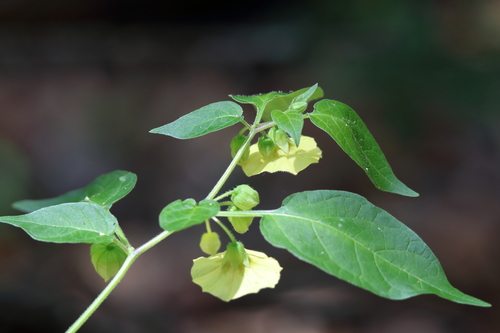
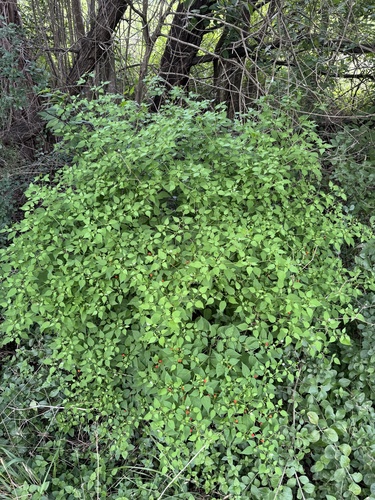
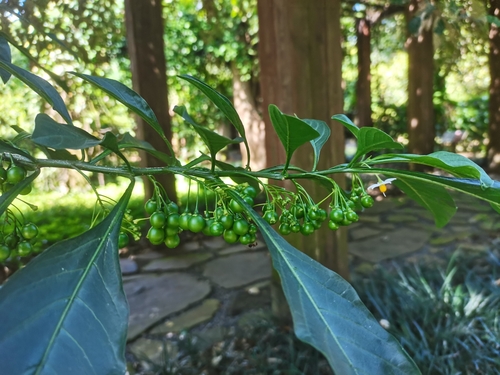
A small shrub. It grows 4 m tall. The stem is erect and has sharp ridges. The plant is green. The leaves have very small leaves near there base. The flowers are white. They are in dense spiral groups. The fruit are round and yellow when ripe.
How to Grow
Plants can be grown from seeds.
Propagation: Seed - sow in trays in a nursery. Prick out the seedlings into individual pots when they are large enough to handle and grow them on fast. Plant them out when 10cm or more tall. Cuttings of half-ripe wood. Very easy, the cuttings root within a couple of weeks.
Medicinal Uses
The roots are anaesthetic, diuretic and narcotic. The bark is broken and soaked in cold water, then used as a febrifuge for adults and infants.
Wikipedia
Source ↗Solanum spirale is a small fruiting shrub in the family Solanaceae, present in mid-elevation (500 to 1,900 m) paleotropical areas, in Southern China, India, Burma, Thailand, Laos, Vietnam, Indonesia and Australia (Queensland). It is widely cultivated in dooryard gardens in India, Thailand, and Laos and used for: food (cooked young leaves, raw or cooked berries) medicine (roots used as a narcotic and diuretic in Assam; bark macerate used as a febrifuge in Laos).
Other Information
Leaves are sold in local markets.
Notes
There are about 1400 Solanum species.
Names & Synonyms
Banga, Bangko, Chatu bili, Gai ge lei lu, Hai xi ba ha, Jihaweiniu, Jok-ho, Kaithuh, Kanarengma, Khunthai goukha, Ku liao liao ye, Loratita, Mak did, Mungas kajur, Mungaskajur, Nkabua, Oko oing, Oko-ing, Pali, Pa lie, Shengkao, Soh-jaring, Soh-jhari, Titakuchi, Tutakuchi, Yavsailpavqhaq, Yiaseibuka
References (22)
- Ambasta, S.P. (Ed.), 2000, The Useful Plants of India. CSIR India. p 582
- Cao, Y., et al, 2020, Ethnobotanical study on wild edible plants used by three trans-boundary ethnic groups in Jiangcheng County, Pu’er, Southwest China. Journal of Ethnobiology and Ethnomedicine (2020) 16:66
- Fl. ind. 2:247. 1824
- Flora of China. www.eFloras.org
- Fu, Yongneng, et al, 2003, Relocating Plants from Swidden Fallows to Gardens in Southwestern China. Economic Botany, 57(3): 389-402
- Ghorbani, A., et al, 2012, A comparison of the wild food plant use knowledge of ethnic minorities in Naban River Watershed Nature Reserve, Yunnan, SW China. Journal of Ethnobiology and Ethnomedicine; 8:17
- Hani Medicine of Xishuangbanna, 1999, p 775
- Jin, Chen et al, 1999, Ethnobotanical studies on Wild Edible Fruits in Southern Yunnan: Folk Names: Nutritional Value and Uses. Economic Botany 53(1) pp 2-14
- Kar, A., & Borthakur, S. K., 2008, Wild vegetables of Karbi - Anglong district, Assam, Natural Product Radiance, Vol. 7(5), pp 448-460
- Luczaj, L., et al, 2021, Wild food plants and fungi sold in the markets of Luang Prabang, Lao PDR. Journal of Ethnobiology and Ethnomedicine (2021) 17:6
- Lungphi, P., Wangpan, T. & Tangjang, S., 2018, Wild edible plants and their additional uses by the Tangsa community living in the Changlang district of Arunachal Pradesh, India. Pleione 12(2): 151 - 164. 2018.
- Medhi, P. & Borthakur, S. K., 2012, Phytoresources from North Cachur Hills of Assam -3: Edible plants sold at Hflong market. Indian Journal or Natural Products and Resources. 3(1) pp 84-109
- Medhi, P. & Borthakur, S. K., 2013, Wild edible plants sold by the Zeme Nagas at the makeshift market of Mahur, Dima Hasao district of Assam. Pleione 7(1): 84 - 93. 2013
- Medhi, P., Sarma, A and Borthakur, S. K., 2014, Wild edible plants from the Dima Hasao district of Assam, India. Pleione 8(1): 133-148
- Patiri, B. & Borah, A., 2007, Wild Edible Plants of Assam. Geethaki Publishers. p 92
- Salvi, J. et al, 2016, A review: Underutilized wild edible plants as a potential source of alternative nutrition. International Journal of Botany Studies. Volume 1; Issue 4; May 2016; Page No. 32-36
- Samuels, J., 2015, Biodiversity of Food Species of the Solanaceae Family: A Preliminary Taxonomic Inventory of Subfamily Solanoideae. Resources 2015, 4. 277-322
- Sawian, J. T., et al, 2007, Wild edible plants of Meghalaya, North-east India. Natural Product Radiance Vol. 6(5): p 422
- Singh, H.B., Arora R.K.,1978, Wild edible Plants of India. Indian Council of Agricultural Research, New Delhi. p 37, 78
- Taram, M., et al, 2018, Wild Food Plant Resources of Komkar Adi Tribe of Upper Siang District in Arunachal Pradesh, India. Bulletin of Arunachal Forest Research, Vol. 33(2), 27-35
- Wild edible plants of Himachal Pradesh
- Xu, You-Kai, et al, 2004, Wild Vegetable Resources and Market Survey in Xishuangbanna, Southwest China. Economic Botany. 58(4): 647-667.