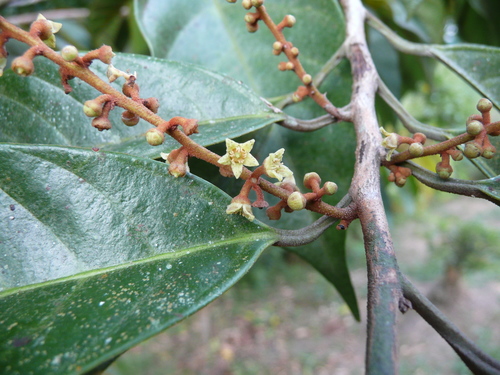
Olax nana
Wall. ex Brandis

Botanical Research Institute of Texas
What to Eat
Edible parts: Fruit, Leaves
The leaves are boiled and eaten, and are sold in local markets. The fruit are also edible.
Where to Find It
A tropical plant. It is an undershrub in the grasslands in the sub-himalayan tract up to 1,900 m altitude in Pakistan.
Asia, Himalayas, India, Indochina, Myanmar, Nepal, Northeastern India, Pakistan, SE Asia, Thailand,
How to Identify
A small shrub. It has a woody rootstock. The shoots are upright and green. They are 60 cm tall and ribbed. The leaves are sword shaped and have short stalks. The leaves are 3-6 cm long by 6-14 mm wide. The flowers occur singly in the axils of leaves and are white. The fruit are fleshy and about 8 mm across. They are yellow when ripe.
Wikipedia
Source ↗Olax nana, known as Sudiyo in Gujarat, is a species of flowering plant in the Olacaceae family. The species is a small, woody shrub found in Pakistan, India, Nepal, and Thailand.
Other Information
Leaves are sold in local markets.
Notes
There are about 40 Olax species. They are tropical.
Names & Synonyms
Himi, Merom-met, Se-may, Shigroti, Studio, Tadholi
References (4)
- Ambasta, S.P. (Ed.), 2000, The Useful Plants of India. CSIR India. p 406
- Flora of Pakistan. www.eFloras.org
- Kar, A., et al, 2013, Wild Edible Plant Resources used by the Mizos of Mizoram, India. Kathmandu University Journal of Science, Engineering and Technology. Vol. 9, No. 1, July, 2013, 106-126
- Singh, H.B., Arora R.K.,1978, Wild edible Plants of India. Indian Council of Agricultural Research, New Delhi. p 67