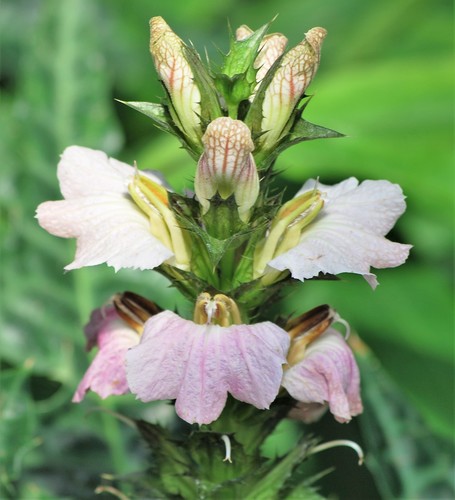
Barleria opaca
(Vahl) Nees
Child's vegetable

Marshman at English Wikipedia / Eric Guinther (via Wikimedia Commons)
What to Eat
Edible parts: Leaves, Vegetable
Leaves - cooked and eaten as a vegetable. Leaf-analysis showed carbohydrates 47%, protein 19%, ash 17% with high mineral content especially calcium, aluminium, and iron.
Where to Find It
A tropical plant. It grows as an under-shrub in West Africa. It grows in the lowlands.
Africa, Benin, Cameroon, Central Africa, Congo, Côte d'Ivoire, Gabon, Ghana, Ivory Coast, Nigeria, Sierra Leone, Togo, West Africa,
How to Identify
A straggling herb or shrub. It has a white coating. It sometimes forms roots at the nodes. The leaves are simple and opposite. They are 8 cm long by 4 cm wide. They taper at both ends. The flowers are in groups of 1-3 in the axils of leaves. The flowers are white. The fruit are spindle-shaped capsules. They are 1 cm long. There are 2 seeds.
Nutrition Score: 32/100
| Part | Moisture | kJ | kcal | Protein | Vit A | Vit C | Iron | Zinc |
|---|---|---|---|---|---|---|---|---|
| Leaves raw | 81 | 230 | 55 | 3.6 | — | — | — | 0.6 |
How to Grow
Plants can be grown from cuttings.
Medicinal Uses
The plant is used as a children’s medicine for piles, the leaves being boiled in water and the child squatting in the warm liquor. The whole plant is used in the treatment of jaundice, rheumatism and paralysis. The leaf-sap is used in the treatment of catarrh.
Wikipedia
Source ↗Barleria opaca is a shrub in the botanical family Acanthaceae.
Other Information
It is a minor vegetable.
Notes
There are over 250 Barleria species.
Names & Synonyms
Kwahu, Mu
References (13)
- Abbiw, D.K., 1990, Useful Plants of Ghana. West African uses of wild and cultivated plants. Intermediate Technology Publications and the Royal Botanic Gardens, Kew. p 41
- Bircher, A. G. & Bircher, W. H., 2000, Encyclopedia of Fruit Trees and Edible Flowering Plants in Egypt and the Subtropics. AUC Press. p 54
- Burkill, H. M., 1985, The useful plants of west tropical Africa, Vol. 3. Kew.
- Busson, 1965,
- A. L. P. P. de Candolle, Prodr. 11:230. 1847
- Dalziel, J. M., 1937, The Useful plants of west tropical Africa. Crown Agents for the Colonies London.
- FAO Corporate Document Repository. The Major Significance of 'Minor' Forest Products. Appendix 4
- Grubben, G. J. H. and Denton, O. A. (eds), 2004, Plant Resources of Tropical Africa 2. Vegetables. PROTA, Wageningen, Netherlands. p 103
- Jardin, C., 1970, List of Foods Used In Africa, FAO Nutrition Information Document Series No 2.p 58
- Martin, F.W. & Ruberte, R.M., 1979, Edible Leaves of the Tropics. Antillian College Press, Mayaguez, Puerto Rico. p 171
- Peters, C. R., O'Brien, E. M., and Drummond, R.B., 1992, Edible Wild plants of Sub-saharan Africa. Kew. p 43
- USDA, ARS, National Genetic Resources Program. Germplasm Resources Information Network - (GRIN). [Online Database] National Germplasm Resources Laboratory, Beltsville, Maryland. Available: www.ars-grin.gov/cgi-bin/npgs/html/econ.pl (10 April 2000)
- World Checklist of Useful Plant Species 2020. Royal Botanic Gardens, Kew