Withania coagulans
(Stocks) Dunal
Indian rennet, Indian cheese-maker

(c) MRN, some rights reserved (CC BY-NC), uploaded by MRN
(c) Dr. Ghulam Sarwar, some rights reserved (CC BY-NC)
What to Eat
Edible parts: Fruit - rennet, Leaves
The berries are used to coagulate milk and prepare soft cheeses, and may be eaten raw. The leaves and fruit are used for herbal drinks.
Where to Find It
It is a temperate plant. In Pakistan it grows in dry hot stony places up to 1,700 m altitude.
Afghanistan, Asia, Himalayas, India, Iran, Middle East, Nepal, Pakistan,
How to Identify
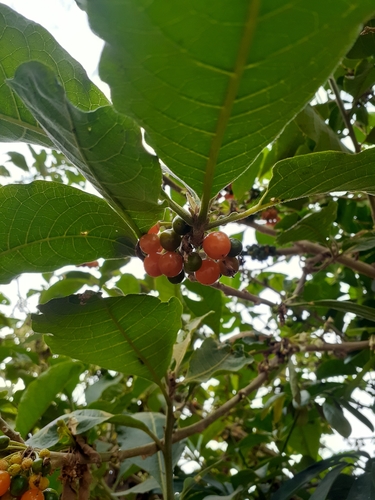
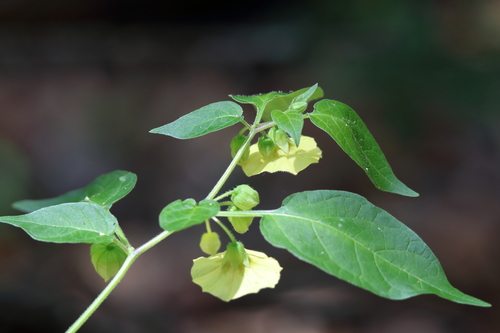
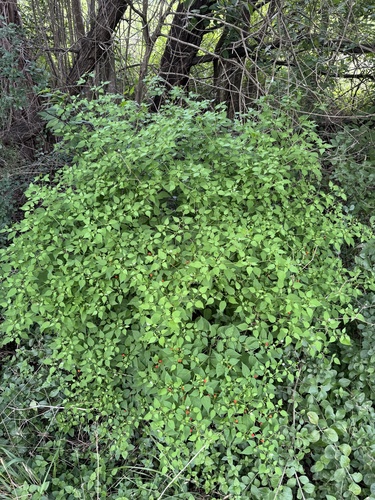
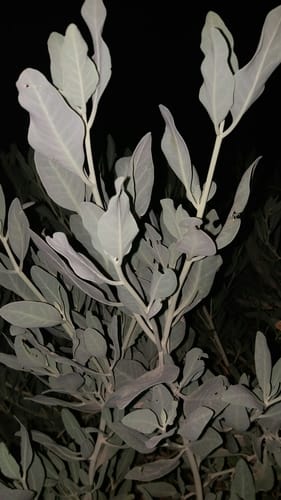
A branched shrub. It grows 1 m tall. The shoots are rigid. The leaves are 3-8 cm long by 2-4 cm wide. They are narrowly oval and wedge shaped at the base. They are leathery. The flowers have both sexes. The fruit is a round berry 10-12 mm across. It is red. The seeds are 2.5 mm wide. They are kidney shaped.
Wikipedia
Source ↗Withania coagulans ( Sanskrit: ऋष्यगंधा, Rishyagandha; Urdu: پنیر بوٹی, Paneer booti; پنیر ڈوڈا, paneer doddi; تخم حیات, tukhme hayat; Tamil: Panneer ilai chedi, Hindi: पनीर के फूल, Paneer phool, Pashto: شاپیانگا/مخازور) is a plant in the Solanaceae or nightshade family, native to Afghanistan and the Indian subcontinent. Within the genus Withania, W. somnifera (Ashwagandha) and W. coagulans (Paneer doddi/Ashutosh booti) are economically significant, and are cultivated in several regions for their use in Ayurveda. It is claimed to help control diabetes. The berries contain a rennet-like protease that can be used to clot milk for cheese production. The plant is prone to leaf spot disease caused by Alternaria alternata.
Other Information
It is sold in local markets.
Notes
There are about 10 Withania species.
Names & Synonyms
Akri, Ammukkura, Asgandhas, Asgandh nagori, Ashvagandha, Ashwgandhas, Asvagandhi, Bajja, Jangly chana, Khamjaria, Khamzora, Paneer, Panir-band, Panir, Panneru-gadda, Punir, Shapyanga, Spin
References (7)
- Ambasta, S.P. (Ed.), 2000, The Useful Plants of India. CSIR India. p 690
- A. L. P. P. de Candolle, Prodr. 13(1):685. 1852
- Flora of Pakistan. www.eFloras.org
- Khalid, N., et al, 2023, Wild food plants gathered by four cultural groups in North Waziristan, Pakistan. Genet Resour Crop Evol. 70:1243–1276
- Majeed, M., et al, 2021, Gathered Wild Food Plants among Diverse Religious Groups in Jhelum District, Punjab, Pakistan. Foods 2021, 10, 594.
- Samuels, J., 2015, Biodiversity of Food Species of the Solanaceae Family: A Preliminary Taxonomic Inventory of Subfamily Solanoideae. Resources 2015, 4. 277-322
- World Checklist of Useful Plant Species 2020. Royal Botanic Gardens, Kew