Carlina acanthifolia
All.
Acanthus-leaved thistle, Acanthus-leaved carline thistle, Stemless carlien thistle.

(c) José María Escolano, some rights reserved (CC BY-NC-SA)
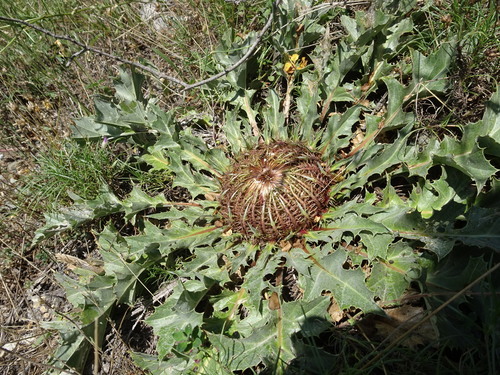
(c) Thomas Koffel, some rights reserved (CC BY), uploaded by Thomas Koffel
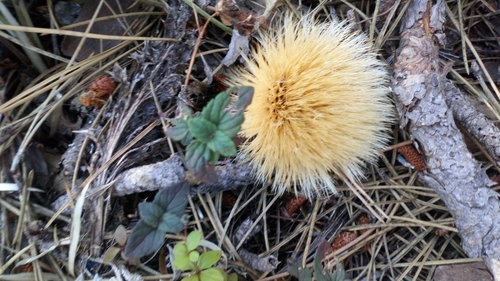
(c) Papageorgiou Nikolaos, some rights reserved (CC BY-NC), uploaded by Papageorgiou Nikolaos
What to Eat
Edible parts: Flowers
The flowering head is eaten cooked and used as a substitute for globe artichoke, though the heads are considerably smaller and even more fiddly to prepare.
Where to Find It
It is a Mediterranean climate plant. It grows in dry grassy habitats. It grows on hills and mountains. It needs well drained soil and neutral to alkaline.
Andorra, Balkans, Europe, France, Greece, Italy, Macedonia, Mediterranean, Slovenia, Spain, Switzerland,
How to Identify
A stemless thistle. It has a long taproot. It grows 10 cm high and spreads 30 cm wide. The leaves form in a ring around the plant. The leaves are oval and divided into leaflets along the stalk. There are spines at the ends. The leaves have white felt underneath. The lower leaves have stalks. The flower heads are large. They are 30-70 mm wide and have pink florets and yellowish flower bracts. In fertile soils, flowers develop stalks.
How to Grow
Succeeds in a sunny position in ordinary garden soil. Prefers an alkaline soil. Prefers a poor soil. Plants are hardy to about -15°c. A very ornamental plant. This species resents root disturbance, it should be planted into its final position as soon as possible.
Propagation: Surface sow seed in a cold frame in spring. Seed typically germinates in 4–8 weeks at 15°C. Prick seedlings out into individual pots as soon as they are large enough to handle, then plant out into permanent positions in summer. Divide in spring, though this is difficult as the plant resents root disturbance.
Medicinal Uses
No medicinal uses are known for this plant.
Other Uses
No other uses are known for this plant.
Wikipedia
Source ↗Carlina acanthifolia is a hardy perennial reaching 0.6 m tall, hardy to UK zone 5. It flowers in June with seeds ripening July to August. The plant is hermaphroditic and self-fertile, pollinated by bees and butterflies. It grows in light sandy, medium loamy, or heavy clay soils, preferring well-drained conditions and tolerating nutritionally poor soil. It has mildly acidic to basic pH tolerance, requires full sun, and adapts to dry or moist soil.
Notes
There are about 20-28 Carlina species.
Names & Synonyms
Trnatolistna kompava
References (10)
- Abbet, C., et al, 2014, Ethnobotanical survey on wild alpine food plants in Lower and Central Valais (Switzerland). Journal of Ethnopharmacology 151 (2014) 624–634
- Auctarium synops. meth. stirp. horti reg. Taurine 15. 1773 (Melanges Philos. Math. Soc. Roy. Turin 5:67. 1774)
- Bircher, A. G. & Bircher, W. H., 2000, Encyclopedia of Fruit Trees and Edible Flowering Plants in Egypt and the Subtropics. AUC Press. p 84
- Blamey, M and Grey-Wilson, C., 2005, Wild flowers of the Mediterranean. A & C Black London. p 448
- Brown, D., 2002, The Royal Horticultural Society encyclopedia of Herbs and their uses. DK Books. p 155
- Facciola, S., 1998, Cornucopia 2: a Source Book of Edible Plants. Kampong Publications, p 35
- Hedrick, U.P., 1919, (Ed.), Sturtevant's edible plants of the world. p 162
- Pieroni, A. et al, 2013, One century later: the folk botanical knowledge of the last remaining Albanians of the upper Reka Valley, Mount Korab, Western Macedonia. Journal of Ethnobiology and Ethnomedicine. 9:22
- Rigat, M et al, 2009, Ethnobotany of Food Plants in the High River Ter Valley (Pyrenees, catalonia, Iberian Peninsula): Non-Crop Food Vascular Plants and Crop Food Plants with medicinal Properties. Ecology of Food and Nutrition, 48:303-327
- Tardio, J., et al, Ethnobotanical review of wild edible plants in Spain. Botanical J. Linnean Soc. 152 (2006), 27-71