Eclipta erecta
DC.
AsteraceaeLeaves

iNaturalist · cc-by-nc
(c) Laura P., some rights reserved (CC BY-NC)
(c) Laura P., some rights reserved (CC BY-NC)

iNaturalist · cc-by-nc
(c) Laura P., some rights reserved (CC BY-NC)
(c) Laura P., some rights reserved (CC BY-NC)
iNaturalist · cc-by-nc
(c) Oliver Komar, some rights reserved (CC BY-NC)
(c) Oliver Komar, some rights reserved (CC BY-NC)
What to Eat
Edible parts: Leaves
The leaves are occasionally eaten as a pot-herb.
Where to Find It
It is a subtropical plant. In Argentina it grows below 500 m above sea level.
Argentina, Asia, Brazil, India, South America, Uruguay,
Countries: United Arab Emirates, Afghanistan, Armenia, Argentina, Azerbaijan, Bangladesh, Bahrain, Brunei, Bolivia, Brazil, Bhutan, Chile, China, Colombia, Ecuador, Georgia, French Guiana, Guyana, Indonesia, Israel, India, Iraq, Iran, Jordan, Japan, Kyrgyzstan, Cambodia, North Korea, South Korea, Kuwait, Kazakhstan, Laos, Lebanon, Sri Lanka, Myanmar, Mongolia, Maldives, Malaysia, Nepal, Oman, Peru, Philippines, Pakistan, Paraguay, Qatar, Saudi Arabia, Singapore, Suriname, Syria, Thailand, Tajikistan, Timor-Leste, Turkmenistan, Turkey, Taiwan, Uruguay, Uzbekistan, Venezuela, Vietnam, Yemen
How to Identify
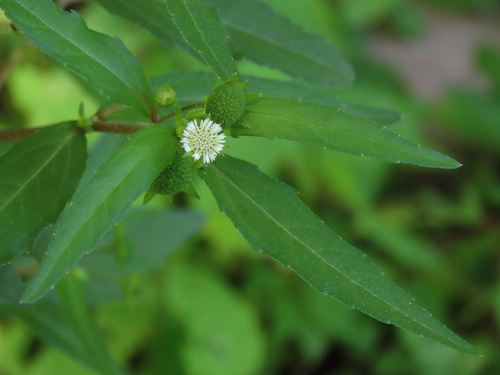
A herb. It keeps growing from year to year. It grows 20-30 cm tall. The leaves are opposite and narrowly oval. They are 2-5 cm long by 0.5-2 cm wide.
Medicinal Uses
Eclipta prostrata contains various phytochemicals, such as coumestans, polypeptides, polyacetylenes, thiophene derivatives, steroids, sterols, triterpenes, and flavonoids.
Notes
There are 4 Eclipta species. Eclipta erecta L. is a synonym of Eclipta prostrata (L.) L. - with many other synonyms; Ecliptica erecta DC. is an accepted name.
References (2)
- Hedrick, U.P., 1919, (Ed.), Sturtevant's edible plants of the world. p 285
- Mant. pl. 2:902. 1753