Cota tinctoria
L.
Golden marguerite, Yellow chamomile

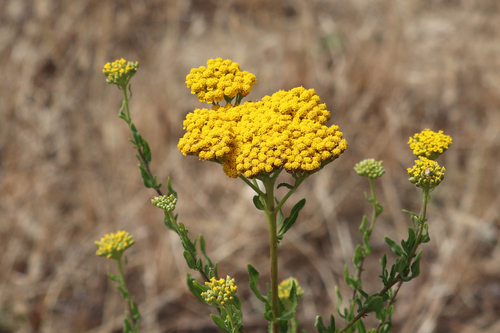
(c) grinnin, some rights reserved (CC BY-NC)

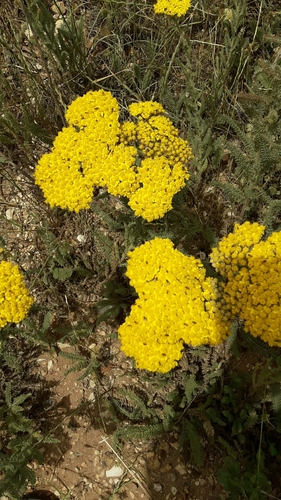
(c) Svetlana Nesterova, some rights reserved (CC BY-NC), uploaded by Svetlana Nesterova
What to Eat
Edible parts: Flowers - tea, Leaves
The golden flowers are dried and brewed as tea, and the leaves can also be consumed.
Where to Find It
A temperate plant. It can grow in most well drained soils. It does best in an open sunny position. It is frost resistant.
Asia, Australia, Estonia, Europe*, Luxembourg, Norway, Scandinavia, Slovenia, Tasmania, Turkey, Türkiye,
How to Identify
A herb that keeps growing from year to year. It grows 50 cm high and spread 50 cm wide. The stems are erect and branched and form mounds. The leaves are greyish green and finely divided. The flowers are like daisy flowers and golden yellow. There are many flowers at the top of the plant.
How to Grow
Plants are grown from seed. They can also be grown by division. They can be grown from cuttings near the base.
Medicinal Uses
The plant is rich in flavones (apigenin and luteolin) and flavonols (quercetagetin and patuletin).
Wikipedia
Source ↗Cota tinctoria, the golden marguerite, yellow chamomile, or oxeye chamomile, is a species of perennial flowering plant in the sunflower family. Other common names include dyer's chamomile, Boston daisy, and Paris daisy. In horticulture this plant is still widely referred to by its synonym Anthemis tinctoria. It is a short-lived plant often treated as biennial, native to Europe, the Mediterranean and Western Asia and naturalized in scattered locations in North America. It has aromatic, bright green, feathery foliage. The serrate leaves are bi-pinnatifid (= finely divided) and downy beneath. It grows to a height of 60 cm (24 in). It has yellow daisy-like terminal flower heads on long thin angular stems, blooming in profusion during the summer. It has no culinary or commercial uses and only limited medicinal uses. However, it produces excellent yellow, buff and golden-orange dyes, used in the past for fabrics. Cota tinctoria is grown in gardens for its bright attractive flowers and fine lacy foliage; there is a white-flowering form. Under the synonym Anthemis tinctoria, the cultivar 'E.C. Buxton' has gained the Royal Horticultural Society's Award of Garden Merit. The popular seed-raised cultivar 'Kelwayi' has 5 cm wide, yellow flowers on 65 cm plants. The species hybridizes with Tripleurospermum inodorum to form the hybrid × Tripleurocota sulfurea.
Production
Seedlings are fast growing.
Notes
The plant is rich in flavones (apigenin and luteolin) and flavonols (quercetagetin and patuletin).
Names & Synonyms
Barvilna pasja kamilica, Gul-gaseblom, Papatya, Rumaska, Sari papatya
References (11)
- Bodkin, F., 1991, Encyclopedia Botanica. Cornstalk publishing, p 88 (As Anthemis tinctoria)
- Brown, D., 2002, The Royal Horticultural Society encyclopedia of Herbs and their uses. DK Books. p 123 (As Anthemis tinctoria)
- Dogan, Y., et al, 2004, The Use of Wild Edible Plants in Western and Central Anatolia (Turkey). Economic Botany 58(4) pp. 684-690 (As Anthemis tinctoria)
- Dogan, A. & Tuzlaci, E., 2015, Wild Edible Plants of Pertek (Tunceli-Turkey). Marmara Pharmaceutical Journal 19: 126-135 (As Anthemis tinctoria)
- Ertug, F, Yenen Bitkiler. Resimli Türkiye Florası -I- Flora of Turkey - Ethnobotany supplement
- Facciola, S., 1998, Cornucopia 2: a Source Book of Edible Plants. Kampong Publications, p 33 (As Anthemis tinctoria)
- Girard, N. J., 2020, Sustainable Foraging of Wild Edible Plants in Norway. A Biocultural Approach. M. Sc. thesis Norwegian University. p 128
- Kalle, R. & Soukand, R., 2012, Historical ethnobotanical review of wild edible plants of Estonia (1770s-1960s) Acta Societatis Botanicorum Poloniae 81(4):271-281 (As Anthemis tinctoria)
- Orhan, I., et al., 2009, Antiviral activity and cytotoxicity of the lipophilic extracts of various edible plants and their fatty acids. Food Chemistry 115: 701-705 (As Anthemis tinctoria)
- Sp. pl. 2:896. 1753 (As Anthemis tinctoria)
- Tasmanian Herbarium Vascular Plants list p 3 (As Anthemis tinctoria)