Arctotheca calendula
(L.) Levyns
Cape dandelion, Capeweed
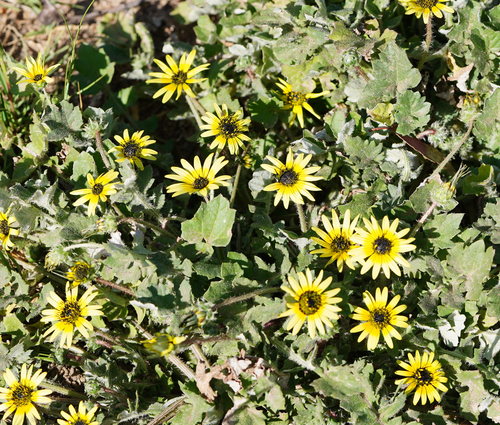
(c) Reiner Richter, some rights reserved (CC BY-NC-SA), uploaded by Reiner Richter
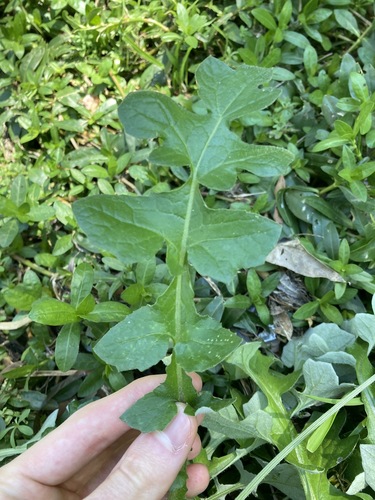
(c) Thomas Mesaglio, some rights reserved (CC BY), uploaded by Thomas Mesaglio
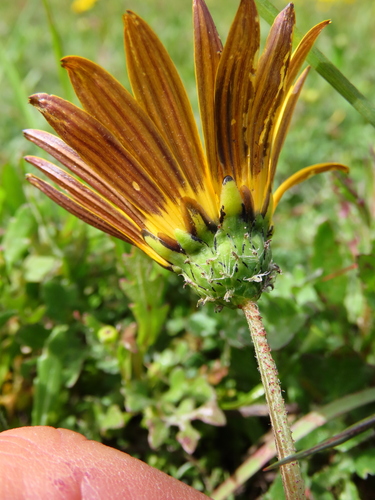
(c) Jacobus Retief, some rights reserved (CC BY-NC), uploaded by Jacobus Retief
What to Eat
Edible parts: Pollen, Root, Young leaves, Caution
The young leaves are eaten raw as a snack or cooked as a vegetable, and the pollen is used in cooking. The roots are also edible.
Where to Find It
It is a temperate or subtropical plant. In Argentina it grows from sea level to 500 m above sea level.
Africa, Argentina, Australia, Chile, Hawaii, Pacific, South Africa, Southern Africa, South America, Tasmania,
How to Identify
An annual herb. It has a short stem or no stem. It can grow 30 cm high and 80 cm wide. It has a taproot and ring of leaves at the base. The leaves are 5-25 cm long and 2-6 cm wide. The leaf stalks are 6 cm long. They clasp the stem. The leaves are spear shaped and backward pointing. They have deep lobes and are felted underneath. The flower head is 1.5 cm across and yellow.
Wikipedia
Source ↗Arctotheca calendula is a plant in the sunflower family commonly known as capeweed, plain treasureflower, cape dandelion, or cape marigold because it occurs in the Western Cape Province in South Africa. It has a wide distribution in coastal areas of South Africa, extending from Namaqualand to Cape Point and as far as KwaZulu-Natal.
Other Information
Probably only a very minor edible plant.
Notes
Arctotheca calendula (L.) Levyns
Names & Synonyms
References (9)
- Facciola, S., 1998, Cornucopia 2: a Source Book of Edible Plants. Kampong Publications, p 33
- http://permaculture.org.au/resources/pw-edible-weeds-and-foraging-around-perth.pdf
- Kunkel,
- J. S. African Bot. 8:284. 1942 (As Arctotheca calendula (L.) Levyns)
- Peters, C. R., O'Brien, E. M., and Drummond, R.B., 1992, Edible Wild plants of Sub-saharan Africa. Kew. p 87 - eaten by baboons.
- Ruiters-Welcome, A. K., 2019, Food plants of southern Africa. Ph.D. thesis. Univ. of Johannesburg p 32
- Tasmanian Herbarium Vascular Plants list p 3 (Arctotheca calendula ?)
- Welcome, A. K. & Van Wyk, B.-E., 2019, An inventory and analysis of the food plants of southern Africa. South African Journal of Botany 122 (2019) 136–179
- Youngblood, D., 2004, Identification and Quantification of Edible Plant Foods in the Upper (Nama) Karoo, South Africa. Economic Botany 58 (Supplement) :S43-S65