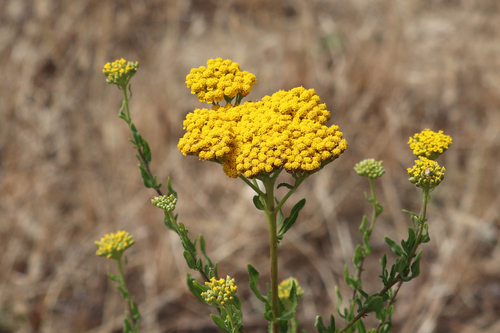
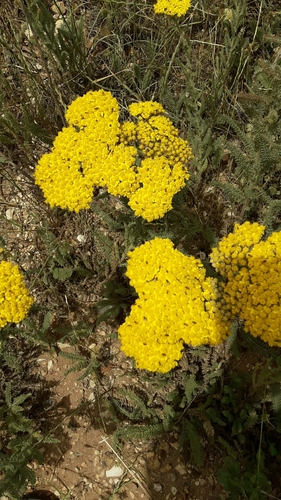
Blumea lanceolaria
(Roxb.) Druce
Lanceleaf blumea
(c) johntsai365, some rights reserved (CC BY-NC)

(c) JODY HSIEH, some rights reserved (CC BY-NC), uploaded by JODY HSIEH

(c) Dinesh Valke, some rights reserved (CC BY-SA)
What to Eat
Edible parts: Leaves, Spice, Roots
The leaves are boiled and eaten, and used to flavor fish. The roots are also edible.
Where to Find It
A tropical plant. It grows in the central mountains in Malaysia. In southern China it grows in forests, on grassy slopes and along rivers between 400-1,500 m above sea level. In Yunnan.
Asia, Bhutan, China, Himalayas, India, Indochina, Indonesia, Japan, Malaysia, Myanmar, Northeastern India, Pakistan, Philippines, SE Asia, Sri Lanka, Taiwan, Thailand, Vietnam,
How to Identify
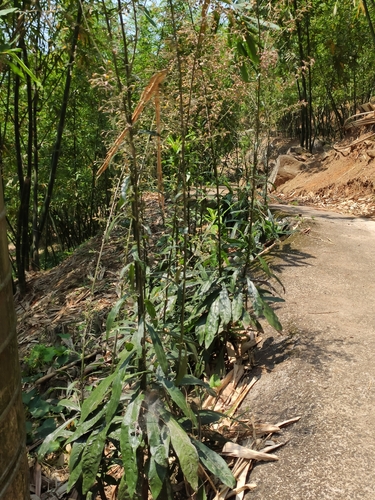
A tall herb. It takes 2 years to complete its life cycle. It can keep growing from year to year. It can be 3 m or more tall. The stems are woody at the base and have lines along them. The leaves are narrowly oblong and 20-30 cm long by 4-8 cm wide.
Nutrition Score: 18/100
| Part | Moisture | kJ | kcal | Protein | Vit A | Vit C | Iron | Zinc |
|---|---|---|---|---|---|---|---|---|
| Leaves | 91.7 | 63 | 15 | 2.2 | — | 4 | — | — |
How to Grow
A highly variable plant.
Medicinal Uses
The leaves are used as a spice.
Other Information
It is cultivated.
Names & Synonyms
Bualze, Buar-ze, Chapa, Kepijit, Lanceolated buffalo ear
References (15)
- Bircher, A. G. & Bircher, W. H., 2000, Encyclopedia of Fruit Trees and Edible Flowering Plants in Egypt and the Subtropics. AUC Press. p 60 (As Blumea myriocephala)
- Bot. Soc. Exch. Club Brit. Isles 4:609. 1917
- Burkill, I.H., 1966, A Dictionary of the Economic Products of the Malay Peninsula. Ministry of Agriculture and Cooperatives, Kuala Lumpur, Malaysia. Vol 1 (A-H) p 343 (As Blumea myriocephala)
- Guite, C., 2016, A study of wild edible plants associated with the Paite tribe of Manipur, India, International Journal of Current Research. Vol. 8, Issue, 11, pp. 40927-40932
- Kar, A., et al, 2013, Wild Edible Plant Resources used by the Mizos of Mizoram, India. Kathmandu University Journal of Science, Engineering and Technology. Vol. 9, No. 1, July, 2013, 106-126
- Martin, F.W. & Ruberte, R.M., 1979, Edible Leaves of the Tropics. Antillian College Press, Mayaguez, Puerto Rico. p 184 (As Blumea myriocephala)
- Mot So Rau Dai an Duoc O Vietnam. Wild edible Vegetables. Ha Noi 1994, p 242
- Murtem, G. & Chaudhrey, P., 2016, An ethnobotanical note on wild edible plants of Upper Eastern Himalaya, India. Brazilian Journal of Biological Sciences, 2016, v. 3, no. 5, p. 63-81
- Phangchopi, U., et al, 2015, Diversity of wild edible plants in Marat Longri Wildlife Sanctuary, Assam. Indian Journal of Natural Products and Resources Vol. 6(4), December 2015 pp. 305-313
- PROSEA handbook Volume 13 Spices. p 274
- Seal, T., et al, 2013,Evaluation of Proximate and Mineral Composition of Wild Edible Leaves, traditionally used by the Local People of Meghalaya State in India. Asian Journal of Plant Sciences 12(4): 171-175
- Seidemann J., 2005, World Spice Plants. Economic Usage, Botany, Taxonomy. Springer. p 66
- Terra, G.J.A., 1973, Tropical Vegetables. Communication 54e Royal Tropical Institute, Amsterdam, p 29 (As Blumea myriocephala)
- World Checklist of Useful Plant Species 2020. Royal Botanic Gardens, Kew
- Zeven, A. C. & de West, J. M. J., 1982, Dictionary of cultivated plants and their regions of diversity. Wageningen. p 51 (As Blumea myriocephala)