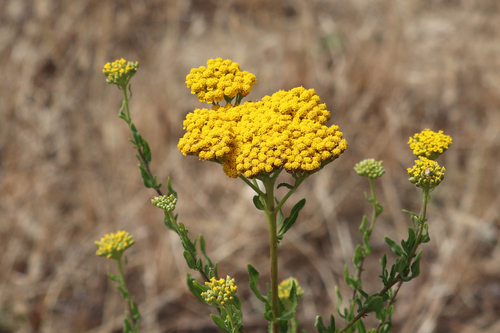
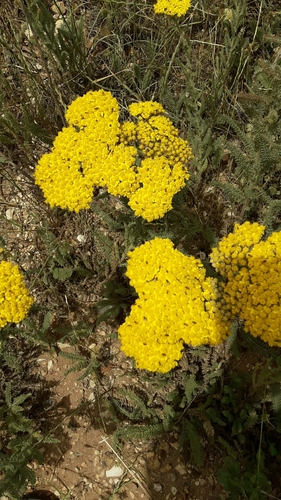
Gnaphalium polycaulon
Persoon
Many-stemmed cudweed

(c) cinclosoma, some rights reserved (CC BY-NC), uploaded by cinclosoma
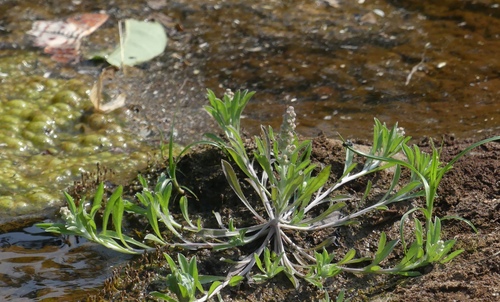
(c) Radha Veach, some rights reserved (CC BY-NC)
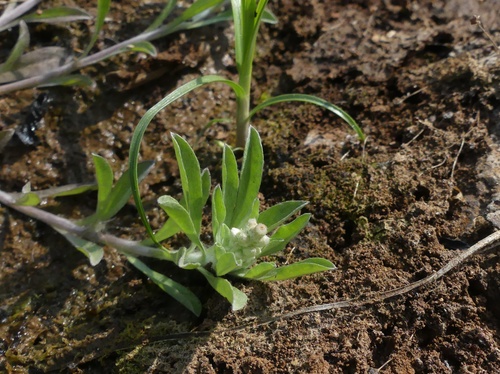
(c) Radha Veach, some rights reserved (CC BY-NC)
What to Eat
Edible parts: Leaves, Flowers
The leaves and flowers are cooked and eaten as a vegetable.
Where to Find It
It grows in tropical and subtropical places. It grows in moist sunny places. In Yunnan.
Africa, Asia, Australia, Botswana, China, Dominican Republic, Eswatini, Guyana, Haiti, India, Indochina, Japan, Laos, Northeastern India, Pakistan, SE Asia, South Africa, South America, Southern Africa, Swaziland, Thailand, Venezuela, West Indies,
How to Identify
A herb. It can be erect or lie over. It grows each year. It is 15-30 cm tall. It is branched from the base. It is covered with a white woolly covering. The leaves are narrowly oval.
Wikipedia
Source ↗Gnaphalium polycaulon, the many stem cudweed, is a plant species in the family Asteraceae. It is widespread across much of Mesoamerica, South America, and the West Indies, and naturalized in parts of Asia and Africa. Gnaphalium polycaulon is a small annual herb up to 25 cm (9.8 in) tall, with several erect to ascending branches. Stems, leaves and phyllaries are covered with a dense coat of woolly hairs, giving the plant a whitish appearance. Leaves are narrowly linear, up to 4.5 cm (1.8 in) long. Flower heads are born in tight, elongated array. Each head contains numerous florets, mostly yellowish but sometimes with purple tips
Names & Synonyms
Chandoa, Gorlalumu, Paaput, Phak kaeb
References (9)
- Dey, A. & Mukhererjee, A., 2015, Living and Survival Amidst Hunger: Wild Edible Botanicals as a Prime Forest Productivity in the Rural Purulia District, West Bengal, India from Colonial to Present. Research Journal of Forestry 9(3): 71-86
- Flora of Pakistan.
- Liu, Yi-tao, & Long, Chun-Lin, 2002, Studies on Edible Flowers Consumed by Ethnic Groups in Yunnan. Acta Botanica Yunnanica. 24(1):41-56
- Luczaj, L., et al, 2021, Wild food plants and fungi sold in the markets of Luang Prabang, Lao PDR. Journal of Ethnobiology and Ethnomedicine (2021) 17:6
- Peters, C. R., O'Brien, E. M., and Drummond, R.B., 1992, Edible Wild plants of Sub-saharan Africa. Kew. p 90
- Plants of Haiti Smithsonian Institute http://botany.si.edu
- Reddy, K. N. et al, 2007, Traditional knowledge on wild food plants in Andhra Pradesh. Indian Journal of Traditional Knowledge. Vol. 6(1): 223-229
- Scudder, 1962,
- Taram, M., et al, 2018, Wild Food Plant Resources of Komkar Adi Tribe of Upper Siang District in Arunachal Pradesh, India. Bulletin of Arunachal Forest Research, Vol. 33(2), 27-35