Tolpis capensis
(L.) Schultz.-Bip.
AsteraceaeLeaves

iNaturalist · cc-by-nc
(c) Bart Wursten, some rights reserved (CC BY-NC), uploaded by Bart Wursten
(c) Bart Wursten, some rights reserved (CC BY-NC), uploaded by Bart Wursten

iNaturalist · cc-by-nc
(c) Luc Strydom, some rights reserved (CC BY-NC)
(c) Luc Strydom, some rights reserved (CC BY-NC)
What to Eat
Edible parts: Leaves
The leaves are cooked and eaten as a spinach.
Where to Find It
It is a tropical plant. It can grow in arid places.
Africa, Angola, Burundi, Central Africa, Congo, East Africa, Eswatini, Kenya, Lesotho, Madagascar, Malawi, Mozambique, Rwanda, South Africa, Southern Africa, Sudan, Swaziland, Tanzania, Uganda, Zambia, Zimbabwe,
Countries: Angola, Burkina Faso, Burundi, Benin, Botswana, Congo (DRC), Central African Republic, Congo (Republic), Cote d'Ivoire, Cameroon, Cape Verde, Djibouti, Algeria, Egypt, Eritrea, Ethiopia, Gabon, Ghana, Gambia, Guinea, Equatorial Guinea, Guinea-Bissau, Kenya, Comoros, Liberia, Lesotho, Libya, Morocco, Madagascar, Mali, Mauritania, Mauritius, Malawi, Mozambique, Namibia, Niger, Nigeria, Rwanda, Seychelles, Sudan, Sierra Leone, Senegal, Somalia, South Sudan, Sao Tome & Principe, Eswatini, Chad, Togo, Tunisia, Tanzania, Uganda, South Africa, Zambia, Zimbabwe
How to Identify
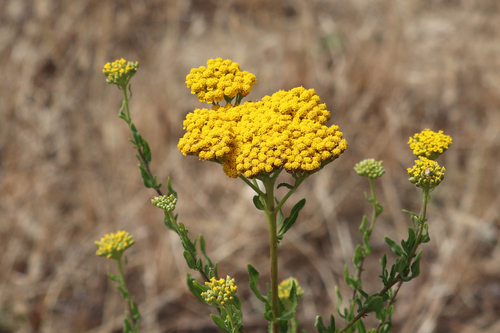
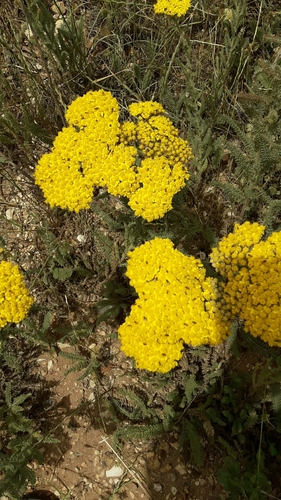
A herb. It is slightly hairy. It can keep growing from year to year. The leaves are oval and blunt. They are 3 cm long by 1.5 cm wide. The flower heads are in loose clusters. These are on a common slender stalk 30 cm long. They are yellow.
Names & Synonyms
Fukuthoane
Hieracium capensis L.
References (9)
- Fox, F. W. & Young, M. E. N., 1982, Food from the Veld. Delta Books. p 128
- Guillarmod, J., 1971,
- Long, C., 2005, Swaziland's Flora - siSwati names and Uses http://www.sntc.org.sz/flora/
- Peters, C. R., O'Brien, E. M., and Drummond, R.B., 1992, Edible Wild plants of Sub-saharan Africa. Kew. p 92
- Royal Botanic Gardens, Kew (1999). Survey of Economic Plants for Arid and Semi-Arid Lands (SEPASAL) database. Published on the Internet; http://www.rbgkew.org.uk/ceb/sepasal/internet [Accessed 14th April 2011]
- Ruiters-Welcome, A. K., 2019, Food plants of southern Africa. Ph.D. thesis. Univ. of Johannesburg p 37
- Swaziland's Flora Database http://www.sntc.org.sz/flora
- Welcome, A. K. & Van Wyk, B.-E., 2019, An inventory and analysis of the food plants of southern Africa. South African Journal of Botany 122 (2019) 136–179
- World Checklist of Useful Plant Species 2020. Royal Botanic Gardens, Kew