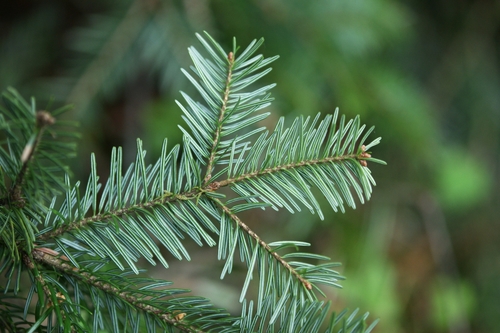
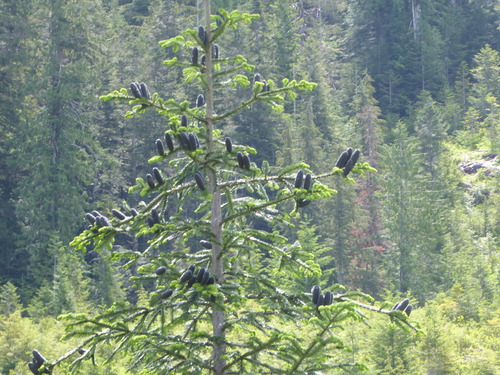
Abies fraseri
(Pursh) Poir.
Fraser fir

(c) Harold Smith, some rights reserved (CC BY), uploaded by Harold Smith

(c) David B. Gleason, some rights reserved (CC BY-SA)

(c) Douglas Goldman, some rights reserved (CC BY-SA), uploaded by Douglas Goldman
What to Eat
Edible parts: Inner bark, Gum
The following uses are based on the closely related A. balsamea; because this species also has resin blisters in the bark, they very likely apply here too. Inner bark can be cooked — it is usually dried, ground to a powder, and used as a soup thickener or mixed with cereals when making bread. It is an emergency food, used only when other options are exhausted. The aromatic resinous pitch found in bark blisters is delicious and chewy eaten raw, and an oleoresin drawn from it is used to flavour sweets, baked goods, ice cream, and drinks. Tips of young shoots can be brewed as a tea substitute.
Where to Find It
It is a temperate plant. It will grow in most soils. It is resistant to drought and frost.
Australia, Canada, Netherlands Antilles, North America, USA,
How to Identify
A shrub or small tree. It grows 5 m tall. There are prickles along the stem. The leaves are twice divided and there are 8-18 pairs of pinnae. There are up to 50 pairs of pinnules on each pinnae. The flowers are yellow. They are in large clusters at the ends of branches. The pods are flattened.
How to Grow
Plants are grown from seed.
Propagation: Sow seed in early February in a greenhouse, or outdoors in March. Germination is often poor, typically taking 6–8 weeks. Stratification tends to produce more even germination, so sowing in a cold frame as soon as seed is ripe in autumn is recommended. Seed remains viable for up to 5 years if stored well. Prick seedlings out into individual pots when large enough to handle and grow on for at least their first winter under cover. Plant out into permanent positions in late spring or early summer, after the last expected frosts. Sowing in an outdoor seedbed is possible where sufficient seed is available. One report recommends growing seedlings in shade at around 550 plants per square metre; another favours a sunny position. Trees often self-layer in the wild, which may offer a way of propagating named varieties in cultivation.
Medicinal Uses
The following uses are based on the closely related A. balsamea and likely apply here given the shared resin blisters. The resin is a highly effective antiseptic and healing agent used worldwide. Applied externally, it protects and heals burns, bruises, wounds, and sores, and is also used on sore nipples and is considered one of the best treatments for a sore throat. The buds, resin, and sap feature in folk remedies for cancers, corns, and warts. The resin is also antiscorbutic, diaphoretic, diuretic, stimulant, and tonic. Taken internally, it appears in proprietary preparations for coughs and diarrhoea, though excess causes a purgative effect. A warm drink of the gummy sap was used to treat gonorrhoea. A leaf tea is antiscorbutic and used for coughs, colds, and fevers; leaves and young shoots are best harvested in spring and dried for later use. Various North American Indian tribes used the resin as an antiseptic on wounds, sores, and bites, as an inhalant for headaches, and internally for colds, sore throats, and related complaints.
Other Uses
The wood is light, soft, and coarse-grained, not strong, and is only occasionally manufactured into lumber. The following uses are based on the closely related A. balsamea and likely apply here. A balsamic resin — known as Canada Balsam or Balm of Gilead depending on the source — is collected during July and August from bark blisters or by cutting pockets in the wood; one source describes it as a turpentine. It is used medicinally and in the manufacture of glues and candles, and as a cement for microscopes and slides due to its high refractive index, which resembles that of glass. Average yield is around 8–10 oz per tree. The resin also serves as a fixative in soaps and perfumes. Leaves are used as a stuffing material for pillows and similar items — they impart a pleasant scent and repel moths.
Wikipedia
Source ↗Abies fraseri is an evergreen tree growing to 15 m (49 ft) at a fast rate, hardy to UK zone 4. It retains foliage year-round, flowers in May, and ripens seeds September to October. Monoecious and wind-pollinated, it grows in light sandy, medium loamy, and heavy clay soils with mildly acid to neutral pH. It tolerates full shade, semi-shade, or open conditions and prefers moist soil, but is not wind-tolerant.
Notes
There are about 50 Abies species.
References (1)
- Grandtner, M. M., 2008, World Dictionary of Trees. Wood and Forest Science Department. Laval University, Quebec, Qc Canada. (Internet database http://www.WDT.QC.ca)