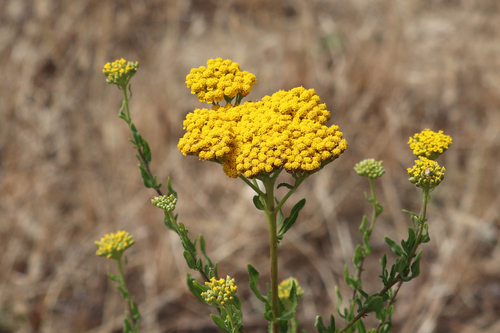
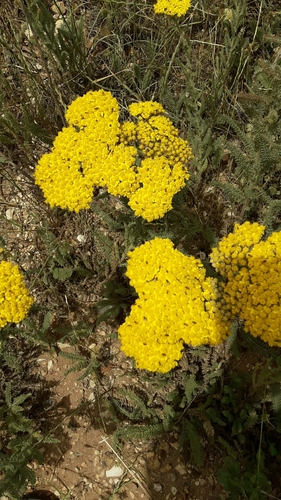
Solidago virgaurea subsp. asiatica
Kitam. ex Hara
Miyokch'wi
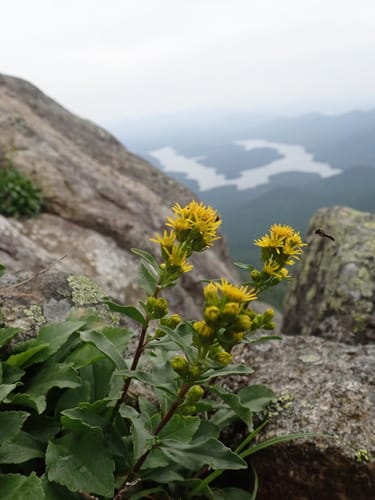
(c) Sequoia Janirella Wrens, some rights reserved (CC BY-NC)

(c) Михаил Малышев, some rights reserved (CC BY), uploaded by Михаил Малышев
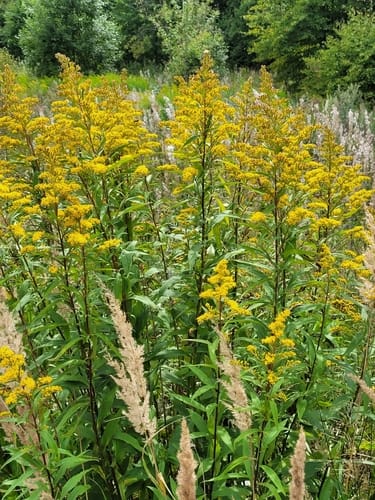
(c) Dmitriy Bochkov, some rights reserved (CC BY)
What to Eat
Edible parts: Leaves
Young leaves are cooked with seasoned vegetables.
Where to Find It
It is a temperate plant.
Asia, Balkans, Korea, Macedonia,
How to Identify
A temperate herb in the Asteraceae family, native to Asia.
Medicinal Uses
In the fifteenth and sixteenth centuries Solidago virgaurea was used in Europe to heal wounds. Its astringent, diuretic, antiseptic and other properties are well known. In various assessments by the European Medicines Agency with respect to Solidago virgaurea, non-clinical data shows diuretic, anti-inflammatory, antioxidant, analgesic and spasmolytic, antibacterial, and immunomodulatory activity. However, as no single ingredient is responsible for these effects, the whole herbal preparation of Solidago inflorescences must be considered as the active ingredient. Further, the relevance of those effects found in vitro could not be confirmed by clinical studies.
Wikipedia
Source ↗Solidago virgaurea, the European goldenrod or woundwort, is an herbaceous perennial plant of the family Asteraceae. It is widespread across most of Europe as well as North Africa and northern, central, and southwestern Asia (China, Russia, India, Turkey, Kazakhstan, etc.). It is grown as a garden flower with many different cultivars. It flowers profusely in late summer. Solidago virgaurea is a perennial herb up to 100 cm (40 inches) tall, with a branching underground caudex and a woody rhizome. It produces arrays of numerous small yellow flower heads at the top of the stem. Subspecies and varieties Solidago virgaurea subsp. alpestris (Waldst. & Kit.) Gremli Solidago virgaurea subsp. armena (Grossh.) Greuter Solidago virgaurea subsp. asiatica Kitam. ex Hara Solidago virgaurea var. calcicola Fernald Solidago virgaurea subsp. caucasica (Kem.-Nath.) Greuter Solidago virgaurea subsp. dahurica (Kitag.) Kitag. Solidago virgaurea subsp. gigantea (Nakai) Kitam. Solidago virgaurea var. insularis (Kitam.) Hara Solidago virgaurea subsp. jailarum (Juz.) Tzvelev Solidago virgaurea subsp. lapponica (With.) Tzvelev Solidago virgaurea subsp. macrorrhiza (Lange) Nyman Solidago virgaurea subsp. minuta (L.) Arcang. Solidago virgaurea subsp. stenophylla (G.E.Schultz) Tzvelev Solidago virgaurea subsp. talyschensis (Tzvelev) Sennikov Solidago virgaurea subsp. taurica (Juz.) Tzvelev Solidago virgaurea subsp. turfosa (Woronow ex Grossh.) Greuter Solidago virgaurea subsp. virgaurea Solidago virgaurea var. virgaurea
Names & Synonyms
Miyeikchwi
References (4)
- Hwang, H., et al, 2013, A Study on the Flora of 15 Islands in the Western Sea of Jeollanamdo Province, Korea. Journal of Asia-Pacific Biodiversity Vol. 6, No. 2 281-310
- Hwang, HS, et al, 2014, Distribution characteristics of plant in the Ungseokbong Mountain, Gyeongsangnam-do, Korea. Journal of Asia-Pacific Biodiversity. 7(2014) e164-e178
- Kim, H. & Song, M., 2013, Ethnobotanical analysis for traditional knowledge of wild edible plants in North Jeolla Province (Korea). Genetic. Resour. Crop Evol. (2013) 60:1571-1585
- Pemberton, R. W. & Lee, N. S., 1996, Wild Food Plants in South Korea: Market Presence, New Crops, and Exports to the United States. Economic Botany, Vol. 50, No. 1, pp. 57-70