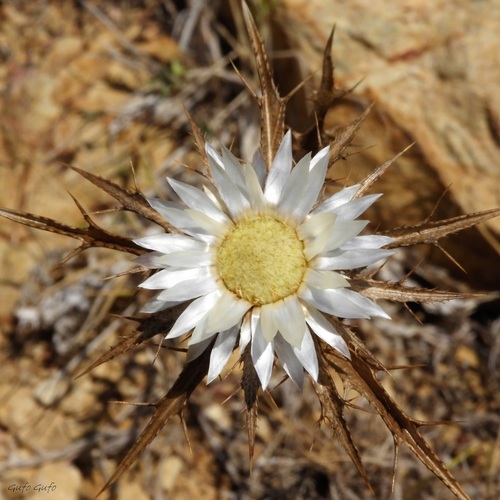
Carlina sicula
Ten.
Carlina siciliana
AsteraceaeLeaves
iNaturalist · cc-by-nc
(c) vittorio1962, some rights reserved (CC BY-NC), uploaded by vittorio1962
(c) vittorio1962, some rights reserved (CC BY-NC), uploaded by vittorio1962

iNaturalist · cc-by-nc
(c) Abdulnaser Abdulkarim, some rights reserved (CC BY-NC)
(c) Abdulnaser Abdulkarim, some rights reserved (CC BY-NC)

iNaturalist · cc-by-nc
(c) Abdulnaser Abdulkarim, some rights reserved (CC BY-NC)
(c) Abdulnaser Abdulkarim, some rights reserved (CC BY-NC)
What to Eat
Edible parts: Leaves
The leaves and stems are eaten boiled and seasoned with oil and vinegar.
Where to Find It
It is a Mediterranean climate plant.
Europe, Italy, Mediterranean, Sicily,
Countries: Andorra, Albania, Austria, Bosnia & Herzegovina, Belgium, Bulgaria, Belarus, Switzerland, Cyprus, Czechia, Germany, Denmark, Algeria, Estonia, Egypt, Spain, Finland, France, United Kingdom, Greece, Croatia, Hungary, Ireland, Israel, Iceland, Italy, Lebanon, Liechtenstein, Lithuania, Luxembourg, Latvia, Libya, Morocco, Monaco, Moldova, Montenegro, North Macedonia, Malta, Netherlands, Norway, Poland, Portugal, Romania, Serbia, Russia, Sweden, Slovenia, Slovakia, San Marino, Syria, Tunisia, Turkey, Ukraine
How to Identify
A Mediterranean thistle herb in the Asteraceae family with edible leaves and stems.
Notes
There are about 20-28 Carlina species.
Names & Synonyms
Panicaudu
References (4)
- Geraci, A., et al, 2018, The wild taxa utilized as vegetables in Sicily (Italy): a traditional component of the Mediterranean diet. Journal of Ethnobiology and Ethnomedicine (2018) 14:14
- Lentini, F. and Venza, F., 2007, Wild food plants of popular use in Sicily. J Ethnobiol Ethnomedicine. 3: 15
- Licata, M., et al, 2016, A survey of wild plant species for food use in Sicily (Italy) – results of a 3-year study in four Regional Parks. Journal of Ethnobiology and Ethnomedicine 12:12
- Pasta, S., et al, 2020, An Updated Checklist of the Sicilian Native Edible Plants: Preserving the Traditional Ecological Knowledge of Century-Old Agro-Pastoral Landscapes. Frontiers in Plant Science. Volume 11|Article 388