Athrixia phylicoides
DC.
Zulu tea, Bushman's tea

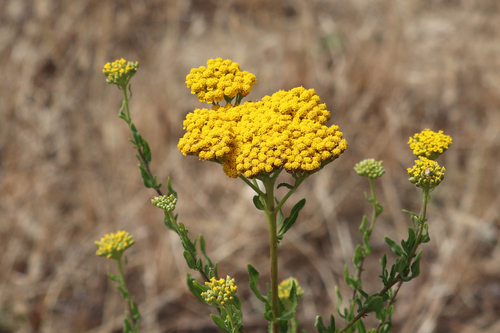
(c) Brian du Preez, some rights reserved (CC BY-SA), uploaded by Brian du Preez

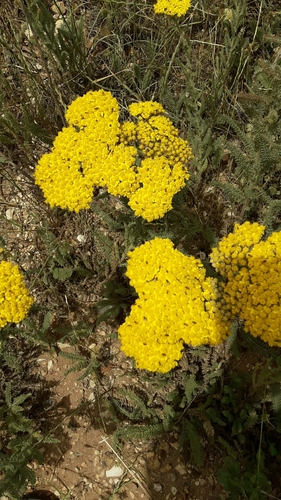
(c) Errol Douwes, some rights reserved (CC BY-NC), uploaded by Errol Douwes
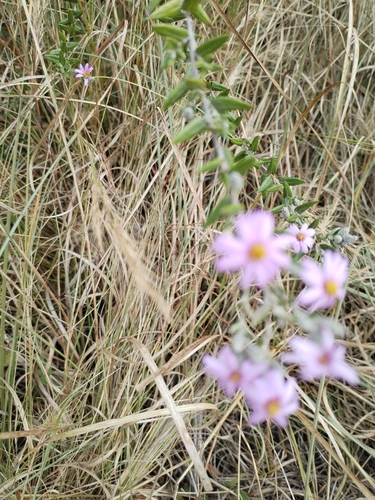
(c) jpj1960, some rights reserved (CC BY-NC)
What to Eat
Edible parts: Leaves - tea
The leaves are used to make tea.
Where to Find It
It is a subtropical plant. It grows in South Africa in grassland and forest. It can be in rocky and sloping places. It grows well in full sun. It can grow in arid places.
Africa, East Africa, Eswatini, Mozambique, South Africa, Southern Africa, Swaziland,
How to Identify
A shrub. It grows about 1 m high. The stems are leafy throughout. The leaves are dark green and fine. They are 3 cm long by 1 cm wide. They are shiny above and grey white underneath. The flowers are purple and in heads. They are towards the ends of branches.
How to Grow
It can be grown from cuttings. It can be cut back and will re-sprout.
Propagation: Seed - Cuttings.
Medicinal Uses
The plant is chewed as a treatment for sore throats and coughs. Extracts of the soaked roots and leaves are used as anthelmintics.
Other Uses
The stems are used to make hard brooms.
Names & Synonyms
Icholocholo, Itshelo, Itiye-la-bantu, Itshalo, Mothathaila, Sephomolo, Umthsanelo, Umtshanela
References (9)
- Bircher, A. G. & Bircher, W. H., 2000, Encyclopedia of Fruit Trees and Edible Flowering Plants in Egypt and the Subtropics. AUC Press. p 47
- Fox, F. W. & Young, M. E. N., 1982, Food from the Veld. Delta Books. p 119
- Plowes, N. J. & Taylor, F. W., 1997, The Processing of Indigenous Fruits and other Wildfoods of Southern Africa. in Smartt, L. & Haq. (Eds) Domestication, Production and Utilization of New Crops. ICUC p 186
- Royal Botanic Gardens, Kew (1999). Survey of Economic Plants for Arid and Semi-Arid Lands (SEPASAL) database. Published on the Internet; http://www.rbgkew.org.uk/ceb/sepasal/internet [Accessed 10th April 2011]
- Ruiters-Welcome, A. K., 2019, Food plants of southern Africa. Ph.D. thesis. Univ. of Johannesburg p 33
- van Wyk, Be., & Gericke, N., 2007, People's plants. A Guide to Useful Plants of Southern Africa. Briza. p 102
- van Wyk, B-E., 2011, The potential of South African plants in the development of new food and beverage products. South African Journal of Botany 77 (2011) 857–868
- Welcome, A. K. & Van Wyk, B.-E., 2019, An inventory and analysis of the food plants of southern Africa. South African Journal of Botany 122 (2019) 136–179
- World Checklist of Useful Plant Species 2020. Royal Botanic Gardens, Kew