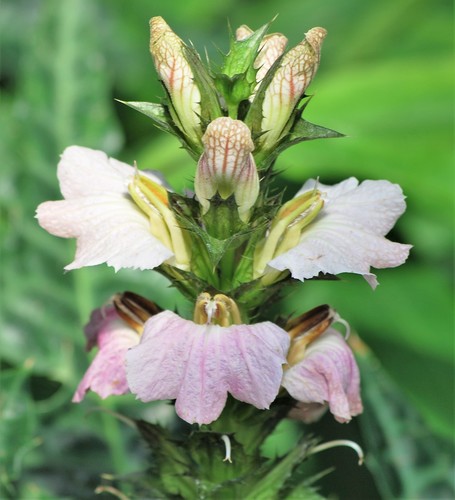
Hypoestes aristata
(Vahl) Sol. ex Roem. & Schult.
Ribbon bush
AcanthaceaeLeaves

iNaturalist · cc-by-nc
(c) Petro, some rights reserved (CC BY-NC), uploaded by Petro
(c) Petro, some rights reserved (CC BY-NC), uploaded by Petro

iNaturalist · cc-by-sa
(c) Tony Rebelo, some rights reserved (CC BY-SA), uploaded by Tony Rebelo
(c) Tony Rebelo, some rights reserved (CC BY-SA), uploaded by Tony Rebelo

iNaturalist · cc-by-sa
(c) Nicola van Berkel, some rights reserved (CC BY-SA), uploaded by Nicola van Berkel
(c) Nicola van Berkel, some rights reserved (CC BY-SA), uploaded by Nicola van Berkel
What to Eat
Edible parts: Leaves
The leaves are edible and have been used as a famine food.
Where to Find It
It is a tropical and subtropical plant. It is best in light shade.
Africa, Burkina Faso, East Africa, Eswatini, Ethiopia, Mozambique, Nigeria, Sierra Leone, South Africa, Southern Africa, Swaziland, West Africa, Zambia,
Countries: Angola, Burkina Faso, Burundi, Benin, Botswana, Congo (DRC), Central African Republic, Congo (Republic), Cote d'Ivoire, Cameroon, Cape Verde, Djibouti, Algeria, Egypt, Eritrea, Ethiopia, Gabon, Ghana, Gambia, Guinea, Equatorial Guinea, Guinea-Bissau, Kenya, Comoros, Liberia, Lesotho, Libya, Morocco, Madagascar, Mali, Mauritania, Mauritius, Malawi, Mozambique, Namibia, Niger, Nigeria, Rwanda, Seychelles, Sudan, Sierra Leone, Senegal, Somalia, South Sudan, Sao Tome & Principe, Eswatini, Chad, Togo, Tunisia, Tanzania, Uganda, South Africa, Zambia, Zimbabwe
How to Identify
A herb or shrub. The leaves are hairy and dark green. The flowers are in spikes and are tube shaped and mauve or pink. The petals curl.
How to Grow
Plants can be grown from seeds or cuttings.
Other Information
It is a famine food.
Names & Synonyms
Hamshika, Idololenkonyane-elimhlophe
Justicia aristata VahlHypoestes verticillaris (L.f.) Sol. ex Roem. & Schult.
and others
References (8)
- Fox, F. W. & Young, M. E. N., Food from the Veld. Delta Books. p 67
- https://growwild.co.za Edible Indigenous plants
- Joffe, P., 2007, Creative Gardening with Indigenous Plants. A South African Guide. Briza. p 162
- Long, C., 2005, Swaziland's Flora - siSwati names and Uses http://www.sntc.org.sz/flora/
- Lulekal, E., et al, 2011, Wild edible plants in Ethiopia: a review on their potential to combat food insecurity. Afrika Focus - Vol. 24, No 2. pp 71-121
- Ruiters-Welcome, A. K., 2019, Food plants of southern Africa. Ph.D. thesis. Univ. of Johannesburg p 5
- Welcome, A. K. & Van Wyk, B.-E., 2019, An inventory and analysis of the food plants of southern Africa. South African Journal of Botany 122 (2019) 136–179
- World Checklist of Useful Plant Species 2020. Royal Botanic Gardens, Kew