Capsicum cardenasii
Heiser & P. G. Sm.
Ulupica

(c) Stefano, some rights reserved (CC BY-NC-SA)

Caeschfloh, no known copyright restrictions (public domain)
no rights reserved
What to Eat
Edible parts: Fruit, Spice
The very small hot fruits are ground with tomato to make a dish, used in pickles, and preserved in oil and vinegar. They are sold in local markets.
Known Hazards
Where to Find It
A tropical plant. It can tolerate cool climates in mountains.
Andes, Bolivia, South America,
How to Identify
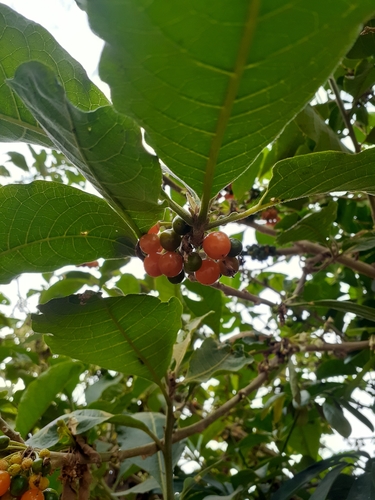
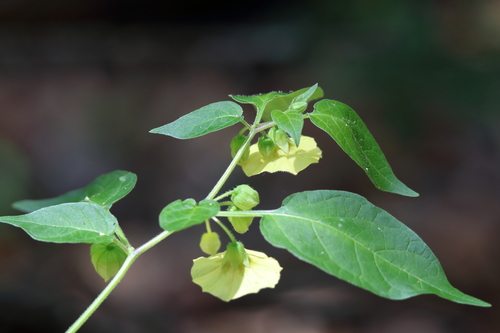
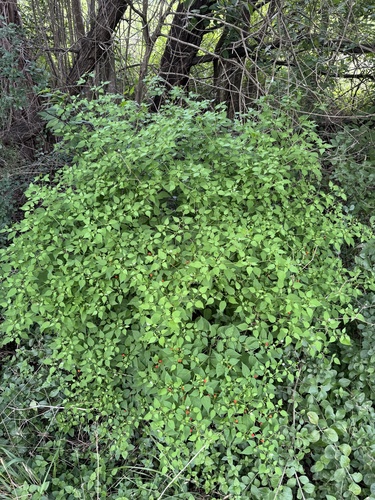
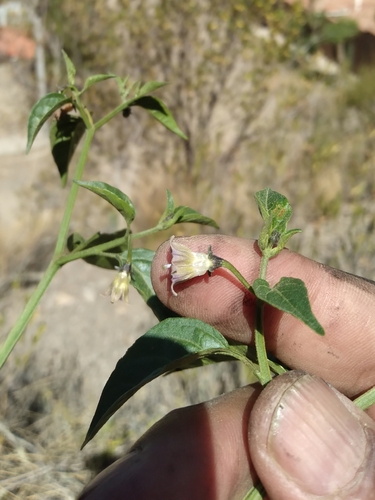
A herb that develops woody stems. It grows up to 1 m tall. The leaves are narrow and sword shaped and are softly hairy. One or two flowers develop between the nodes and hang down. The fruit are very small. They are fleshy and red.
How to Grow
A plant of moderate elevations in the tropics. Requires a very warm sunny position and a humus-rich, fertile, well-drained loam. Prefers a light sandy soil that is slightly acid. Prefers a pH in the range of 5.5 - 5.6, but tolerates 4.3 to 8.3.
Propagation: Seed - sow in a seedbed or in containers. The seed usually germinates in 3 - 4 weeks at 20°c. Plant out into permanent positions when about 8 - 10cm tall.
Medicinal Uses
Its primary use is as a spice. Many wild Capsicums exhibit disease resistance of interest to plant breeders. C. cardenasii has been shown to be resistant to tobacco mosaic virus (TMV), and there is a possibility that one day this resistance may be transferred to other capsicum species through breeding.
Wikipedia
Source ↗Capsicum cardenasii is a plant species in the genus Capsicum and the family Solanaceae. It is a diploid with 2n=2x=24. It is a member within the C. pubescens complex, a group of closely related Capsicum species. It is closely related to C. eximium. It is native to the Andes, and it can be found in Bolivia and Peru. The native name is ulupica.
Other Information
They are sold in local markets.
Notes
There are 10 Capsicum species.
References (8)
- Brittonia 10:195, fig. 1. 1958
- Facciola, S., 1998, Cornucopia 2: a Source Book of Edible Plants. Kampong Publications, p 232
- Herklots,
- Macmillan, H.F. (Revised Barlow, H.S., et al), 1991, Tropical Planting and Gardening. Sixth edition. Malayan Nature Society. Kuala Lumpur. p 376
- Samuels, J., 2015, Biodiversity of Food Species of the Solonaceae Family: A Preliminary Taxonomic Inventory of Subfamily Solanoideae. Resources 2015, 4. 277-322
- Seidemann J., 2005, World Spice Plants. Economic Usage, Botany, Taxonomy. Springer. p 83
- Wikipedia
- World Checklist of Useful Plant Species 2020. Royal Botanic Gardens, Kew