Capsicum pubescens
Ruiz & Pav.
Rocoto, Tree pepper
(c) AwadNeme, some rights reserved (CC BY-NC), uploaded by AwadNeme
(c) Rodrigo Rijalba, some rights reserved (CC BY-NC)
What to Eat
Edible parts: Fruit, Spice, Vegetable
The distinctively thick-fleshed fruits have a hot, pungent flavour and are used as a vegetable, made into sauce, or used primarily as a flavouring in cooked foods. In Peru the seeds are removed, the hollow fruit stuffed with a savoury filling, and the whole baked. The fruit can also be dried and ground into a pepper-like condiment powder.
Known Hazards
Where to Find It
A tropical plant. In South America it grows at 1500-3300 m altitude. In Indonesia it is cultivated above 1400 m altitude. It does not set fruit well in some parts of the tropics. It suits hardiness zones 10-12.
Andes, Asia, Australia, Andes, Bolivia, Central America, Chile, Colombia, Costa Rica, Ecuador, Guatemala, Honduras, Indonesia, Mexico, North America, Peru, SE Asia, South America, Venezuela,
How to Identify
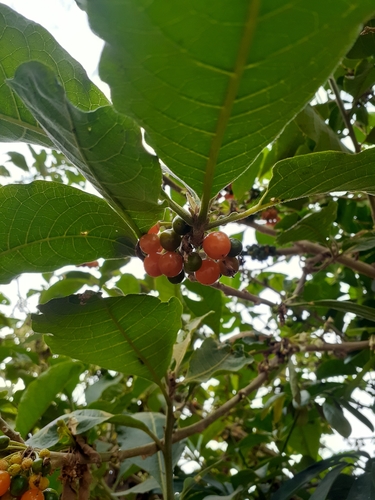
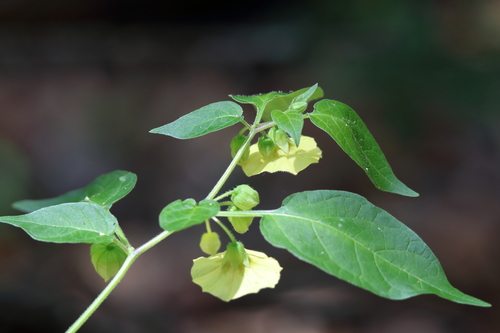
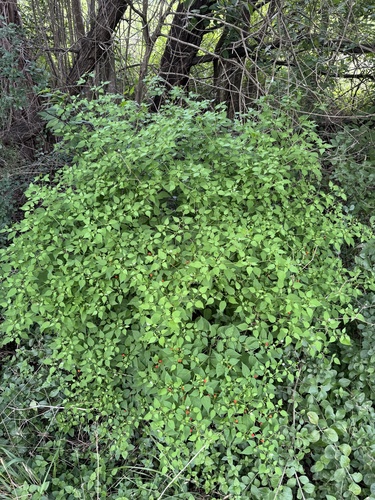
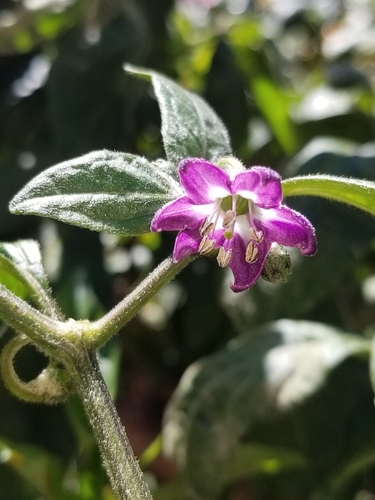
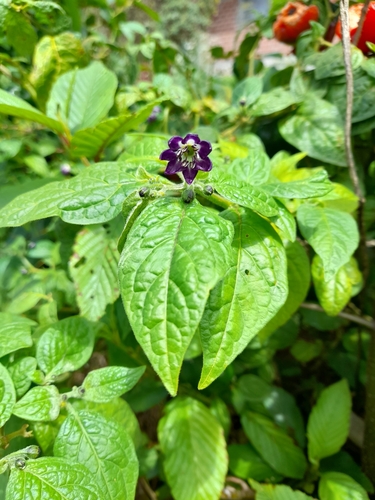
A herb or climbing shrub. It grows 50-70 cm high but can be 3 m high. The stems have purple nodes. The leaves are alternate and rough and oval. The leaves are hairy. The flowers occur singly in the axils of leaves. They have 6 lobes and are blue or purple. The fruit is a berry. The fruit are 3-5 cm long by 2-3 cm wide. They can be yellow or red. They can vary in shape, size and pungency. The seeds are black. There are several named cultivated varieties.
How to Grow
Requires a very warm sunny position and a fertile well-drained soil. Tolerates a pH in the range 4.3 to 8.3. This species is only likely to be hardy in the milder areas of Britain, it can tolerate temperatures down to at least -5°c. It might be possible to get it to fruit outdoors in the mildest areas of the country, especially if given the protection of a sunny wall. Plants are able to continue fruiting for 15 years in cool moist climates.
Propagation: Sow seed in late winter to early spring in a warm greenhouse; germination typically takes 3–4 weeks at 20°C. Prick seedlings out into individual pots of reasonably rich soil and grow on quickly. For outdoor cultivation, plant out after the last expected frosts and protect with a cloche or frame until plants are well established.
Medicinal Uses
The hot, pungent fruit is antihaemorrhoidal when taken in small amounts, antirheumatic, antiseptic, diaphoretic, digestive, irritant, rubefacient, sialagogue, and tonic. Internally it is used in the treatment of the cold stage of fevers, debility in convalescence or old age, varicose veins, asthma, and digestive problems. Externally it is applied for sprains, unbroken chilblains, neuralgia, and pleurisy. The German Commission E Monographs approve Capsicum for muscular tension and rheumatism.
Other Uses
The growing plant repels insects.
Wikipedia
Source ↗Capsicum pubescens is a plant of the genus Capsicum (pepper). The species name, pubescens, refers to the hairy leaves of this pepper. The hairiness of the leaves, along with the black seeds, make Capsicum pubescens distinguishable from other Capsicum species. Capsicum pubescens has pungent yellow, orange, red, green or brown fruits. This species is found primarily in Central and South America, and is known only in cultivation. It is consumed fresh, as a paste, dried, or ground. Of all the domesticated species in the genus Capsicum, it is the least widespread and most genetically distinct. It has no common name in English, and its name in Spanish varies by country: it is called by the indigenous terms rocoto in Peru and Ecuador (from the Quechua rukutu or ruqutu) and locoto in Bolivia and Argentina (from the Aymara luqutu); however, in Mexico the term chile manzano (literally, "appletree pepper") is used due to the visual similarity of the fruit to apples.
Other Information
It is a commercially cultivated vegetable.
Notes
There are 10 Capsicum species.
Names & Synonyms
Apple chilli, Caballo, Cabe bendot, Cabe Dieng, Cabe gondol, Canario, Chile marongo, Horse chili, Locoto, Lokoto, Manzana, Rocot-uchu, Rocoto, Rocut-uchu
References (29)
- Anguilar-Stoen, M, et al, 2009, Home Gardens Sustain Crop Diversity and Improve Farm Resilience in Candelaria Loxicha, Oaxaca, Mexico. Human Ecology, 37:55-77
- Arellanes, Y., et al, 2013, Influence of traditional markets on plant management in the Tehuacan Valley. Journal of Ethnobiology and Ethnomedicine 9:38
- Brown, D., 2002, The Royal Horticultural Society encyclopedia of Herbs and their uses. DK Books. p 155
- Castillo, R. O., 1995, Plant Genetic Resources in the Andes: Impact, Conservation, and Management. Crop Science 35:355-360
- Cundall, P., (ed.), 2004, Gardening Australia: flora: the gardener's bible. ABC Books. p 327
- Esperanca, M. J., 1988. Surviving in the wild. A glance at the wild plants and their uses. Vol. 1. p 182
- Facciola, S., 1998, Cornucopia 2: a Source Book of Edible Plants. Kampong Publications, p 232
- Fl. peruv. 2:30. 1799
- Heiser, C.B., 1979, Peppers, in Simmonds, N.W., (ed), Crop Plant Evolution. Longmans. London. p 265
- Herklots,
- Hermandez Bermejo, J.E., and Leon, J. (Eds.), 1994, Neglected Crops. 1492 from a different perspective. FAO Plant Production and Protection Series No 26. FAO, Rome. p 13
- Joyal, E., 1987, Ethnobotanical Field Notes from Ecuador: Camp, Prieto, Jorgensen, and Giler. Economic Botany 41(2): 163-189
- Kays, S. J., and Dias, J. C. S., 1995, Common Names of Commercially Cultivated Vegetables of the World in 15 languages. Economic Botany, Vol. 49, No. 2, pp. 115-152
- Kiple, K.F. & Ornelas, K.C., (eds), 2000, The Cambridge World History of Food. CUP p 1810
- Macmillan, H.F. (Revised Barlow, H.S., et al), 1991, Tropical Planting and Gardening. Sixth edition. Malayan Nature Society. Kuala Lumpur. p 377
- Pascual-Mendoza, S. et al, 2021, Traditional knowledge of edible plants in an indigenous community in the Sierra Norte of Oaxaca, Mexico. Plant Biosystems - An International Journal Dealing with all Aspects of Plant Biology
- Plants for a Future database, The Field, Penpol, Lostwithiel, Cornwall, PL22 0NG, UK. http://www.scs.leeds.ac.uk/pfaf/
- PROSEA handbook Volume 13 Spices. p 248
- Purseglove, J.W., 1968, Tropical Crops Dicotyledons, Longmans. p 526
- Roa, J. A. G. & Boada, D. S. G., 2018, Fundación para el Fortalecimiento de la Fruticultura y Plantas Alimenticias no Convencionales en Colombia.
- Samuels, J., 2015, Biodiversity of Food Species of the Solonaceae Family: A Preliminary Taxonomic Inventory of Subfamily Solanoideae. Resources 2015, 4. 277-322
- Seidemann J., 2005, World Spice Plants. Economic Usage, Botany, Taxonomy. Springer. p 84
- Small, E., 2009, Top 100 Food Plants. The world's most important culinary crops. NRC Research Press. p 177
- USDA, ARS, National Genetic Resources Program. Germplasm Resources Information Network - (GRIN). [Online Database] National Germplasm Resources Laboratory, Beltsville, Maryland. Available: www.ars-grin.gov/cgi-bin/npgs/html/econ.pl (10 April 2000)
- van Wyk, B., 2005, Food Plants of the World. An illustrated guide. Timber press. p 117
- Vasquez, Roberto Ch. & Coimbra, German S., 1996, Frutas Silvestres Comestibles de Santa Cruz. p 222
- Wiersema, J. H. & Leon, B., 2013, World Economic Plants. A Standard Reference CRC Press. 2nd Ed. p 141
- World Checklist of Useful Plant Species 2020. Royal Botanic Gardens, Kew
- www.theplantlist.org