Launaea capitata
(Sprengel) Dandy
AsteraceaeLeaves
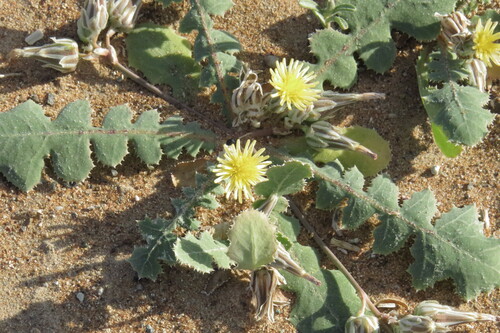
iNaturalist · cc-by-nc
(c) brendanwj, some rights reserved (CC BY-NC), uploaded by brendanwj
(c) brendanwj, some rights reserved (CC BY-NC), uploaded by brendanwj

iNaturalist · cc-by-nc-sa
(c) Tamsin Carlisle, some rights reserved (CC BY-NC-SA)
(c) Tamsin Carlisle, some rights reserved (CC BY-NC-SA)
What to Eat
Edible parts: Leaves
The leaves are eaten raw in salads or cooked as a green vegetable, particularly served with meat.
Where to Find It
It is a Mediterranean plant. It can grow in arid places. It grows in the Sahara.
Africa, Egypt, Mediterranean, Middle East, Morocco, North Africa, Qatar, Saudi Arabia, Sudan, United Arab Emirates, UAE,
Countries: United Arab Emirates, Albania, Angola, Bosnia & Herzegovina, Burkina Faso, Bahrain, Burundi, Benin, Botswana, Congo (DRC), Central African Republic, Congo (Republic), Cote d'Ivoire, Cameroon, Cape Verde, Cyprus, Djibouti, Algeria, Egypt, Eritrea, Spain, Ethiopia, France, Gabon, Ghana, Gambia, Guinea, Equatorial Guinea, Greece, Guinea-Bissau, Croatia, Israel, Iraq, Iran, Italy, Jordan, Kenya, Comoros, Kuwait, Lebanon, Liberia, Lesotho, Libya, Morocco, Monaco, Montenegro, Madagascar, Mali, Mauritania, Malta, Mauritius, Malawi, Mozambique, Namibia, Niger, Nigeria, Oman, Qatar, Rwanda, Saudi Arabia, Seychelles, Sudan, Slovenia, Sierra Leone, Senegal, Somalia, South Sudan, Sao Tome & Principe, Syria, Eswatini, Chad, Togo, Tunisia, Turkey, Tanzania, Uganda, Yemen, South Africa, Zambia, Zimbabwe
How to Identify
Launaea capitata is an herb in the Asteraceae family native to Mediterranean regions, including the Sahara and other arid areas.
Names & Synonyms
Elghorram, Hawa, Huwa, Huwwa, Ouden ennaaja
Chondrilla capitata SieberLaunaea glomerata (Cass.) Hook.f.Sonchus capitatus Spreng.and others
References (6)
- Bidak, L. M., et al, 2015, Goods and services provided by native plants in desert ecosystems: Examples from the northwestern coastal desert of Egypt. Global Ecology and Conservation 3 (2015) 433–447
- Mandaville, J. P., 2004, Bedouin ethnobotany: Plant concepts and plant use in a desert pastoral world. PhD thesis University of Arizona. p 160
- Nassif, F., & Tanji, A., 2013, Gathered food plants in Morocco: The long forgotten species in Ethnobotanical Research. Life Science Leaflets 3:17-54
- Norton, J., et al, 2009, An Illustrated Checklist of the Flora of Qatar. UNESCO Office in Doha.
- Royal Botanic Gardens, Kew (1999). Survey of Economic Plants for Arid and Semi-Arid Lands (SEPASAL) database. Published on the Internet; http://www.rbgkew.org.uk/ceb/sepasal/internet [Accessed 11th April 2011]
- World Checklist of Useful Plant Species 2020. Royal Botanic Gardens, Kew