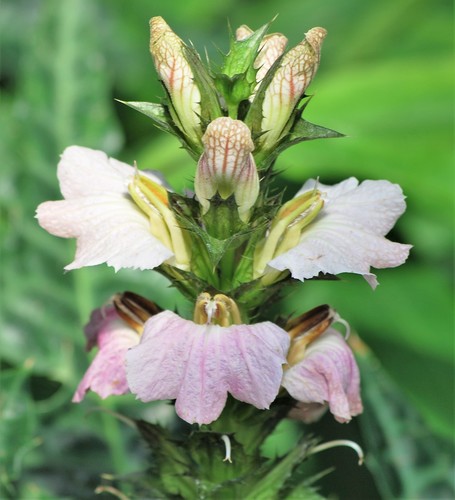
Dicliptera laxata
C. B. Clarke

Royal Botanic Gardens, Kew

Royal Botanic Gardens, Kew

Royal Botanic Gardens, Kew
What to Eat
Edible parts: Leaves, Vegetable
The tender leaves are cooked as a vegetable, typically prepared with coconut milk or ground peanuts added.
Where to Find It
It is a tropical plant. It grows in the high forest often in deep shade. It grows between 1,500-2,300 m above sea level.
Africa, East Africa, Ethiopia, Kenya, Mozambique, Nigeria, Tanzania, Uganda,
How to Identify
A straggling herb or small shrub. It keeps growing from year to year. It grows 1-5 m tall. The leaves are opposite and narrowly oval. They taper towards both ends. They are dark green. The flowers are in stalked clusters. There are a rind of green floral bracts around them. Each flower has 2 bracts. The flowers are tube shaped and white or pink. There are purple streaks. The fruit is an oval capsule about 1 cm long. It has 4 round black seeds.
Medicinal Uses
The plant is used as a remedy for general debility. A macerate in hot water is reported to result in a blood-like liquid. The roots are used to treat stomach-aches and coughs.
Production
Leaves are harvested in the rainy season. The leaves can be dried and stored for a year.
Names & Synonyms
Nyamtitu
References (3)
- Grubben, G. J. H. and Denton, O. A. (eds), 2004, Plant Resources of Tropical Africa 2. Vegetables. PROTA, Wageningen, Netherlands. p 561
- Ruffo, C. K., Birnie, A. & Tengnas, B., 2002, Edible Wild Plants of Tanzania. RELMA p 268
- World Checklist of Useful Plant Species 2020. Royal Botanic Gardens, Kew