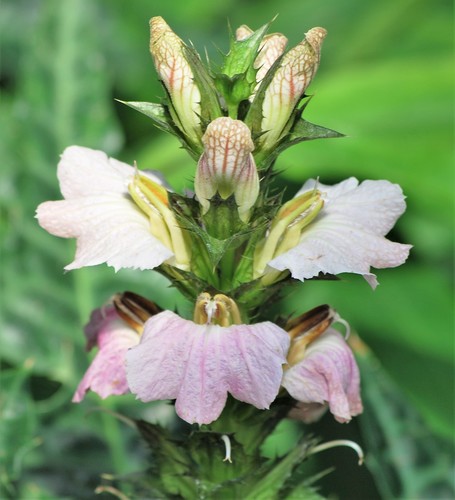
Phlogacanthus curviflorus
Nees
Wild nongmangkha

(c) michi1, some rights reserved (CC BY-NC), uploaded by michi1

ymr01230

(c) Prashanth N S, some rights reserved (CC BY), uploaded by Prashanth N S
What to Eat
Edible parts: Flowers
The young flowers are eaten as a vegetable, typically boiled with rice, or dried and pounded into a spice or condiment. The plant is sold in local markets.
Where to Find It
It is a tropical and subtropical plant. It grows in ravines and on the edge of forests between 400-1,600 m above sea level. In Yunnan.
Asia, Bangladesh, Bhutan, China, Himalayas, India, Indochina, Laos, Myanmar, Northeastern India, SE Asia, Thailand, Tibet, Vietnam,
How to Identify
A shrub. It grows 3-6 m tall. The leaves are oblong and 12-35 cm long by 9-18 cm wide. They are hairy along the veins underneath. The flowers are at the top of the plant. They are in groups 14-18 cm long by 6-8 cm wide. The flowers are pink or red.
Other Information
It is sold in local markets.
Names & Synonyms
Aluso, Dhapa tita, Geurim-heu, Heyavu, Kham-chhit, Ko-na oing, Kola bahak, Kolhou, Lamgi, Maidang, Mogang sudi, Nongmangkha, Pilamola, Tew-phot-saw, Totsiipa
References (10)
- Dutta, B., et al, 2016, Diversity and Ethnobotany of the Genus Phlogacanthus Nees in Assam, India. Int. J. Life. Sci. Scienti. Res., 2(4):472-477
- Medhi, P. & Borthakur, S. K., 2012, Phytoresources from North Cachur Hills of Assam -3: Edible plants sold at Hflong market. Indian Journal or Natural Products and Resources. 3(1) pp 84-109
- Medhi, P. & Borthakur, S. K., 2013, Wild edible plants sold by the Zeme Nagas at the makeshift market of Mahur, Dima Hasao district of Assam. Pleione 7(1): 84 - 93. 2013
- Medhi, P., Sarma, A and Borthakur, S. K., 2014, Wild edible plants from the Dima Hasao district of Assam, India. Pleione 8(1): 133-148
- Meitei, L. R., et al, 2022, An ethnobotanical study on the wild edible plants used by forest dwellers in Yangoupokpi Lokchao Wildlife Sanctuary, Manipur, India. Ethnobotany Research and Application 23:15
- Patiri, B. & Borah, A., 2007, Wild Edible Plants of Assam. Geethaki Publishers. p 94
- Pfoze, N. L., et al, 2012, Survey and assessment of floral diversity on wild edible plants from Senapati district of Manipur, Northeast India. Journal or Biodiversity and Environmental Sciences. 1(6):50-52
- Sarma, H., et al, 2010, Updated Estimates of Wild Edible and Threatened Plants of Assam: A Meta-analysis. International Journal of Botany 6(4): 414-423
- Srivastava, R. C., 2010, Traditional knowledge of Nyishi (Daffla) tribe of Arunachal Pradesh. Indian Journal of Traditional Knowledge. 9(1):26-37
- Thokchom, R., et al, 2016, Documentation and assessment of wild medicinal and edible flowers of valley districts of Manipur. International Journal of Research in Applied, Natural and Social Sciences. 4(11):13-20