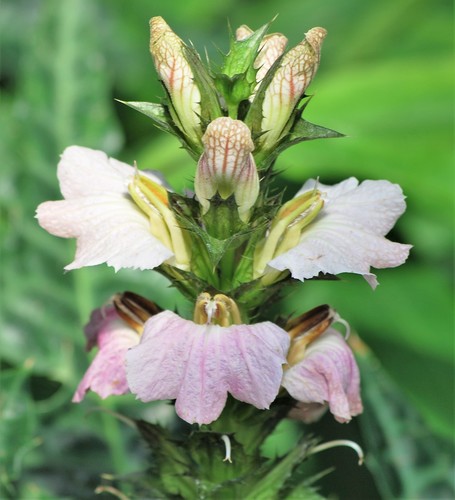
Andrographis paniculata
(Burm.f.) Wall. ex Nees
King of bitters
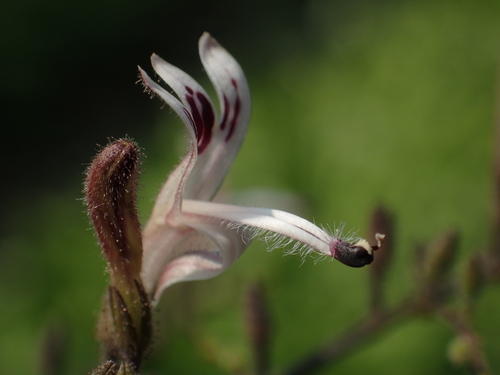
no rights reserved, uploaded by 葉子

(c) Tony Rodd, some rights reserved (CC BY-NC-SA)
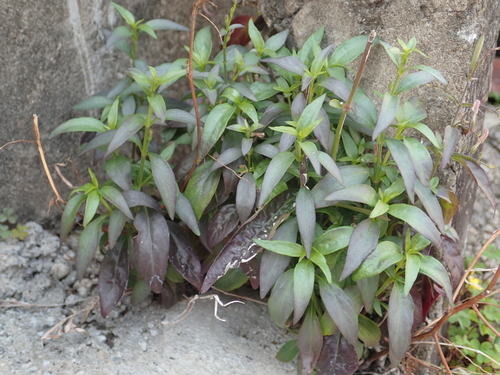
no rights reserved, uploaded by 葉子
What to Eat
Edible parts: Leaves, Vegetable, Stem
The leaves are occasionally eaten mixed with other vegetables. This is a cultivated plant.
Known Hazards
Where to Find It
It is a tropical and subtropical plant. In XTBG Yunnan.
Asia, Assam, Australia, Cambodia, Caribbean, China, Dominica, Dominican Republic, India*, Indochina, Indonesia, Laos, Malaysia, Myanmar, Northeastern India, SE Asia, Sri Lanka*, Thailand, Vietnam, West Indies,
How to Identify
A herb. It grows 50 cm tall. It grows each year from seed. The stems are 4 angled and much branched. The leaves are oval and 2-7 cm long by 1-3 cm wide. They are pale green underneath. The flowers are at the top of the plant. They are tube shaped. They are white and there are purple dots on the lower lip.
How to Grow
Plants can be grown by seeds, cuttings or stems that have developed roots.
Propagation: Seeds should be soaked for 24 hours and then dried before sowing. Germination begins after about 1 week, with a mean germination rate of around 80%. For vegetative propagation, cuttings of 3 nodes taken from the upper third of 1-year-old plants have given the best results, achieving 80–90% rooting.
Medicinal Uses
Green chireta has a long history of traditional medicinal use in India, various parts of South-East Asia, Central America and the Caribbean. The roots and leaves are considered alterative, anthelmintic, bitter, febrifuge, stomachic and tonic. Extensive research has identified several medically active compounds with a wide range of effects. The aerial parts contain a large number of diterpenes, and flavones have also been reported in the root. Trials using leaf extract have shown that powdered leaves can significantly shorten the duration of common colds and may be as effective as paracetamol in relieving fever and sore throat in patients with pharyngotonsilitis. The leaves have also demonstrated significant anti-inflammatory effects and notable inhibition of oedema. An ethanol extract of the leaves stimulates both antigen-specific and nonspecific immune responses more effectively than purified leaf extracts, and also shows significant antipyretic activity. A standardized leaf extract exhibits significant antipyretic properties and acts as an effective analgesic. The crude water extract of the leaves, as well as semi-purified n-butanol and aqueous fractions, have shown significant hypotensive activity. In one trial, a 10% infusion applied intravenously at 1 ml/kg bodyweight reduced blood pressure by 6–10 mm Hg within 10–20 seconds. Leaf extract has also been shown to lower cholesterol levels, with antithrombotic effects also observed, believed to be at least partially due to flavones in the extract. Administered intraperitoneally, the diterpenes andrographiside and neoandrographolide found in the leaves have a significant protective effect on the liver. Leaf extract has shown antidiarrhoeal activity, and the diterpenes andrographolide and neoandrographolide isolated from the alcoholic extract showed potent antisecretory activity against Escherichia coli enterotoxin-induced secretions. Various compounds have shown significant anti-ulcer properties, attributed to antisecretory activity and a protective effect on the gastric mucosa. Oral administration of 20 mg of dry leaf powder for 60 days has an antifertility effect in males. The alcoholic extract of the rhizomes exhibits good in vitro anthelmintic activity against Ascaris lumbricoides. Neoandrographolide isolated from the leaves shows significant antimalarial activity. Dehydroandrographolide succinic acid monoester, derived from andrographolide, has been found to inhibit HIV in vitro. A leaf infusion administered intraperitoneally has an LD50 at 71.1 mg/10 g body weight (acute toxicity), and at a concentration of 1 mg/kg it lowers body temperature by at least 2°C. The plant was historically considered a remedy for snake bites and is still used locally for this purpose. It has also been reported useful for insect bites and, in combination with Orthosiphon aristatus, as a remedy for diabetes. An infusion or sap from crushed leaves is used to treat fever, as a tonic, and for itching skin eruptions. A decoction of the leaves or roots is used against stomach-ache, dysentery, typhus, cholera, influenza and bronchitis, as a vermifuge, and is considered a diuretic. Pills or infusions are recommended for female disorders, dyspepsia, hypertension, rheumatism, gonorrhoea, amenorrhoea, torpid liver and jaundice. The plant is also used as a poultice on swollen legs or feet, vitiligo and piles, and is considered anti-inflammatory and immunosuppressive, though reports on antibacterial activity are contradictory. Leaves should be harvested when the inflorescence axis begins to grow, as andrographolide accumulation is at its maximum at that stage. Roots are harvested when leaves begin to discolour or wilt. Yields of 1–1.5 kg fresh weight per plant are obtained from 7-month-old plants. The herb is generally used fresh and consumed within a few days of collection, though leaves and roots can be washed and sun-dried or artificially dried for storage.
Other Uses
Leaf extract of Andrographis paniculata is reported to have antifeedant and anti-oviposition activity against a number of crop pests including Callosobrunchus chinensis, Darcus dorsalis, Nephotettix cincticeps, Plutella xylostella, Sitophilus oryzae and Spodoptera litura. Suitable for growing in containers. Attracts wildlife.
Wikipedia
Source ↗Andrographis paniculata, commonly known as creat or green chiretta, is an annual herbaceous plant in the family Acanthaceae, native to India and Sri Lanka. It is widely cultivated in Southern and Southeastern Asia, where it has been believed to be a treatment for bacterial infections and some diseases. Mostly the leaves and roots have been used for such purposes; the whole plant is also used, in some cases.
Other Information
The leaves are occasionally eaten mixed with other vegetables. It is a cultivated plant. Leaves are sold in local markets.
Names & Synonyms
Bhuienimb, Bhuin, Chirota, Kaalmedh, Kadukirayata, Kalomegh, Kariyat, Neemba, Sambiloto, Sega-gyi, Se-khar-gyi
References (12)
- Checklist of NT Vascular Plant Species. January 2003.
- Jiwajinda, S., et al, 2002, Suppressive Effects of Edible Thai Plants on Superoxide and Nitric Oxide Generation. Asian Pacific Journal of Cancer Prevention, Vol 3, 2002
- Kaewnarin, K., et al, 2014, Antioxidant and Antiglycation Activities of Some Edible and Medicinal Plants. Chiang Mai J. Sci. 2014; 41(1) : 105-116
- Kiran, K. C., et al, 2019, Diversity and Seasonal Availability of Potential Wild Edible Plants from Vidarbha Region of Maharashtra State, India. Int.J.Curr.Microbiol.App.Sci (2019) 8(2): 1434-1446
- Kumar, S. A., Manus, D. & Mallika, M., 2018, Impact of non-timber forest products on Forest and in Livelihood Economy of the People of Adjoining Areas of Jalpaiguri Forest Division, West Bengal, India. Int. J. of Life Sciences, 2018; 6 (2):365-385
- Kumar, R. & Saikia, P., 2020, Wild edible plants of Jharkhand and their utilitarian perspectives. Indian Journal of Traditional Knowledge Vol 19 (2), April 2020, pp 237-250
- Medhi, P. & Borthakur, S. K., 2012, Phytoresources from North Cachur Hills of Assam -3: Edible plants sold at Hflong market. Indian Journal or Natural Products and Resources. 3(1) pp 84-109
- Medhi, P., Sarma, A and Borthakur, S. K., 2014, Wild edible plants from the Dima Hasao district of Assam, India. Pleione 8(1): 133-148
- Mishra, S. & Chaudhury, S. S., 2012, Ethnobotanical flora used by four major tribes of Koraput, Odisha, India. Genetic Resources Crop Evolution 59:793-804
- Prafulla, S., 2017, Wild Food Diversity of Nawegaon-Nagzira Tiger Reserve in Gondia-Bhandara district of Maharashtra, India. Int. J. of Life Sciences, 2017, Vol. 5 (4): 620-626
- Sarma, H., et al, 2010, Updated Estimates of Wild Edible and Threatened Plants of Assam: A Meta-analysis. International Journal of Botany 6(4): 414-423
- Sukarya, D. G., (Ed.) 2013, 3,500 Plant Species of the Botanic Gardens of Indonesia. LIPI p 1064