Celtis australis
L.
European Hackberry, Southern Nettle tree
(c) Felix Riegel, some rights reserved (CC BY-NC)
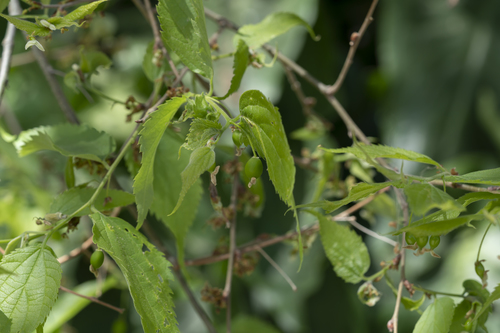
(c) Eleftherios Katsillis, some rights reserved (CC BY)
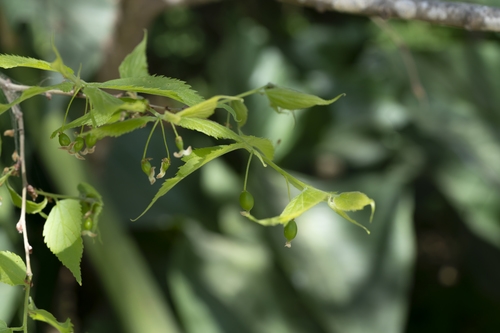
(c) Eleftherios Katsillis, some rights reserved (CC BY)
What to Eat
Edible parts: Fruit, Seeds, Oil
The fruit is eaten raw and has a mealy, pleasantly sweet flavour, though it is small and somewhat insipid and of limited value. Each fruit is about 10mm in diameter and contains a single large seed. The seed can be eaten raw or cooked, and an oil is also extracted from it.
Where to Find It
It grows in temperate places. It is native to S.W. Asia and S. Europe. It grows on warm, dry, rocky slopes. It can grow in arid soils. It does better in soils with lime. It can only tolerate light frosts. In the Indian Himalayas it grows between 1,300-1,500 m above sea level. It suits hardiness zones 8-11. Arboretum Tasmania.
Africa, Algeria, Andorra, Asia, Australia, Balkans, Bosnia, Croatia, Cyprus, Europe, France, Greece, Himalayas, India, Italy, Macedonia, Mediterranean*, Mexico, Morocco, Myanmar, North Africa, Northeastern India, NW India, Pakistan, San Marino, SE Asia, Sicily, Spain, Tasmania, Turkey, Türkiye,
How to Identify
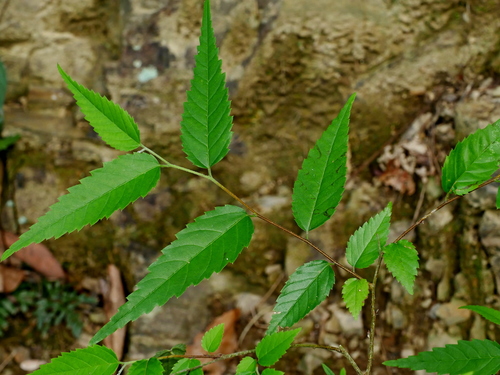
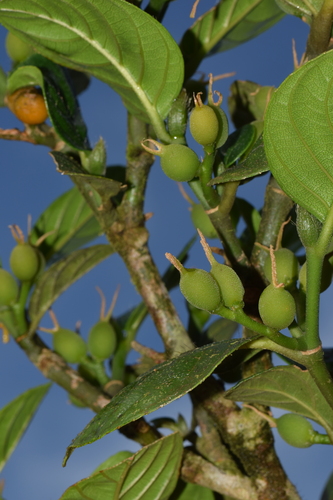
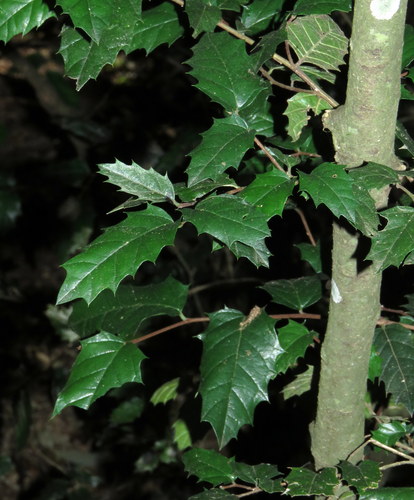
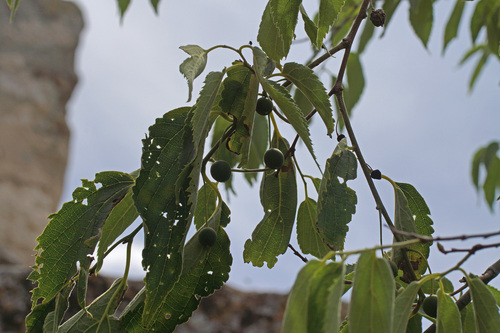
A tree which grows 25 m tall. It loses its leaves during the year. The crown is rounded. The trunk is thick. The young branches are downy. The bark is smooth and grey. The leaves are oval or sword shaped. They are 15 cm long by 5 cm wide. They have a sharp point. There are teeth along the edge. The leaf stalk is short. The male and female flowers are small and greenish. They can occur singly or in small clusters in the axils of leaves. The fruit are small, round and berry-like. They are dark purple when ripe. They are 1 cm across. They are sweet and edible.
Nutrition Score: 9/100
| Part | Moisture | kJ | kcal | Protein | Vit A | Vit C | Iron | Zinc |
|---|---|---|---|---|---|---|---|---|
| Fruit | — | — | — | 0.8 | 3.9 | 3.1 | 0.4 | — |
| Seeds | — | — | — | — | — | — | — | — |
How to Grow
Succeeds in any reasonably good soil, preferring a good fertile well-drained loamy soil. Succeeds on dry gravels and on sandy soils. The trees have deep spreading roots and are very drought resistant once established. This species requires mild winters if it is to succeed. Trees prefer hotter summers and more sunlight than are normally experienced in Britain, they often do not fully ripen their wood when growing in this country and they are then very subject to die-back in winter. A hardier form, from seed collected in the Caucasus, is in cultivation in Britain. The fruit and the seed are sometimes sold in local markets in the Balkans. This plant is said to be the lotus fruit of the ancients. It is mentioned in the story of Odysseus returning from Troy and the story relates that if a person should eat the fruit they will never leave that area. Coppices well. A good shade tree. Trees can be very long-lived, perhaps to 1000 years. Plants in this genus are notably resistant to honey fungus.
Propagation: Sow seed as soon as ripe in a cold frame for best results. Stored seed should receive 2–3 months of cold stratification before sowing in February or March in a greenhouse. Germination is generally good, though stored seed may take 12 months or longer to germinate, and seed can be stored for up to 5 years. Prick seedlings into individual pots as soon as they are large enough to handle. Seedling leaves often show white patches lacking chlorophyll, which is normal; older plants produce fully green leaves. Grow seedlings in a cold frame through their first winter and plant out the following late spring or early summer, with protection from cold during their first winter outdoors. Can also be propagated by cuttings.
Medicinal Uses
The leaves and fruit are astringent, lenitive, and stomachic. Leaves are gathered in early summer and dried for later use. The fruit, particularly when not yet fully ripe, is considered medicinally more effective. A decoction of leaves and fruit combined is used to treat amenorrhoea, heavy menstrual and intermenstrual bleeding, and colic. The same decoction also astringes mucous membranes and is used to treat diarrhoea, dysentery, and peptic ulcers.
Other Uses
A yellow dye is obtained from the bark. A fatty oil is extracted from the seed, though no further details are given. The wood is very tough, pliable, and durable, widely used by turners and for the handles of agricultural implements. Flexible thin shoots are used as walking sticks. The wood makes an excellent fuel.
Wikipedia
Source ↗Celtis australis, the European nettle tree, European hackberry, Mediterranean hackberry, lote tree, southern nettle tree, or honeyberry, is a deciduous tree native to Southern Europe, North Africa, and Asia Minor.
Other Information
The fruit are especially eaten by children. It is cultivated.
Notes
There are 70-100 Celtis species. They are mostly in the tropics. There are 8-10 species in tropical America. It can become invasive. Also put in the family Ulmaceae.
Names & Synonyms
Alatonero, Alatones, Almez, Anku, Batkar, Bremji, Brimij, Chilindronar, Citlik, Dardagan, Glinda, Hojaranzo, Honeyberry, Jaranzo, Kara çitlenbik, Kharik, Khark, Khirk, Khrikh, Konnarka, Koo, Koscela, Kostela, Kru, Ku, Limonero, Lote tree, Lotus berry, Mediterranean hackberry, Meyo, Palo blanco, Roku, Satsha, Stinkwood, Taagh, Teghzaz, Tagha, Tarawan, Thaghah
References (57)
- Agarwal, R. & Chandra, V., 2019, Diversity of wild edible plants in the Mandal-Chopta forest, Uttarakhand. Journal of Medicinal Plants Studies 2019; 7(1): 89-92
- Ahmad, I., et al, 2011, Ethnobotanical Study of Tehsil Kabal, Swat District, KPK, Pakistan. Hindawi Publishing Corporation Journal of Botany Volume 2011, Article ID 368572, 9 pages
- Ahmad, K. & Pieroni, A., 2016, Folk knowledge of wild food plants among the tribal communities of Thakht-e-Sulaiman Hills, North-West Pakistan. Journal of Ethnobiology and Ethnomedicine, 12:17
- Ambasta S.P. (Ed.), 2000, The Useful Plants of India. CSIR India. p 114
- Amin, M. et al, 2023, Edible wild plant species used by different linguistic groups of Kohistan Upper Khyber Pakhtunkhwa (KP), Pakistan. Journal of Ethnobiology and Ethnomedicine 19:6 p 8
- Bahuguna, A. et al, 2010, Floristic Diversity and Indigenous uses of Forest Vegetation of Dabka Watershed in Indian Central Himalayas. Ethnobotanical Leaflets 14:491-510 (As Ciltis)
- Barkatullah and Ibrar, M., 2011, Plants profile of Malakand Pass Hills, District Malakand, Pakistan. African Journal of Biotechnology Vol. 10 (73) pp. 16521-16535
- Blamey, M and Grey-Wilson, C., 2005, Wild flowers of the Mediterranean. A & C Black London. p 34
- Blanco-Salas, J., et al, 2019, Wild Plants Potentially Used in Human Food in the Protected Area “Sierra Grande de Hornachos” of Extremadura (Spain). Sustainability 2019, 11, 456
- Bodkin, F., 1991, Encyclopedia Botanica. Cornstalk publishing, p 233
- Boudraa, S. et al, 2010, Mineral and vitamin composition of fruits of five underexploited species in Algeria: Fruits. Vol. 65:75-84
- Brickell, C. (Ed.), 1999, The Royal Horticultural Society A-Z Encyclopedia of Garden Plants. Convent Garden Books. p 245
- Cundall, P., (ed.), 2004, Gardening Australia: flora: the gardener's bible. ABC Books. p 353
- Della, A., et al, 2006, An ethnobotanical survey of wild edible plants of Paphos and Larnaca countryside of Cyprus. J. Ethnobiol. Ethnomed. 2:34
- Dolina, K. & Luczaj, L., 2014, Wild food plants used on the Dubrovnik coast (south-eastern Croatia) Acta Soc Bot Pol 83(3):175–181
- Ertug, F, Yenen Bitkiler. Resimli Türkiye Florası -I- Flora of Turkey - Ethnobotany supplement
- Etherington, K., & Imwold, D., (Eds), 2001, Botanica's Trees & Shrubs. The illustrated A-Z of over 8500 trees and shrubs. Random House, Australia. p 196
- Ethnobotanical Study of Tehsil Kabal, Swat District, KPK, Pakistan, Table 1
- Facciola, S., 1998, Cornucopia 2: a Source Book of Edible Plants. Kampong Publications, p 75
- Flora of Australia, Volume 3, Hamamelidales to Casuarinales, Australian Government Publishing Service, Canberra (1989) p 10
- Glowinski, L., 1999, The Complete Book of Fruit Growing in Australia. Lothian. p 182
- Gonzalez, J. A., et al, 2011, The consumption of wild and semi-domesticated edible plants in the Arribes del Duero (Salamanca-Zamora, Spain): an ananalysis of traditional knowledge. Genetic Resources and Crop Evolution 58:991-1006
- Gunes, S. et al, 2018, Survey of wild food plants for human consumption in Karaisali (Adana-Turkey). Indian Journal of Traditional Knowledge. Vol. 17(2), April 2018, pp 290-298
- Gurdal, B. & Kultur, S., 2014, The edible and miscellaneous useful plants in Marmaris (Southwest Turkey). İstanbul Ecz. Fak. Derg. / J. Fac. Pharm. Istanbul 44(1) 2014 pp.69-78
- Hedrick, U.P., 1919, (Ed.), Sturtevant's edible plants of the world. p 177
- Hermandez Bermejo, J.E., and Leon, J. (Eds.), 1994, Neglected Crops. 1492 from a different perspective. FAO Plant Production and Protection Series No 26. FAO, Rome. p 264
- Hibbert, M., 2002, The Aussie Plant Finder 2002, Florilegium. p 62
- http://www.planthogar.net/fichas/535/almez-australis
- Jabeen, A., et al, 2009, Indigenous uses of economically important flora of Margallah Hills National Park, Islamabad, Pakistan. African Journal of Biotechnology Vol. 8 (5), pp. 763-784 (As Celtis eriocarpa)
- John, L., & Stevenson, V., 1979, The Complete Book of Fruit. Angus & Robertson p 289
- Kar, A., et al, 2013, Wild Edible Plant Resources used by the Mizos of Mizoram, India. Kathmandu University Journal of Science, Engineering and Technology. Vol. 9, No. 1, July, 2013, 106-126
- Khalid, N., et al, 2023, Wild food plants gathered by four cultural groups in North Waziristan, Pakistan. Genet Resour Crop Evol. 70:1243–1276
- Khan, D. & Shaukat, S.S., 2006, The Fruits of Pakistan: Diversity, Distribution, Trends of Production and Use. Int. J. Biol. Biotech., 3(3):463-499
- Khan, W., et al, Ethnomedicinal plants of Kakul Hills, District Abbottabad, KPK, Pakistan.
- Lord, E.E., & Willis, J.H., 1999, Shrubs and Trees for Australian gardens. Lothian. p 50
- Luczaj, L. et al, 2013, Wild food plants used in the villages of the Lake Vrana Nature Park (northern Dalmatia, Croatia). Acta Societatis Botanicorum Poloniae, 82(4): 275-281
- Luczaj, L. et al, 2014, Wild Food Plants of Dalmatia (Croatia). in A. Pieroni, C. L. Quave (eds.), Ethnobotany and Biocultural Diversities in the Balkans, p 138
- Lyle, S., 2006, Discovering fruit and nuts. Land Links. p 118
- Marinelli, J. (Ed), 2004, Plant. DK. p 448
- Mattalia, G., et al, 2012, Traditional uses of wild food and medicinal plants among Brigasc, Kye ́, and Provenc ̧al communities on the Western Italian Alps. Genet Resour Crop Evol. Springer
- Nassif, F., & Tanji, A., 2013, Gathered food plants in Morocco: The long forgotten species in Ethnobotanical Research. Life Science Leaflets 3:17-54
- Negi, P. S. & Subramani, S. P., 2015, Wild Edible Plant Genetic Resources for Sustainable Food Security and Livelihood of Kinnaur District, Himachal Pradesh, India, International Journal of Conservation Science. 6 (4): 657-668
- Pasta, S., et al, 2020, An Updated Checklist of the Sicilian Native Edible Plants: Preserving the Traditional Ecological Knowledge of Century-Old Agro-Pastoral Landscapes. Frontiers in Plant Science. Volume 11|Article 388
- Plants for a Future database, The Field, Penpol, Lostwithiel, Cornwall, PL22 0NG, UK. http://www.scs.leeds.ac.uk/pfaf/
- Radha, B., et al, 2013, Wild Edible Plant Resources of the Lohba Range of Kedarnath Forest Division (KFD), Garhwal Himalaya, India. Int. Res J. Biological Sci. Vol. 2 (11), 65-73
- Rashid, A., Anand, V.K. & Serwar, J., 2008, Less Known Wild Plants Used by the Gujjar Tribe of District Rajouri, Jammu and Kashmir State. International Journal of Botany 4(2):219-244
- Redzic, S. J., 2006, Wild Edible Plants and their Traditional Use in the Human Nutrition in Bosnia-Herzegovina. Ecology of Food and Nutrition, 45:189-232
- Rivera, C., et al, 2005, The Ethnobotanical Study of Local Mediterranean Food Plants as Medicinal Resources in Southern Spain. Journal of Physiologyand Pharmacology. 56, Suppl. 1, 97-114
- Schuler, S., (Ed.), 1977, Simon & Schuster's Guide to Trees. Simon & Schuster. No. 92
- Segura, S., et al, 2018, The edible fruit species in Mexico. Genet Resour Crop Evol (2018) 65:1767–1793
- Sher, Z., Hussain, F., & Ibrar, M., 2014, Traditional knowledge on plant resources of Ashezai and Salarzai Valleys, District Buner, Pakistan. African Journal of Plant Science. Vol. 8(1), pp. 42-53, January 2014
- Singh, H.B., Arora R.K.,1978, Wild edible Plants of India. Indian Council of Agricultural Research, New Delhi. p 53
- Sp. pl. 2:1043. 1753
- Tardio, J., et al, 2006, Ethnobotanical review of wild edible plants in Spain. Botanical J. Linnean Soc. 152, 27-71
- Upreti, K., et al, 2010, Diversity and Distribution of Wild Edible Fruit Plants of Uttarakhand. Bioversity Potentials of the Himalaya. p 165 (Also as Celtis eriocarpa)
- www.worldagroforestrycentre.org/treedb/
- Zeven, A. C. & de West, J. M. J., 1982, Dictionary of cultivated plants and their regions of diversity. Wageningen. p 118