Celtis occidentalis
L.
Common Hackberry, Sugarberry

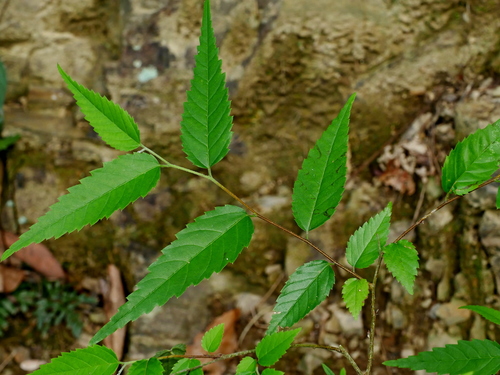
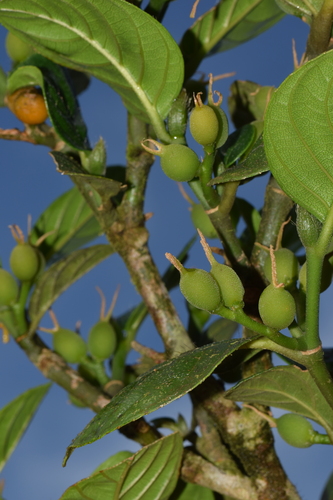
(c) Ayotte, Gilles, 1948-, some rights reserved (CC BY-SA)
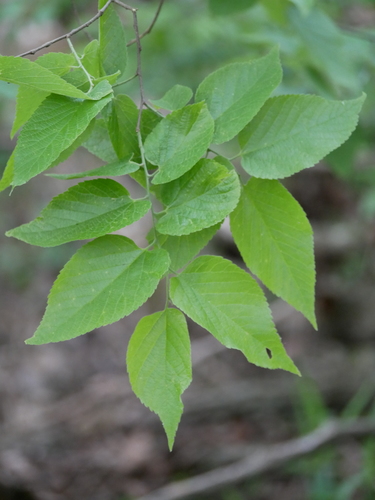
(c) emily-a, some rights reserved (CC BY-NC), uploaded by emily-a

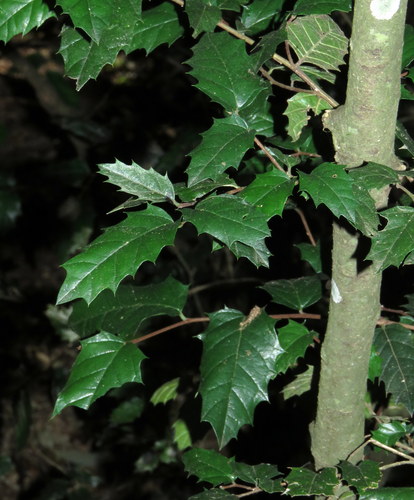
(c) Douglas Goldman, some rights reserved (CC BY-SA), uploaded by Douglas Goldman
What to Eat
Edible parts: Fruit, Seeds
The fruit is eaten raw and is very sweet and pleasant tasting — good enough to eat out of hand, or it can be used to make jellies and preserves. Often produced abundantly, the fruit is roughly the size of a blackcurrant, typically 7–11mm in diameter, though occasionally up to 20mm. It ripens to dark orange, purple, or blue-black. The flesh is dry and mealy but with an agreeable sweetness, though there is very little of it surrounding the large seed, making it a fiddly crop to process. The seed is also edible. The fruit and seed together can be ground finely and used as a flavouring. North American Indigenous peoples ate the ground fruit and seed mixed with parched corn.
Where to Find It
It is native to North America. It grows naturally in deep, rich, alluvial soils. It can tolerate some shade, but does best in a sunny location. It will grow with a range of soil pH and can tolerate pollution. It is cold hardy. It suits hardiness zones 3-10. Arboretum Tasmania.
Australia, Britain, Canada, Central Asia, Europe, Hungary, Mexico, North America*, Slovenia, Tajikistan, Tasmania, USA,
How to Identify
A tree. It grows to 12-18 m high. It spreads 16 m wide. The trunk is 50 cm across. The young bark is smooth but it becomes rough as the tree matures. The leaves are alternate and simple. They are in 2 rows along the twigs. The leaves vary in shape and size. They are 6-9 cm long and widest towards the base. The base is unequal on opposite sides. The tip is long and tapering. There are teeth along the edge of the leaf. The leaves turn pale yellow in autumn. The flowers are small and greenish. The male and female flowers are separate on the same tree. Flowers are wind pollinated. The fruit are pea sized. They are berry like with a hard stone inside. This is pitted. The fruit ripen through red to purple. The fruit are edible.
How to Grow
Succeeds in any reasonably good soil, preferring a good fertile well-drained loamy soil. Succeeds on dry gravels and on sandy soils. Tolerates alkaline soils. Established plants are very drought resistant. Wind resistant. Trees transplant easily. Trees prefer hotter summers and more sunlight than are normally experienced in Britain, they often do not fully ripen their wood when growing in this country and they are then very subject to die-back in winter. Plants in the wild are very variable in size, ranging from small shrubs to large trees. They are fast-growing, and can be very long-lived, perhaps to 1000 years. Only to 200 years according to another report. They usually produce good crops of fruit annually. Trees respond well to coppicing, readily sending up suckers after cutting or the top being killed off in a fire. Plants in this genus are notably resistant to honey fungus.
Propagation: Seed is best sown as soon as it is ripe in a cold frame. Stored seed should be given 2–3 months of cold stratification before sowing in February or March in a greenhouse. Germination rates are usually good, though stored seed may take 12 months or more to germinate. Seed can be stored for up to 5 years. Prick seedlings out into individual pots as soon as they are large enough to handle. Seedling leaves often show white patches lacking chlorophyll — this is normal, and older plants produce fully green leaves. Grow seedlings on in a cold frame through their first winter, then plant out the following late spring or early summer, with some cold protection during their first winter outdoors. Cuttings can also be used.
Medicinal Uses
An extract obtained from the wood has been used in the treatment of jaundice. A decoction of the bark has been used for sore throats. When combined with powdered shells, it has been used to treat venereal disease.
Other Uses
A dye is obtained from the roots, though no further details are given. The tree is fairly wind-tolerant and can be planted as part of a shelterbelt. The wood is rather soft, weak, coarse-grained, and heavy, weighing 45lb per cubic foot. It is sometimes used commercially for cheap furniture, veneer, fencing, and fuel.
Wikipedia
Source ↗Celtis occidentalis, commonly known as the common hackberry, is a large deciduous tree native to North America. It is also known as the nettletree, beaverwood, northern hackberry, and American hackberry. It is a moderately long-lived hardwood, with a light-colored wood that is yellowish gray to light brown with yellow streaks. The common hackberry is easily distinguished from elms and some other hackberries by its cork-like bark with wart-like protuberances. The leaves are distinctly asymmetrical and coarse-textured. It produces small fruits that turn orange-red to dark purple in the autumn, often staying on the trees for several months. The common hackberry is easily confused with the sugarberry (Celtis laevigata); these two are most easily distinguished by their range and habitat. The common hackberry also has wider leaves that are coarser above than the sugarberry.
Production
Trees are fast growing. Trees live for 150 years.
Other Information
The fruit are especially eaten by children.
Notes
There are 70-100 Celtis species. They are mostly in the tropics. There are 8-10 species in tropical America. Also put in the family Ulmaceae.
Names & Synonyms
American hackberry, Ameriški koprivovec, Madarbogyo, Nettle tree, Olmo blanco, Ostorfa, Rough-leaved hackberry, Zsidomeggy
References (30)
- Beckstrom-Sternberg, Stephen M., and James A. Duke. "The Foodplant Database." http://probe.nalusda.gov:8300/cgi-bin/browse/foodplantdb.(ACEDB version 4.0 - data version July 1994)
- Bodkin, F., 1991, Encyclopedia Botanica. Cornstalk publishing, p 234
- Brickell, C. (Ed.), 1999, The Royal Horticultural Society A-Z Encyclopedia of Garden Plants. Convent Garden Books. p 244
- Coombes, A.J., 2000, Trees. Dorling Kindersley Handbooks. p 307
- Cundall, P., (ed.), 2004, Gardening Australia: flora: the gardener's bible. ABC Books. p 353
- Denes, A., et al, 2012, Wild plants used for food by Hungarian ethnic groups living in the Carpathian Basin. Acta Societatis Botanicorum Poloniae 81 (4): 381-396
- Elias, T.S. & Dykeman P.A., 1990, Edible Wild Plants. A North American Field guide. Sterling, New York p 220
- Encycl. 4:138. 1797 (As Celtis crassifolia)
- Esperanca, M. J., 1988. Surviving in the wild. A glance at the wild plants and their uses. Vol. 1. p 307
- Etherington, K., & Imwold, D., (Eds), 2001, Botanica's Trees & Shrubs. The illustrated A-Z of over 8500 trees and shrubs. Random House, Australia. p 197
- Facciola, S., 1998, Cornucopia 2: a Source Book of Edible Plants. Kampong Publications, p 75
- Farrar, J.L., 1995, Trees of the Northern United States and Canada. Iowa State University press/Ames p 362
- Fisk, J. R. & Hoover, E., 2015, Wild Fruits of Minnesota. A Field Guide. University of Minnesota p 35
- Flora of Australia, Volume 3, Hamamelidales to Casuarinales, Australian Government Publishing Service, Canberra (1989) p 11
- Glowinski, L., 1999, The Complete Book of Fruit Growing in Australia. Lothian. p 182 (Also as Celtis crassifolia)
- Grandtner, M. M., 2008, World Dictionary of Trees. Wood and Forest Science Department. Laval University, Quebec, Qc Canada. (Internet database http://www.WDT.QC.ca)
- Hedrick, U.P., 1919, (Ed.), Sturtevant's edible plants of the world. p 178
- Hibbert, M., 2002, The Aussie Plant Finder 2002, Florilegium. p 62
- Jackes, D. A., Edible Forest Gardens
- Little, E.L., 1980, National Audubon Society Field Guide to North American Trees. Alfred A. Knopf. p 414
- Lord, E.E., & Willis, J.H., 1999, Shrubs and Trees for Australian gardens. Lothian. p 50
- Lyle, S., 2006, Discovering fruit and nuts. Land Links. p 118
- Medsger, O. P., 1939, Edible Wild Plants. Macmillan Company. p 3 and p 5 (As Celtis crassifolia)
- Plants for a Future database, The Field, Penpol, Lostwithiel, Cornwall, PL22 0NG, UK. http://www.scs.leeds.ac.uk/pfaf/
- Reis, S. V. and Lipp, F. L., 1982, New Plant Sources for Drugs and Foods from the New York Botanical Garden herbarium. Harvard. p 39 (As Celtis crassifolia)
- Segura, S., et al, 2018, The edible fruit species in Mexico. Genet Resour Crop Evol (2018) 65:1767–1793
- Sp. pl. 2:1044. 1753
- Tozer, F., 2007, The Uses of Wild Plants. Green Man Publishing. p 60
- Young, J., (Ed.), 2001, Botanica's Pocket Trees and Shrubs. Random House. p 219
- www.desert-tropicals.com