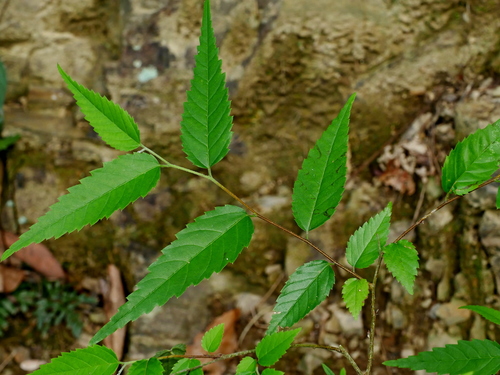
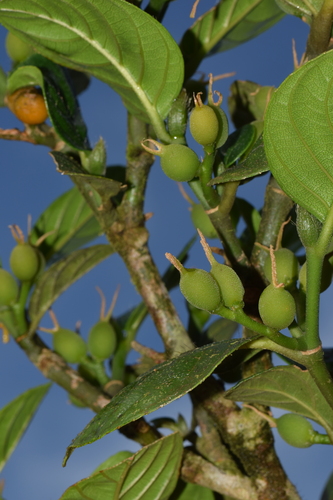
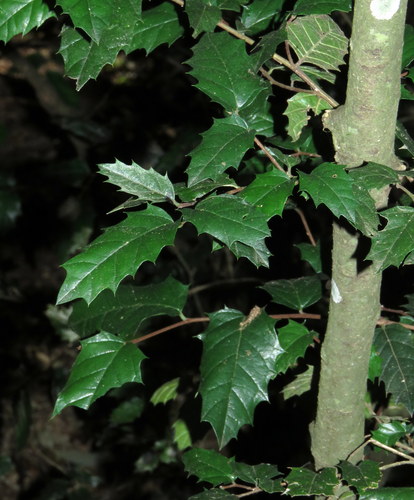
Celtis tetrandra
Roxb.
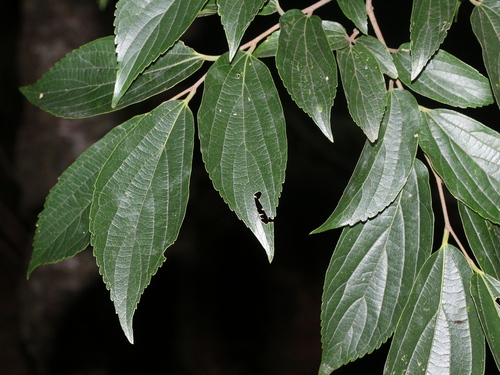
(c) Lijin Huang (紫楝), some rights reserved (CC BY-NC), uploaded by Lijin Huang (紫楝)
(c) fernslu九妹, some rights reserved (CC BY-NC), uploaded by fernslu九妹
no rights reserved, uploaded by 葉子
What to Eat
Edible parts: Fruit
The fruit can be eaten raw and has a mealy, pleasant taste. Each fruit grows up to 8mm in diameter and contains a single large seed about 5mm across. The edible portion is a thin layer of sweet but dry, mealy flesh surrounding that large seed.
Where to Find It
It is a tropical and subtropical plant. In NW India it grows up to 1,200 m above sea level. It grows in Sichuan and Yunnan.
Asia, Bangladesh, Bhutan, China, Himalayas, India, Indochina, Indonesia, Iran, Laos, Malaysia, Middle East, Myanmar, Nepal, Northeastern India, Pakistan, SE Asia, Sikkim, Thailand, Vietnam,
How to Identify
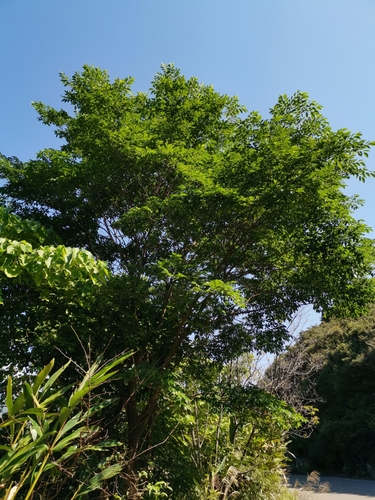
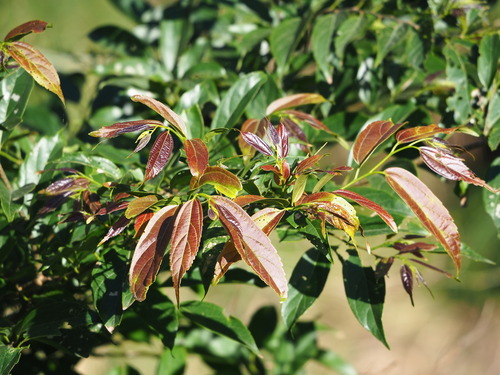
A medium sized tree that loses its leaves during the year. It grows 15 m high. It has a short thick trunk. The crown is spreading. The bark is bluish-grey. It is smooth and speckled with raised white dots. Old trees develop horizontal wrinkles. Young leaves are pale green. They become dark green later and turn yellow before falling. The leaves are 8-12 cm long on short stalks. There are teeth along a part of the leaf edge. They are pointy at the tip and have 3 veins at the base. The flowers are small and green. Flowers can be male, female or of both sexes. They are in the axils of the leaves at the end of longer stalks. Male and bisexual flowers are at the base of short stalks below the leaves. The fruit are small and berry-like. They are green and turn orange-red. They are the size of a peppercorn and eventually turn black.
How to Grow
We have very little information on this species and do not know if it will be hardy in Britain, though judging by its native range it could succeed outdoors at least in the milder parts of this country. The following notes are based on the general needs of the genus. Succeeds in any reasonably good soil, preferring a good fertile well-drained loamy soil. Succeeds on dry gravels and on sandy soils. Established plants are very drought resistant. Trees prefer hotter summers and more sunlight than are normally experienced in Britain, they often do not fully ripen their wood when growing in this country and they are then very subject to die-back in winter. Trees can be very long-lived, perhaps to 1000 years. Plants can be coppiced. Plants in this genus are notably resistant to honey fungus.
Propagation: Seed is best sown as soon as it is ripe in a cold frame. Stored seed should be given 2–3 months of cold stratification before sowing in February or March in a greenhouse. Germination rates are generally good, though stored seed may take 12 months or more to germinate. Seed remains viable for up to 5 years. Prick seedlings out into individual pots as soon as they are large enough to handle. Seedling leaves often show white patches lacking chlorophyll, which is normal — mature plants produce fully green leaves. Grow seedlings on in a cold frame through their first winter, then plant out the following late spring or early summer, with some frost protection during their first winter outdoors. Can also be propagated by cuttings.
Medicinal Uses
The juice extracted from the seeds is used to treat indigestion.
Other Uses
The wood is very tough, pliable, strong, and durable, making it well suited for oars and tool handles. It also serves as an excellent fuel.
Wikipedia
Source ↗Celtis tetrandra, called the Nilgiri elm, is a species of flowering plant in the hackberry genus Celtis, family Cannabaceae. It is widely distributed across the Indian Subcontinent, southern China, Southeast Asia, and western Indonesia. It is occasionally available commercially.
Production
In NW India fruit are available February to October.
Notes
There are 70-100 Celtis species. They are mostly in the tropics. There are 8-10 species in tropical America. Also put in the family Ulmaceae.
Names & Synonyms
Ada, Adona, Aduva, Batkar, Haktapatia, Jabjabal, Khalk, Kharak, Kharik, Khirk, Kona, Ku, Long-shing, Marukka, Nrumaj, Thit-pok
References (12)
- Ambasta S.P. (Ed.), 2000, The Useful Plants of India. CSIR India. p 114
- Barkatullah, et al, 2009, Ethnobotanical studies of plants of Charkotli Hills, Batkhela District, Malakand, Pakistan. Front. Biol. China 2009, 4(4): 539–548
- Bohra, N., et al, 2017, Ethnobotany of wild edible plants traditionally used by the local people in the Ramnagar regions from Nainital District, Uttarakhand, India. Biolife 5(1): 12-19
- Flora of China @ efloras.org Volume 5
- Fl. ind. ed. 1832, 2:63. 1832
- Flora of Pakistan. www.eFloras.org
- Krishen P., 2006, Trees of Delhi, A Field Guide. DK Books. p 61
- Li, S., et al, 2020, Monpa, memory, and change: an ethnobotanical study of plant use in Mêdog County, South-east Tibet, China. Journal of Ethnobiology and Ethnomedicine. (2020) 16:5 p 16
- Plants for a Future database, The Field, Penpol, Lostwithiel, Cornwall, PL22 0NG, UK. http://www.scs.leeds.ac.uk/pfaf/
- Sharma, G., et al, 2016, Agrobiodiversity in the Sikkim Himalaya. International Centre for Integrated Mountain Development, ICIMOD Working Paper 2016/5 p 20
- Sundriyal, M. & Sundriyal, R. C., 2004, Structure, Phenology, Fruit Yield, and Future Prospects of some Prominent Wild Edible Plant Species of the Sikkim Himalaya, India. Journal of Ethnobiology 24(1): 113-138
- Upreti, K., et al, 2010, Diversity and Distribution of Wild Edible Fruit Plants of Uttarakhand. Bioversity Potentials of the Himalaya. p 165