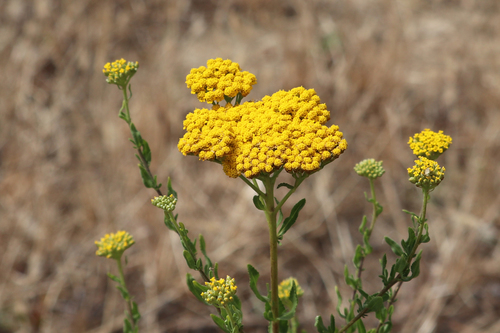
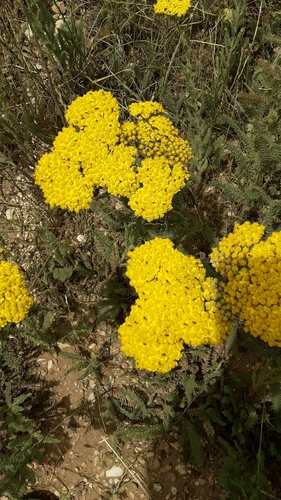
Ismelia carinata
Schousboe
Tricolor chrysanthemum, Annual Chrysanthemum
AsteraceaeLeaves

iNaturalist · cc-by
(c) Mike Kerry, some rights reserved (CC BY), uploaded by Mike Kerry
(c) Mike Kerry, some rights reserved (CC BY), uploaded by Mike Kerry

iNaturalist · cc-by-nc
(c) Dragonfyre, some rights reserved (CC BY-NC), uploaded by Dragonfyre
(c) Dragonfyre, some rights reserved (CC BY-NC), uploaded by Dragonfyre
iNaturalist · cc-by-nc
(c) Jesús Serradilla, some rights reserved (CC BY-NC), uploaded by Jesús Serradilla
(c) Jesús Serradilla, some rights reserved (CC BY-NC), uploaded by Jesús Serradilla
What to Eat
Edible parts: Leaves, Vegetable.
The leaves are eaten as a vegetable and the plant is cultivated for this purpose.
Where to Find It
It is a Mediterranean climate plant. It suits dry sunny places.
Africa, Asia, China, Hawaii, Mediterranean, Morocco*, North Africa, Pacific, USA,
Countries: United Arab Emirates, Afghanistan, Albania, Armenia, Angola, Australia, Azerbaijan, Bosnia & Herzegovina, Bangladesh, Burkina Faso, Bahrain, Burundi, Benin, Brunei, Bhutan, Botswana, Congo (DRC), Central African Republic, Congo (Republic), Cote d'Ivoire, Cameroon, China, Cape Verde, Cyprus, Djibouti, Algeria, Egypt, Eritrea, Spain, Ethiopia, Fiji, Micronesia, France, Gabon, Georgia, Ghana, Gambia, Guinea, Equatorial Guinea, Greece, Guinea-Bissau, Croatia, Indonesia, Israel, India, Iraq, Iran, Italy, Jordan, Japan, Kenya, Kyrgyzstan, Cambodia, Kiribati, Comoros, North Korea, South Korea, Kuwait, Kazakhstan, Laos, Lebanon, Sri Lanka, Liberia, Lesotho, Libya, Morocco, Monaco, Montenegro, Madagascar, Marshall Islands, Mali, Myanmar, Mongolia, Mauritania, Malta, Mauritius, Maldives, Malawi, Malaysia, Mozambique, Namibia, Niger, Nigeria, Nepal, Nauru, New Zealand, Oman, Papua New Guinea, Philippines, Pakistan, Palau, Qatar, Rwanda, Saudi Arabia, Solomon Islands, Seychelles, Sudan, Singapore, Slovenia, Sierra Leone, Senegal, Somalia, South Sudan, Sao Tome & Principe, Syria, Eswatini, Chad, Togo, Thailand, Tajikistan, Timor-Leste, Turkmenistan, Tunisia, Tonga, Turkey, Tuvalu, Taiwan, Tanzania, Uganda, United States, Uzbekistan, Vietnam, Vanuatu, Samoa, Yemen, South Africa, Zambia, Zimbabwe
How to Identify
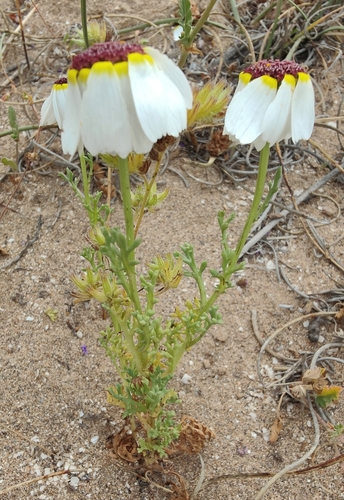
An annual plant. It grows 60 cm tall. The leaves are bright green and divided into leaflets. The flowers have purple eyes and are in heads. They have banding on them. The flower heads occur singly. They can be 10 cm across.
How to Grow
Plants are grown from seed.
Other Information
Cultivated as a vegetable.
Notes
There are about 20-40 Chrysanthemum species and many cultivated varieties.
Names & Synonyms
Hao zi gan, Painted daisy
Chrysanthemum assakae Caball.Chrysanthemum carinatum Schousb.Chrysanthemum carinatum var. chrysoporphyreum Maire & al.Glebionis carinata (Schousb.) TzvelevIsmelia carinata (Schousboe) Schultz.
Ismelia versicolor Cassini
References (7)
- Blamey, M and Grey-Wilson, C., 2005, Wild flowers of the Mediterranean. A & C Black London. p 444 (As Chrysanthemum carinatum)
- Iagttag. Vextrig. Marokko 198, t. 6. 1800 (As Chrysanthemum carinatum)
- Ling Yuou-ruen & C. J. Humphries, ASTERACEAE (Draft), Tribe ANTHEMIDEAE Cassini, in Flora of China. (As Chrysanthemum carinatum)
- Plants for a Future database, The Field, Penpol, Lostwithiel, Cornwall, PL22 0NG, UK. http://www.scs.leeds.ac.uk/pfaf/ (As Chrysanthemum carinatum)
- Staples, G.W. and Herbst, D.R., 2005, A tropical Garden Flora. Bishop Museum Press, Honolulu, Hawaii. p 156 (As Chrysanthemum carinatum)
- Wiersema, J. H. & Leon, B., 2013, World Economic Plants. A Standard Reference CRC Press. 2nd Ed. p 323 (As Glebionis carinata)
- World Checklist of Useful Plant Species 2020. Royal Botanic Gardens, Kew (As Glebionis carinata)