Chrysosplenium alternifolium
L.
Alternate-leaved golden saxifrage
(c) Silst64, some rights reserved (CC BY-NC), uploaded by Silst64

(c) Robert Flogaus-Faust, some rights reserved (CC BY)

(c) Kari Pihlaviita, some rights reserved (CC BY-NC)
What to Eat
Edible parts: Leaves
The leaves are eaten raw and added to salads. They are rather small and carry a distinct bitterness, which is especially pronounced during hot weather.
Where to Find It
It is a temperate plant. It grows in alkaline soil.
Asia, Australia, Britain, Europe, Ireland, Luxembourg, North America, Slovenia, USA,
How to Identify
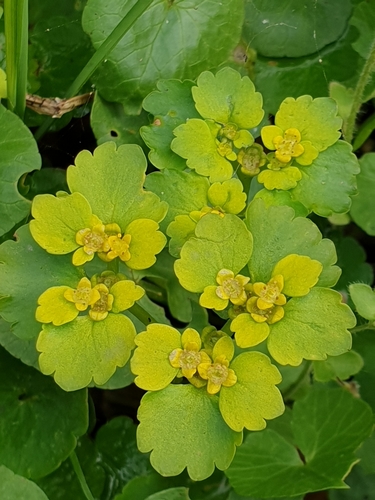
Perennial ground cover reaching 0.3m tall and 0.5m wide, hardy to UK zone 4. Flowers from April to July. Hermaphroditic and self-fertile, pollinated by beetles and flies. Grows in light sandy, medium loamy, and heavy clay soils across mildly acid to basic pH ranges, including very acidic soils. Tolerates semi-shade to full sun and thrives in moist to wet soil.
How to Grow
Plants can be grown from seed or division of the clump.
Propagation: Sow seed in spring or autumn in a lightly shaded position in a cold frame, standing the pot in 2cm of water. Prick seedlings into individual pots when large enough to handle and grow them on in a tray of water in the cold frame through at least their first winter. Plant out into permanent positions in late spring or early summer, after the last expected frosts. Division in spring is very easy; larger clumps can go directly into permanent positions, though smaller clumps are better potted up and grown on in light shade in a cold frame until rooting well, then planted out in summer or the following spring.
Medicinal Uses
None known
Other Uses
The plant's creeping habit makes it a useful ground cover for the bog garden.
Wikipedia
Source ↗Chrysosplenium alternifolium is a species of flowering plant in the saxifrage family known as the alternate-leaved golden-saxifrage. It is a mat-forming perennial of wet places that grows between 5 and 15 cm (2 and 6 in) tall. It blooms from March onward.
Notes
There are 57 Chrysosplenium species.
Names & Synonyms
Premenjalnolistni vraničnik
References (6)
- Crawford, M., 2012, How to grow Perennial Vegetables. Green Books. p 113
- Facciola, S., 1998, Cornucopia 2: a Source Book of Edible Plants. Kampong Publications, p 229
- Hedrick, U.P., 1919, (Ed.), Sturtevant's edible plants of the world. p 190
- Hibbert, M., 2002, The Aussie Plant Finder 2002, Florilegium. p 67
- Irving, M., 2009, The Forager Handbook, A Guide to the Edible Plants of Britain. Ebury Press p 288
- Plants for a Future database, The Field, Penpol, Lostwithiel, Cornwall, PL22 0NG, UK. http://www.scs.leeds.ac.uk/pfaf/