Chrysothamnus viscidiflorus
(Hook.) Nutt.
Sticky-leafed rabbit brush

(c) Todd Ramsden, some rights reserved (CC BY-NC), uploaded by Todd Ramsden
no rights reserved
no rights reserved
What to Eat
Edible parts: Bark - chewing
A latex obtained from the root is used as a chewing gum, and the plant has been used as a spice. Edible use is extremely limited. Roots have been chewed as gum or simmered into broth in rare historical contexts. Roots are woody at all stages and splinter into sharp fibres when chewed; simmered roots produce a faintly starchy, resinous broth. Flowers and leaves are intensely acrid and resinous, producing a burning sensation in the mouth and throat that boiling does not eliminate, and are not suitable for culinary use. Roots were occasionally chewed as gum by Paiute and Goshiute groups, but the plant was never a dietary staple and this use was rare and limited.
Known Hazards
Where to Find It
It is a temperate plant. It needs to be in full sun and in a light well-drained soil. It suits hardiness zones 6-9.
Australia, Canada, North America, USA,
How to Identify
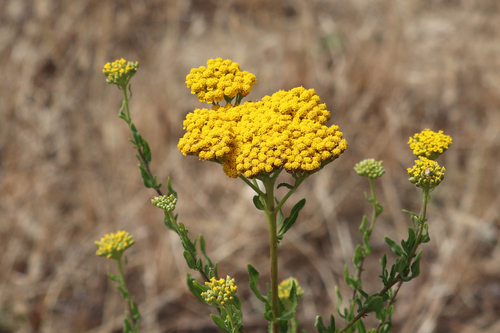
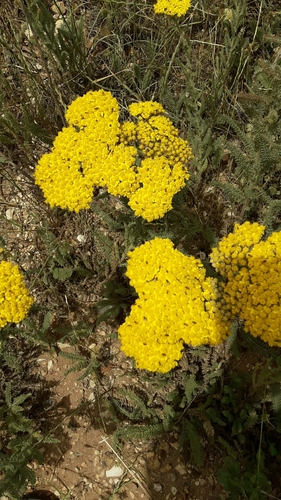
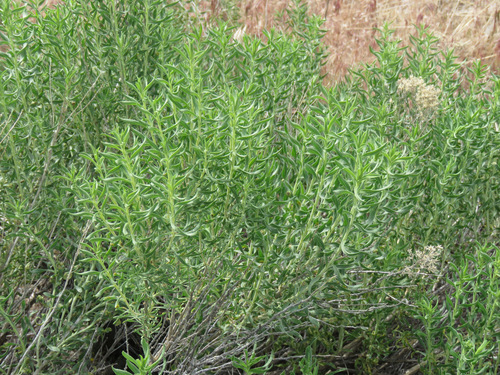
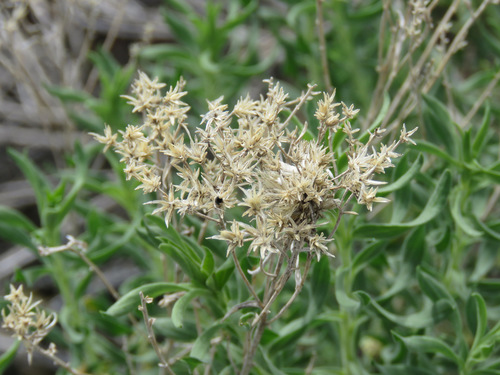
A small shrub in the daisy family. It grows 30-90 cm high and spreads 30-90 cm wide. It has a rounded shape. The bark is whitish. The leaves are narrow and often twisted. The flowers are daisy like but without the rays. They are yellow.
How to Grow
It can be grown from seed or cuttings.
Propagation: Sow seed in spring in a greenhouse, just barely covering it. Prick seedlings into individual pots when large enough to handle and grow them on in a greenhouse through at least their first winter. Plant out into permanent positions in late spring or early summer, after the last expected frosts. Cuttings of half-ripe wood can be taken in July or August and rooted in sand in a frame.
Medicinal Uses
A poultice made from chewed plant tips has been applied to boils and rheumatic joints. An infusion of the leaves has been used to treat colds. Finely mashed leaves have been inserted into tooth cavities to relieve toothache.
Other Uses
The latex from the roots could potentially be used in making rubber, but is not produced in sufficient quantity to make commercial extraction worthwhile. A green dye is obtained from the bark, and a yellow-gold dye from the flowers, which turns orange when alum is used as a mordant. The plant establishes rapidly in disturbed habitats including burns, flooded washes, and rockslides, making it a valuable shrub for revegetating damaged land such as overgrazed rangeland and abandoned mining areas. Rabbitbrush species provide important late-season nectar for insects, especially bees and flies, when few other plants are in flower.
Wikipedia
Source ↗Chrysothamnus viscidiflorus is an American species of shrub in the family Asteraceae known by the common names yellow rabbitbrush and green rabbitbrush.
Notes
There are 16 Chrysothamnus species.
Names & Synonyms
References (5)
- Beckstrom-Sternberg, Stephen M., and James A. Duke. "The Foodplant Database." http://probe.nalusda.gov:8300/cgi-bin/browse/foodplantdb.(ACEDB version 4.0 - data version July 1994)
- Cundall, P., (ed.), 2004, Gardening Australia: flora: the gardener's bible. ABC Books. p 377
- Kermath, B. M., et al, 2014, Food Plants in the Americas: A survey of the domesticated, cultivated and wild plants used for Human food in North, Central and South America and the Caribbean. On line draft. p 228
- MacKinnon, A., et al, 2009, Edible & Medicinal Plants of Canada. Lone Pine. p 143
- Trans. Amer. Philos. Soc. ser. 2, 7:324. 1840