Ixeridium dentatum
(Thunb. ex Thunb.) Tzvelev
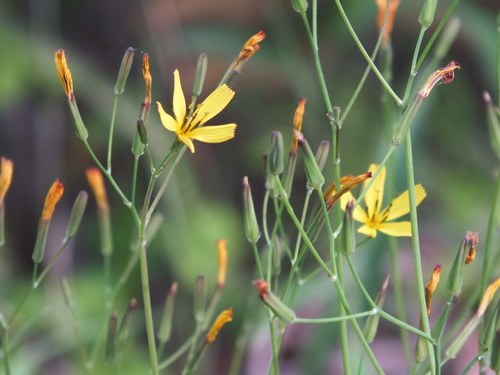
(c) 松岡明芳, some rights reserved (CC BY-SA)

(c) Stargazer, some rights reserved (CC BY-NC)

(c) Stargazer, some rights reserved (CC BY-NC)
What to Eat
Edible parts: Leaves
The leaves are cooked as seasoned vegetables and are also used in the fermented side dish kimchi.
Where to Find It
It is a temperate plant. It grows on mountain slopes and moist places between 300-1,100 m above sea level in China.
Asia, China, Japan, Korea, Russia,
How to Identify
A herb. It keeps growing from year to year. It grows 20-50 cm tall. It has short rhizomes. The leaves at the base are crowded. They are narrowly oval and 4-15 cm long by 1-3 cm wide. They can be divided. There are fine teeth along the edge.
Medicinal Uses
Used as a folk remedy in Japan where it's said to relieve indigestion and reduce inflammation. The whole plant is used as a remedy including roots. The plant is harvested during its flowering period, and then washed and dried before consuming.
Wikipedia
Source ↗Ixeridium dentatum, the toothed ixeridium, is a species of flowering plant in the family Asteraceae, native to East Asia (China, Japan, Korea, and Russian Far east). It is a perennial plant whose leaves and stems and produce a white juice with a bitter taste.
Names & Synonyms
Sinnae-i, Sseumbagwi
References (5)
- Hwang, H., et al, 2013, A Study on the Flora of 15 Islands in the Western Sea of Jeollanamdo Province, Korea. Journal of Asia-Pacific Biodiversity Vol. 6, No. 2 281-310
- Hwang, HS, et al, 2014, Distribution characteristics of plant in the Ungseokbong Mountain, Gyeongsangnam-do, Korea. Journal of Asia-Pacific Biodiversity. 7(2014) e164-e178
- Kim, H. & Song, M., 2013, Ethnobotanical analysis for traditional knowledge of wild edible plants in North Jeolla Province (Korea). Genetic. Resour. Crop Evol. (2013) 60:1571-1585
- Ong, H. G., et al, 2015, Ethnobotany of the wild edible plants gathered in Ulleung Island, South Korea. Genet Resourc Crop Evol. Springer
- Song, M., et al, 2013, Traditional knowledge of wild edible plants in Jeju Island, Korea. Indian Journal of Traditional Knowledge. 12(2) pp 177-194